

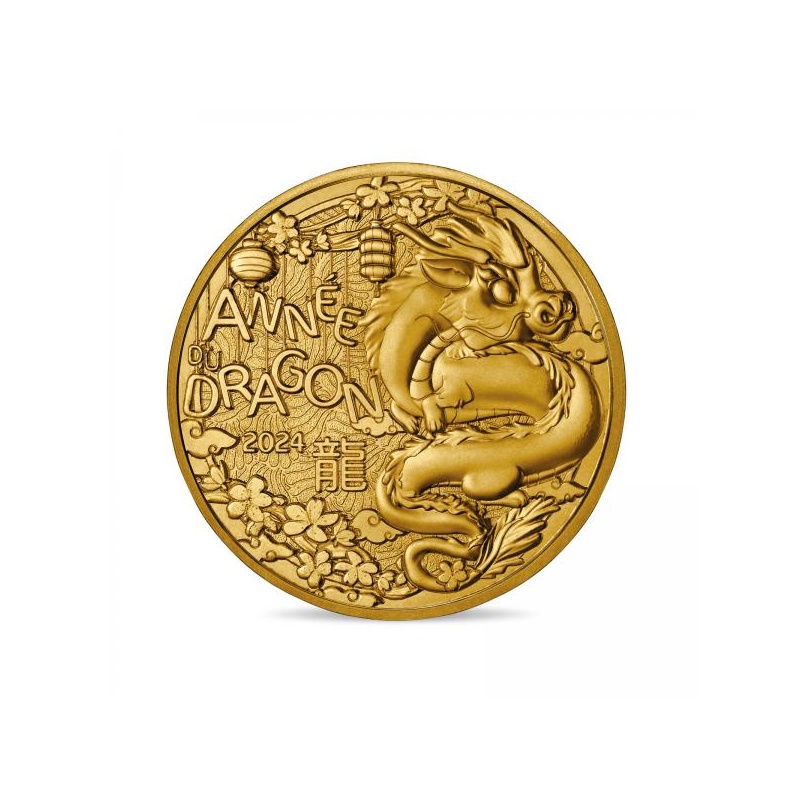
Lunar Year of the Dragon 2024 France 0,25€ Brilliant Uncirculated Coin
Price:
9,90 €
Denomination: 0,25 €
Alloy: Cupro-nickel Nordicgold
Weight: 15,8 g
Diameter: 34 mm
Quality Brilliant Uncirculated
Year: 2024
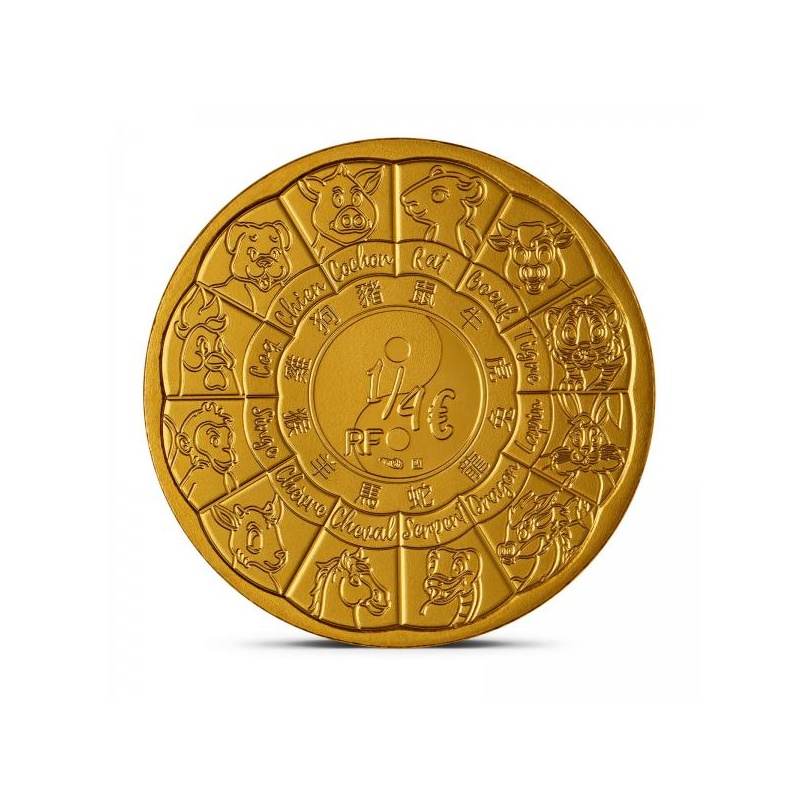
Surrounded by plum blossom, a popular symbol in Chinese history, art, and lanterns, the dragon’s depiction appeals to children. The inscription 'Year of the dragon’ and the yeardate appear at the center of the coin. The ideogram of the dragon appears below. On the reverse side, all the animals of the Chinese zodiac are drawn in a cartoon-like way around the Ying and Yang symbol. A complete cycle of the Chinese zodiac will be composed from 2018 to 2029
Alloy: Cupro-nickel Nordicgold
Weight: 15,8 g
Diameter: 34 mm
Quality Brilliant Uncirculated
Year: 2024
Surrounded by plum blossom, a popular symbol in Chinese history, art, and lanterns, the dragon’s depiction appeals to children. The inscription 'Year of the dragon’ and the yeardate appear at the center of the coin. The ideogram of the dragon appears below. On the reverse side, all the animals of the Chinese zodiac are drawn in a cartoon-like way around the Ying and Yang symbol. A complete cycle of the Chinese zodiac will be composed from 2018 to 2029
Sarnased tooted
Denomination: 5£
Alloy: cu/ni
Weight: 28.28 g
Diameter: 38,6 mm
Quality Brilliant Uncirculated
Year: 2024
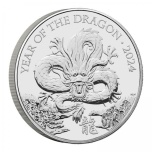
A beautiful celebration of the most significant symbol in Chinese culture
The first Lunar coin to feature the official coinage portrait of His Majesty The King
In 2024, Chinese New Year, The Year of the Dragon starts on 10 February. A joyful time that is marked by communities all over the world, friends and family will gather to enjoy traditional food, watch firework displays and gift children money in red envelopes. Each year is characterised by one of 12 zodiac animals, and 2024 sees the dragon in the ascendancy. Wise and powerful, the dragon is China’s most important cultural symbol and has come to represent confidence, courage and adventurousness. People born under its zodiac sign are said to possess these traits
Alloy: cu/ni
Weight: 28.28 g
Diameter: 38,6 mm
Quality Brilliant Uncirculated
Year: 2024
A beautiful celebration of the most significant symbol in Chinese culture
The first Lunar coin to feature the official coinage portrait of His Majesty The King
In 2024, Chinese New Year, The Year of the Dragon starts on 10 February. A joyful time that is marked by communities all over the world, friends and family will gather to enjoy traditional food, watch firework displays and gift children money in red envelopes. Each year is characterised by one of 12 zodiac animals, and 2024 sees the dragon in the ascendancy. Wise and powerful, the dragon is China’s most important cultural symbol and has come to represent confidence, courage and adventurousness. People born under its zodiac sign are said to possess these traits
25,00 €
Country: Mongolia
Year: 2024
Face Value: 1000 Togrog
Gold: 99.99%
Weigh: 0.5 g
Size: 11 mm
Quality: Proof
Mintage: 5000
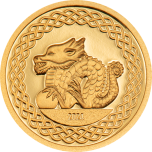
In Chinese mythology, dragons are majestic beasts that dwell in rivers, lakes, oceans and roam the skies. Originally a rain deity, the Chinese dragon is associated with heavenly beneficence and fertility.
Year: 2024
Face Value: 1000 Togrog
Gold: 99.99%
Weigh: 0.5 g
Size: 11 mm
Quality: Proof
Mintage: 5000
In Chinese mythology, dragons are majestic beasts that dwell in rivers, lakes, oceans and roam the skies. Originally a rain deity, the Chinese dragon is associated with heavenly beneficence and fertility.
169,00 €
Kollektsioon
Denomination: 0,25 €
Alloy: Cupro-nickel Nordicgold
Weight: 15,8 g
Diameter: 34 mm
Quality Brilliant Uncirculated
Year: 2023
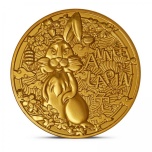
Surrounded by plum blossom, a popular symbol in Chinese history, art, and lanterns, the rabbit’s depiction appeals to children. The inscription 'Year of the rabbit’ and the year date appear at the center of the coin. The ideogram of the rabbit appears below.
Alloy: Cupro-nickel Nordicgold
Weight: 15,8 g
Diameter: 34 mm
Quality Brilliant Uncirculated
Year: 2023
Surrounded by plum blossom, a popular symbol in Chinese history, art, and lanterns, the rabbit’s depiction appeals to children. The inscription 'Year of the rabbit’ and the year date appear at the center of the coin. The ideogram of the rabbit appears below.
9,90 €
Similar products
Quality: Special Uncirculated
Face Value: 5 Euro
Diameter: 28,5 mm
Copper: 99,9%
Total Weight: 8,5 g
Comes without packaging
The New Year Coin 2024 is a special coin for a very special year. With 366 days instead of the usual 365, 2024 is a leap year and this limited-mintage coin is designed to remind you that the extra day should be enjoyed amid the hustle and bustle of everyday life.
The extra day in a leap year keeps the calendar year synchronised with the solar year and thus with the cosmic order. You should accept it as a heavenly gift and treat it as an extra portion of luck. The extra day is a day with great potential on which you can allow yourself a little more ‘me time’, dedicate more time than usual to someone else, or do something you have always wanted to do. Or if you have resolved to tackle something completely new by the end of the year, why not use the extra day for that? Everyday life tends to demand a great deal from us without making any concessions, but that is not the case in 2024 when we are given a whole extra day to enjoy.
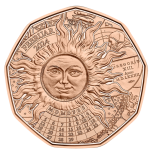
The reverse of the nine-sided coin is dedicated to the Gregorian calendar, which was introduced by Pope Gregory XIII in 1582 to bring the calendar back into line with the solar year. Pope Gregory XIII features on the right edge of the coin next to a large, flame-haired human manifestation of the Sun. Below the Sun is the calendar page for the month of February showing the 29th of February – the extra day. At the top is the zodiac sign Pisces, which corresponds to late February. The coin’s obverse shows the coats of arms of the nine provinces of Austria.
Face Value: 5 Euro
Diameter: 28,5 mm
Copper: 99,9%
Total Weight: 8,5 g
Comes without packaging
The New Year Coin 2024 is a special coin for a very special year. With 366 days instead of the usual 365, 2024 is a leap year and this limited-mintage coin is designed to remind you that the extra day should be enjoyed amid the hustle and bustle of everyday life.
The extra day in a leap year keeps the calendar year synchronised with the solar year and thus with the cosmic order. You should accept it as a heavenly gift and treat it as an extra portion of luck. The extra day is a day with great potential on which you can allow yourself a little more ‘me time’, dedicate more time than usual to someone else, or do something you have always wanted to do. Or if you have resolved to tackle something completely new by the end of the year, why not use the extra day for that? Everyday life tends to demand a great deal from us without making any concessions, but that is not the case in 2024 when we are given a whole extra day to enjoy.
The reverse of the nine-sided coin is dedicated to the Gregorian calendar, which was introduced by Pope Gregory XIII in 1582 to bring the calendar back into line with the solar year. Pope Gregory XIII features on the right edge of the coin next to a large, flame-haired human manifestation of the Sun. Below the Sun is the calendar page for the month of February showing the 29th of February – the extra day. At the top is the zodiac sign Pisces, which corresponds to late February. The coin’s obverse shows the coats of arms of the nine provinces of Austria.
15,00 €
Issuing Country: France
Face value: 5 €
Metal: Copper/Nickel
Weight: 11,7 g
Diameter: 29 mm
Quality: B.U.
Mintage: 25 000
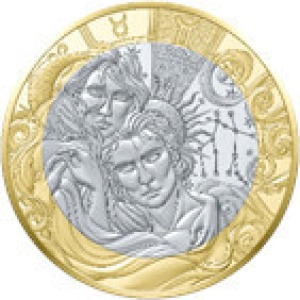
The wheel of the zodiac signs is engraved on the coin's gold-colored crown. One sign stands out from the background because it is larger than the others and has a sandblasted background, different from the smoother one of the others. It is the Gemini symbol. In reference to the sign's element, air, part of the wheel is hidden by spirals of mist. In the middle of these, twins, a man and a woman, are intertwined. Behind them, the sun and a quarter-moon stand out against a starry sky featuring the Gemini constellation.
Face value: 5 €
Metal: Copper/Nickel
Weight: 11,7 g
Diameter: 29 mm
Quality: B.U.
Mintage: 25 000
The wheel of the zodiac signs is engraved on the coin's gold-colored crown. One sign stands out from the background because it is larger than the others and has a sandblasted background, different from the smoother one of the others. It is the Gemini symbol. In reference to the sign's element, air, part of the wheel is hidden by spirals of mist. In the middle of these, twins, a man and a woman, are intertwined. Behind them, the sun and a quarter-moon stand out against a starry sky featuring the Gemini constellation.
20,00 €
Issuing Country: France
Face value: 5 €
Metal: Copper/Nickel
Diameter: 29 mm
Quality: B.U.
Mintage: 25 000
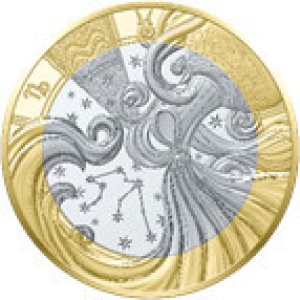
The wheel of the zodiac signs is engraved on the coin's gold-colored crown. One sign stands out from the background because it is larger than the others and has a sandblasted background, different from the smoother one of the others. It is the symbol of Aquarius. Part of the wheel is hidden by spirals of mist, in reference to air, the element of this sign. Another part of the wheel is submerged by water poured from the spout of an ornate vase. A starry sky with the constellation Aquarius can be seen in the background.
Face value: 5 €
Metal: Copper/Nickel
Diameter: 29 mm
Quality: B.U.
Mintage: 25 000
The wheel of the zodiac signs is engraved on the coin's gold-colored crown. One sign stands out from the background because it is larger than the others and has a sandblasted background, different from the smoother one of the others. It is the symbol of Aquarius. Part of the wheel is hidden by spirals of mist, in reference to air, the element of this sign. Another part of the wheel is submerged by water poured from the spout of an ornate vase. A starry sky with the constellation Aquarius can be seen in the background.
20,00 €
Materiall: CuNi
Weight: 9g
Diameter: 26,9 mm
Mintage: 100 000
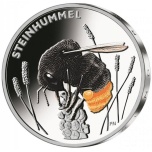
The German government has decided to mint a €5 collectors’ coin entitled “Red mason bee”, to be issed at 7 September 2023. It is the fourth coin issued as part of the “Wonderful world of insects” series, which will see a total of nine coins with partially coloured motifs issued over the period 2022-24. The series is intended to bring into focus – especially in light of current developments (insect extinction) – a special group of animals that make up a significant part of our natural heritage.
The €5 collectors’ coin “Red-tailed bumblebee” is made of a cupronickel alloy. It weighs 9.68 g, measures 27.25 mm in diameter and will be available both in mint condition and with a proof-like finish. The mint condition coins will be brought into circulation at their face value (€5). The collector quality coins with a proof-like finish will be higher than their face value and will be issued by the Münze Deutschland (Germany’s official sales agency for collector coins).
The coin was designed by Patrick Niesel, an artist based in Röthenbach an der Pegnitz (picture side), and Andre Witting, a Berlin-based artist (reverse).
The reverse, which will be used for all coins in the series, features an eagle, the words “BUNDESREPUBLIK DEUTSCHLAND”, the value and denomination, the year 2024, the twelve stars of Europe and the letter “J” for the State Mint of Hamburg.
Its smooth edge is engraved with the inscription: “WUNDERWELT INSEKTEN” (WONDERFUL WORLD OF INSECTS).
Weight: 9g
Diameter: 26,9 mm
Mintage: 100 000
The German government has decided to mint a €5 collectors’ coin entitled “Red mason bee”, to be issed at 7 September 2023. It is the fourth coin issued as part of the “Wonderful world of insects” series, which will see a total of nine coins with partially coloured motifs issued over the period 2022-24. The series is intended to bring into focus – especially in light of current developments (insect extinction) – a special group of animals that make up a significant part of our natural heritage.
The €5 collectors’ coin “Red-tailed bumblebee” is made of a cupronickel alloy. It weighs 9.68 g, measures 27.25 mm in diameter and will be available both in mint condition and with a proof-like finish. The mint condition coins will be brought into circulation at their face value (€5). The collector quality coins with a proof-like finish will be higher than their face value and will be issued by the Münze Deutschland (Germany’s official sales agency for collector coins).
The coin was designed by Patrick Niesel, an artist based in Röthenbach an der Pegnitz (picture side), and Andre Witting, a Berlin-based artist (reverse).
The reverse, which will be used for all coins in the series, features an eagle, the words “BUNDESREPUBLIK DEUTSCHLAND”, the value and denomination, the year 2024, the twelve stars of Europe and the letter “J” for the State Mint of Hamburg.
Its smooth edge is engraved with the inscription: “WUNDERWELT INSEKTEN” (WONDERFUL WORLD OF INSECTS).
14,90 €
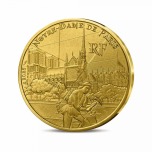
Denomination: 1/4 €
Alloy: Common metal
Weight: 15,8 g
Diameter: 34 mm
Quality BU
Year: 2025
Notre-Dame Cathedral in Paris is a Gothic cathedral in the heart of the French capital, on the Île de la Cité. Built in the 12th century, its stained glass windows, gargoyles and flying buttresses have inspired many literary works such as Victor Hugo's novel. In April 2019, a violent fire ravaged a significant part of its structure, including its spire and roof. Restoration work then quickly began, in order to rebuild the monument identically.
On the front, in the foreground, a stonemason from the medieval period symbolizing the craftsmen who built the cathedral. In the background, the left part of the cathedral in detailed view and the right part, as well as the spire, in schematic outline of the structure to evoke its construction/reconstruction.
The reverse is common to all coins in the UNESCO series of this year 2025. It represents the terrestrial globe with the parallels and meridians on the left side and the inscriptions of major sites classified as UNESCO World Heritage on the right side. These inscriptions are as if engraved in stone, which echoes the Rosetta Stone. The left side of the globe is surrounded by the UNESCO logo as well as the marking "World Heritage". The face value is inscribed on the left side of the globe, blending perfectly with the parallels and meridians.
Alloy: Common metal
Weight: 15,8 g
Diameter: 34 mm
Quality BU
Year: 2025
Notre-Dame Cathedral in Paris is a Gothic cathedral in the heart of the French capital, on the Île de la Cité. Built in the 12th century, its stained glass windows, gargoyles and flying buttresses have inspired many literary works such as Victor Hugo's novel. In April 2019, a violent fire ravaged a significant part of its structure, including its spire and roof. Restoration work then quickly began, in order to rebuild the monument identically.
On the front, in the foreground, a stonemason from the medieval period symbolizing the craftsmen who built the cathedral. In the background, the left part of the cathedral in detailed view and the right part, as well as the spire, in schematic outline of the structure to evoke its construction/reconstruction.
The reverse is common to all coins in the UNESCO series of this year 2025. It represents the terrestrial globe with the parallels and meridians on the left side and the inscriptions of major sites classified as UNESCO World Heritage on the right side. These inscriptions are as if engraved in stone, which echoes the Rosetta Stone. The left side of the globe is surrounded by the UNESCO logo as well as the marking "World Heritage". The face value is inscribed on the left side of the globe, blending perfectly with the parallels and meridians.
15,00 €