


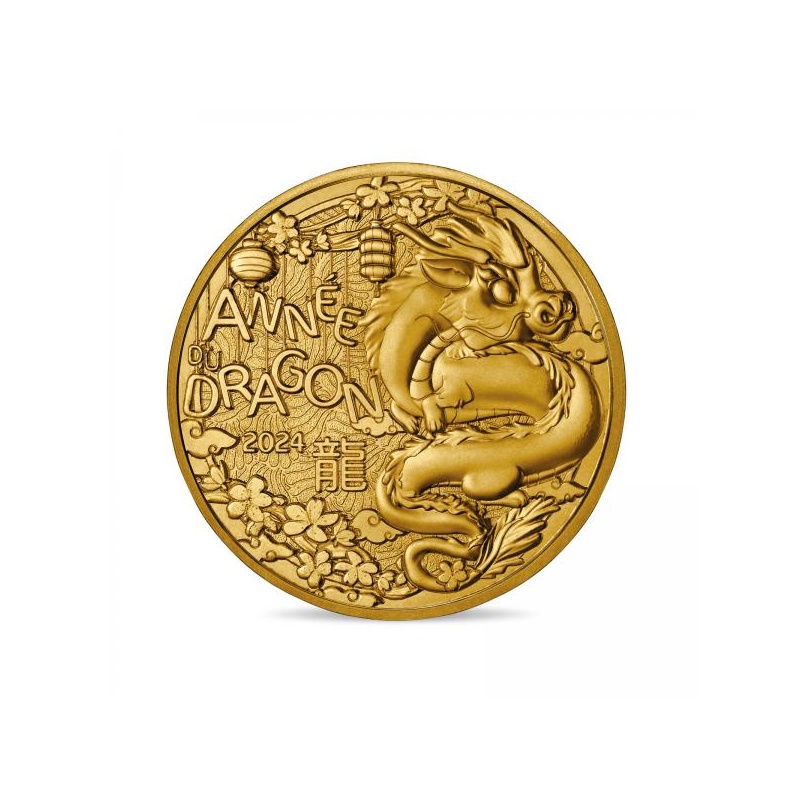
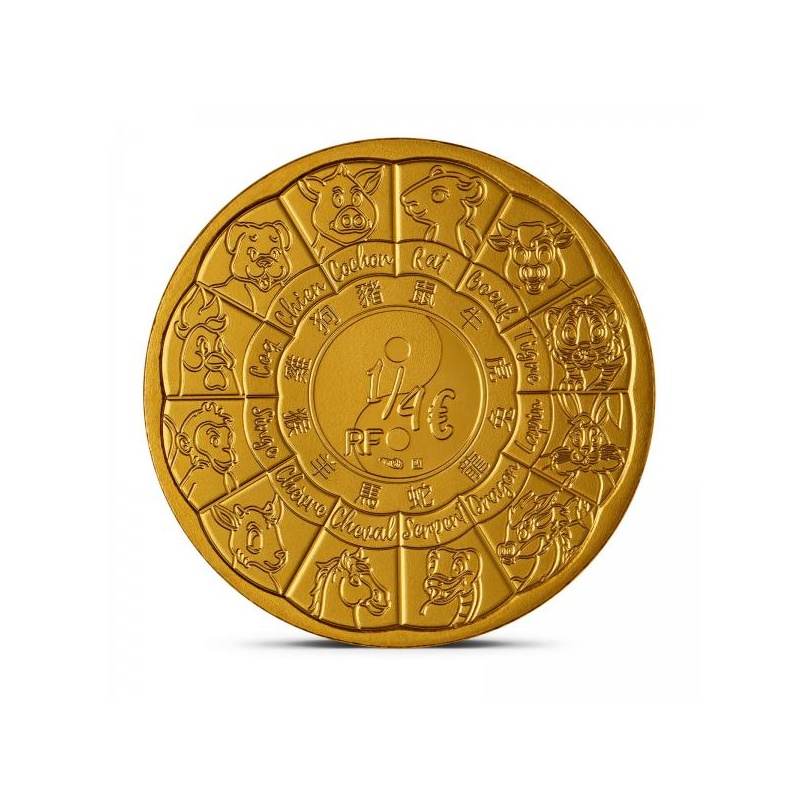
Lunar Year of the Dragon 2024 France 0,25€ Brilliant Uncirculated Coin
Price:
9,90 €
Denomination: 0,25 €
Alloy: Cupro-nickel Nordicgold
Weight: 15,8 g
Diameter: 34 mm
Quality Brilliant Uncirculated
Year: 2024
Surrounded by plum blossom, a popular symbol in Chinese history, art, and lanterns, the dragon’s depiction appeals to children. The inscription 'Year of the dragon’ and the yeardate appear at the center of the coin. The ideogram of the dragon appears below. On the reverse side, all the animals of the Chinese zodiac are drawn in a cartoon-like way around the Ying and Yang symbol. A complete cycle of the Chinese zodiac will be composed from 2018 to 2029
Alloy: Cupro-nickel Nordicgold
Weight: 15,8 g
Diameter: 34 mm
Quality Brilliant Uncirculated
Year: 2024
Surrounded by plum blossom, a popular symbol in Chinese history, art, and lanterns, the dragon’s depiction appeals to children. The inscription 'Year of the dragon’ and the yeardate appear at the center of the coin. The ideogram of the dragon appears below. On the reverse side, all the animals of the Chinese zodiac are drawn in a cartoon-like way around the Ying and Yang symbol. A complete cycle of the Chinese zodiac will be composed from 2018 to 2029
Sarnased tooted
Denomination: 5£
Alloy: cu/ni
Weight: 28.28 g
Diameter: 38,6 mm
Quality Brilliant Uncirculated
Year: 2024
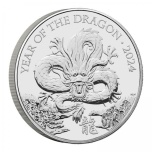
A beautiful celebration of the most significant symbol in Chinese culture
The first Lunar coin to feature the official coinage portrait of His Majesty The King
In 2024, Chinese New Year, The Year of the Dragon starts on 10 February. A joyful time that is marked by communities all over the world, friends and family will gather to enjoy traditional food, watch firework displays and gift children money in red envelopes. Each year is characterised by one of 12 zodiac animals, and 2024 sees the dragon in the ascendancy. Wise and powerful, the dragon is China’s most important cultural symbol and has come to represent confidence, courage and adventurousness. People born under its zodiac sign are said to possess these traits
Alloy: cu/ni
Weight: 28.28 g
Diameter: 38,6 mm
Quality Brilliant Uncirculated
Year: 2024
A beautiful celebration of the most significant symbol in Chinese culture
The first Lunar coin to feature the official coinage portrait of His Majesty The King
In 2024, Chinese New Year, The Year of the Dragon starts on 10 February. A joyful time that is marked by communities all over the world, friends and family will gather to enjoy traditional food, watch firework displays and gift children money in red envelopes. Each year is characterised by one of 12 zodiac animals, and 2024 sees the dragon in the ascendancy. Wise and powerful, the dragon is China’s most important cultural symbol and has come to represent confidence, courage and adventurousness. People born under its zodiac sign are said to possess these traits
25,00 €
Country: Mongolia
Year: 2024
Face Value: 1000 Togrog
Gold: 99.99%
Weigh: 0.5 g
Size: 11 mm
Quality: Proof
Mintage: 5000
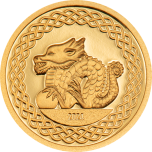
In Chinese mythology, dragons are majestic beasts that dwell in rivers, lakes, oceans and roam the skies. Originally a rain deity, the Chinese dragon is associated with heavenly beneficence and fertility.
Year: 2024
Face Value: 1000 Togrog
Gold: 99.99%
Weigh: 0.5 g
Size: 11 mm
Quality: Proof
Mintage: 5000
In Chinese mythology, dragons are majestic beasts that dwell in rivers, lakes, oceans and roam the skies. Originally a rain deity, the Chinese dragon is associated with heavenly beneficence and fertility.
169,00 €
Kollektsioon
Denomination: 0,25 €
Alloy: Cupro-nickel Nordicgold
Weight: 15,8 g
Diameter: 34 mm
Quality Brilliant Uncirculated
Year: 2023
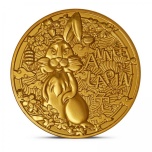
Surrounded by plum blossom, a popular symbol in Chinese history, art, and lanterns, the rabbit’s depiction appeals to children. The inscription 'Year of the rabbit’ and the year date appear at the center of the coin. The ideogram of the rabbit appears below.
Alloy: Cupro-nickel Nordicgold
Weight: 15,8 g
Diameter: 34 mm
Quality Brilliant Uncirculated
Year: 2023
Surrounded by plum blossom, a popular symbol in Chinese history, art, and lanterns, the rabbit’s depiction appeals to children. The inscription 'Year of the rabbit’ and the year date appear at the center of the coin. The ideogram of the rabbit appears below.
9,90 €
Similar products
Quality: Uncirculated
Face Value: 5 Euro
Diameter: 28,5 mm
Material: Copper
Total Weight: 8,9 g
Mintage: 200 000
A coin the likes of which Austria has never seen before, Democracy is made from copper from the former roof of the Parliament building in Vienna. When you purchase the coin you therefore acquire a little piece of democracy and by spending 5 euros you get something priceless in return.
On the occasion of the reopening of the Parliament building in Vienna, we are issuing this very special coin. The copper it contains originally formed part of the former roof of the building but was removed during the ongoing renovation of the building. By using it to make the copper edition of the Democracy coin, we are making our democratic tradition something tangible. A strong democracy thrives on discourse. Our opinions may differ, but our consensus is democracy. Likewise, fundamental rights and freedoms make a democracy what it is. They enable individual and social freedom and guarantee the co-determination of the individual.
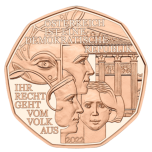
The coin’s reverse features two heads in profile and one full face, which represent the people as sovereign. To the left, we see a watchful eye surrounded by stylised laurel leaves, to the right, we see a section of the Austrian Parliament building in the background. But much more than this, the coin illustrates the spirit from which our nation was born. This is reflected in the Austrian Constitution, where it says: "Austria is a democratic republic. Its law emanates from the people." These wise words appear on the top and bottom edges of the coin.
Face Value: 5 Euro
Diameter: 28,5 mm
Material: Copper
Total Weight: 8,9 g
Mintage: 200 000
A coin the likes of which Austria has never seen before, Democracy is made from copper from the former roof of the Parliament building in Vienna. When you purchase the coin you therefore acquire a little piece of democracy and by spending 5 euros you get something priceless in return.
On the occasion of the reopening of the Parliament building in Vienna, we are issuing this very special coin. The copper it contains originally formed part of the former roof of the building but was removed during the ongoing renovation of the building. By using it to make the copper edition of the Democracy coin, we are making our democratic tradition something tangible. A strong democracy thrives on discourse. Our opinions may differ, but our consensus is democracy. Likewise, fundamental rights and freedoms make a democracy what it is. They enable individual and social freedom and guarantee the co-determination of the individual.
The coin’s reverse features two heads in profile and one full face, which represent the people as sovereign. To the left, we see a watchful eye surrounded by stylised laurel leaves, to the right, we see a section of the Austrian Parliament building in the background. But much more than this, the coin illustrates the spirit from which our nation was born. This is reflected in the Austrian Constitution, where it says: "Austria is a democratic republic. Its law emanates from the people." These wise words appear on the top and bottom edges of the coin.
15,00 €
Country: Mongolia
Year: 2024
Face Value: 1000 Togrog
Gold: 99.99%
Weigh: 0.5 g
Size: 11 mm
Quality: Proof
Mintage: 5000
In Chinese mythology, dragons are majestic beasts that dwell in rivers, lakes, oceans and roam the skies. Originally a rain deity, the Chinese dragon is associated with heavenly beneficence and fertility.
Year: 2024
Face Value: 1000 Togrog
Gold: 99.99%
Weigh: 0.5 g
Size: 11 mm
Quality: Proof
Mintage: 5000
In Chinese mythology, dragons are majestic beasts that dwell in rivers, lakes, oceans and roam the skies. Originally a rain deity, the Chinese dragon is associated with heavenly beneficence and fertility.
169,00 €
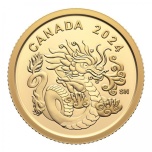
Face value: 8 CAD
Gold: 99,99%
Weight: 1,580 g
Diameter: 14,10 mm
Quality: Proof
Mintage: 8 888
Coiling and floating across the sky, Shenlong is the revered lóng (“dragon”) of Chinese mythology that governs the elements upon which agriculture depends: wind, rain, clouds and, when angered, tempests.
Gold: 99,99%
Weight: 1,580 g
Diameter: 14,10 mm
Quality: Proof
Mintage: 8 888
Coiling and floating across the sky, Shenlong is the revered lóng (“dragon”) of Chinese mythology that governs the elements upon which agriculture depends: wind, rain, clouds and, when angered, tempests.
399,00 €
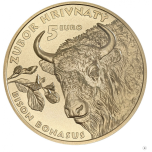
Face value: 5 €
Diameter: 34 mm
Weight: 19.1 g
Metal: Brass
Mintage: 40,000
Obverse:
The obverse of the euro collector coin depicts a male European bison with trees in the background above and fallen branches in the foreground below. The Slovak coat of arms appears in the lower right of the design, just below the year of issuance ‘2024’. The name of the issuing country ‘SLOVENSKO’ is inscribed along part of the left edge. In the lower part of the design are the mint mark of the Kremnica Mint (Mincovňa Kremnica), consisting of the letters ‘MK’ placed between two dies, and the stylised letters ‘KL’, referring to the coin’s designer Karol Ličko.
Reverse:
On the reverse, a depiction of a European bison’s head dominates the centre and right of the design. Above the head are the coin’s denomination and currency, ‘5 EURO’. The Slovak name of the European bison, ‘ZUBOR HRIVNATÝ’, is inscribed along the upper-left edge, and the scientific name, ‘BISON BONASUS’, is at the lower-left edge. The two names are separated by a beech twig with leaves and nuts.
The bison is Europe’s largest land mammal, with its build resembling that of cattle. It has a relatively short, rounded head and is covered with brown hair from head to tail. The forequarters are bulkier than the hindquarters and are further accentuated by longer hair. Strong, hollow horns are a permanent feature of both sexes and grow with age. Bison are most active at dusk, and their vision has adapted accordingly. Their best-developed senses are hearing and smell. They can live to around 35 years of age. Bison are a social animal that typically live in herds of 8 to 13 animals, though older males tend to be solitary. They feed mainly on green and woody plant matter, including branches, bark and leaves. They prefer younger forest stands with dense undergrowth. In winter, their staple food sources are brambles, tree bark, shrubs and dry grass, which they dig out from under the snow. The bison’s historical range extended almost throughout Europe. In Slovakia today, approximately 70 individuals of the species live wild on a reservation in the Poloniny National Park.
Diameter: 34 mm
Weight: 19.1 g
Metal: Brass
Mintage: 40,000
Obverse:
The obverse of the euro collector coin depicts a male European bison with trees in the background above and fallen branches in the foreground below. The Slovak coat of arms appears in the lower right of the design, just below the year of issuance ‘2024’. The name of the issuing country ‘SLOVENSKO’ is inscribed along part of the left edge. In the lower part of the design are the mint mark of the Kremnica Mint (Mincovňa Kremnica), consisting of the letters ‘MK’ placed between two dies, and the stylised letters ‘KL’, referring to the coin’s designer Karol Ličko.
Reverse:
On the reverse, a depiction of a European bison’s head dominates the centre and right of the design. Above the head are the coin’s denomination and currency, ‘5 EURO’. The Slovak name of the European bison, ‘ZUBOR HRIVNATÝ’, is inscribed along the upper-left edge, and the scientific name, ‘BISON BONASUS’, is at the lower-left edge. The two names are separated by a beech twig with leaves and nuts.
The bison is Europe’s largest land mammal, with its build resembling that of cattle. It has a relatively short, rounded head and is covered with brown hair from head to tail. The forequarters are bulkier than the hindquarters and are further accentuated by longer hair. Strong, hollow horns are a permanent feature of both sexes and grow with age. Bison are most active at dusk, and their vision has adapted accordingly. Their best-developed senses are hearing and smell. They can live to around 35 years of age. Bison are a social animal that typically live in herds of 8 to 13 animals, though older males tend to be solitary. They feed mainly on green and woody plant matter, including branches, bark and leaves. They prefer younger forest stands with dense undergrowth. In winter, their staple food sources are brambles, tree bark, shrubs and dry grass, which they dig out from under the snow. The bison’s historical range extended almost throughout Europe. In Slovakia today, approximately 70 individuals of the species live wild on a reservation in the Poloniny National Park.
14,90 €
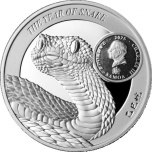
Face value: Samoa 2$
Weight: 31,1 gr
Silver: 99,9%
Diameter: 40 mm
Mintage: 2025
In East Asian Buddhism, the Twelve Heavenly Generals or Twelve Divine Generals are the protective deities, or yaksha, of Bhaisajyaguru, the buddha of healing. They are introduced in the Bhai?ajyaguruvaiduryaprabharaja Sutra.
Weight: 31,1 gr
Silver: 99,9%
Diameter: 40 mm
Mintage: 2025
In East Asian Buddhism, the Twelve Heavenly Generals or Twelve Divine Generals are the protective deities, or yaksha, of Bhaisajyaguru, the buddha of healing. They are introduced in the Bhai?ajyaguruvaiduryaprabharaja Sutra.
149,00 €