

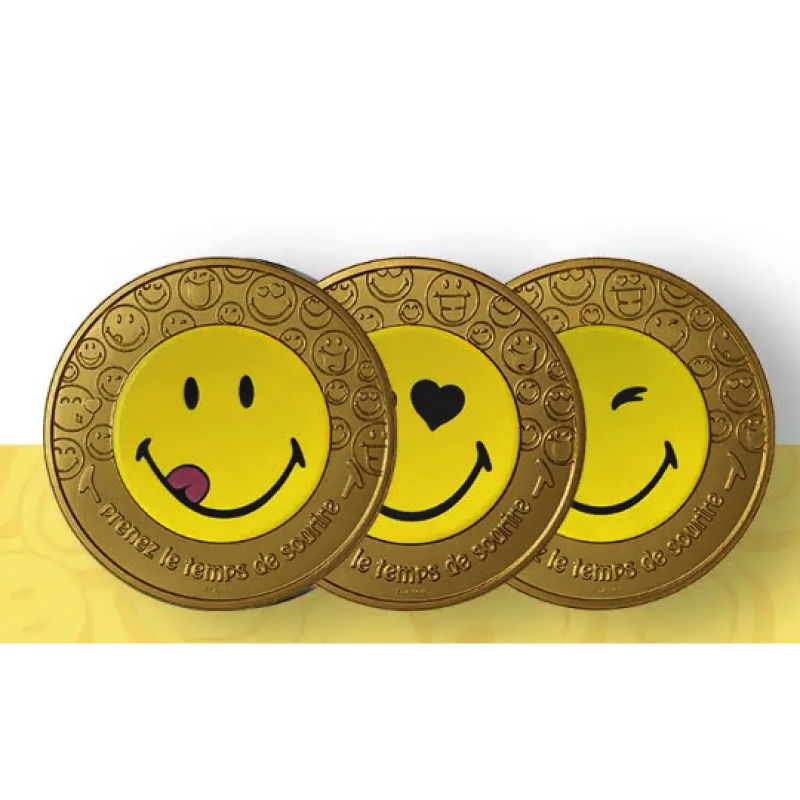
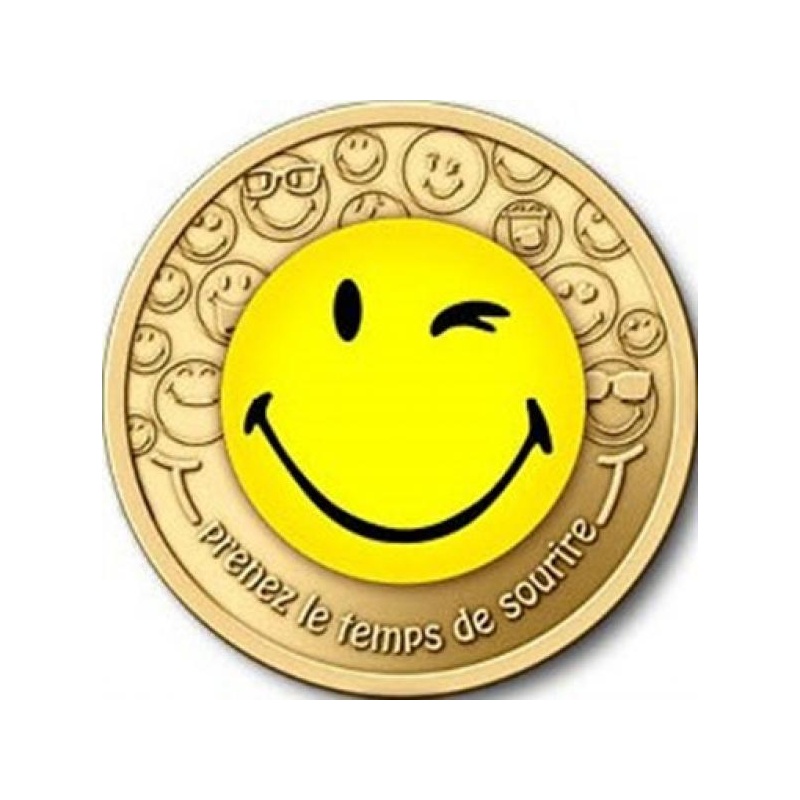
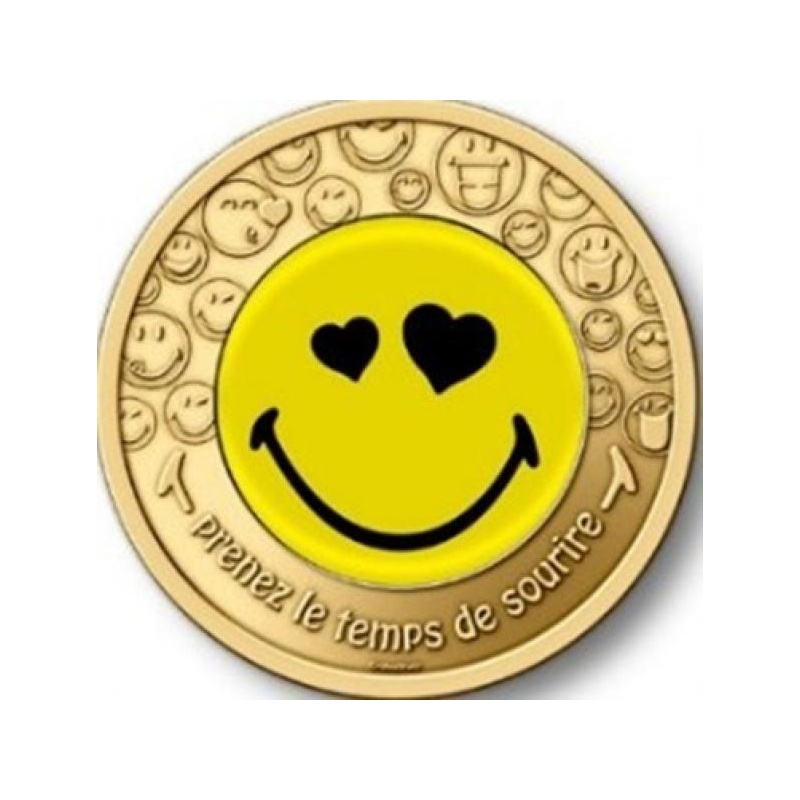
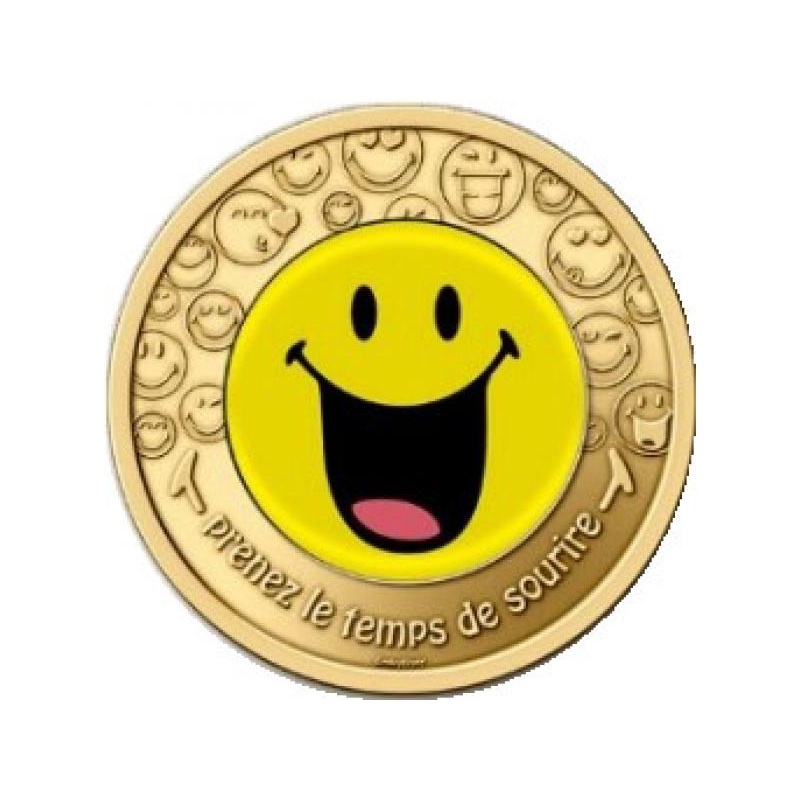
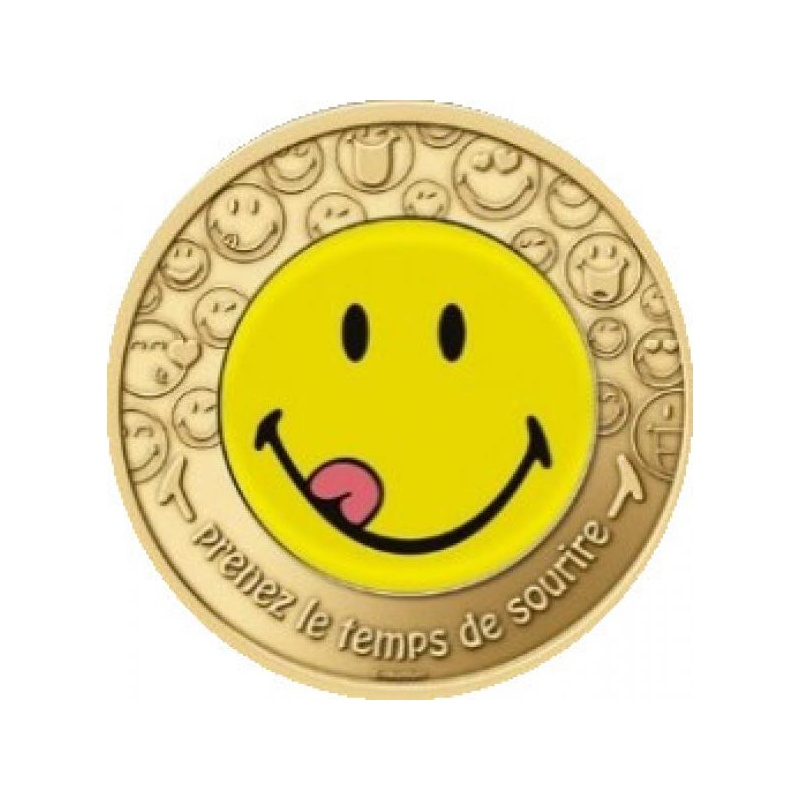
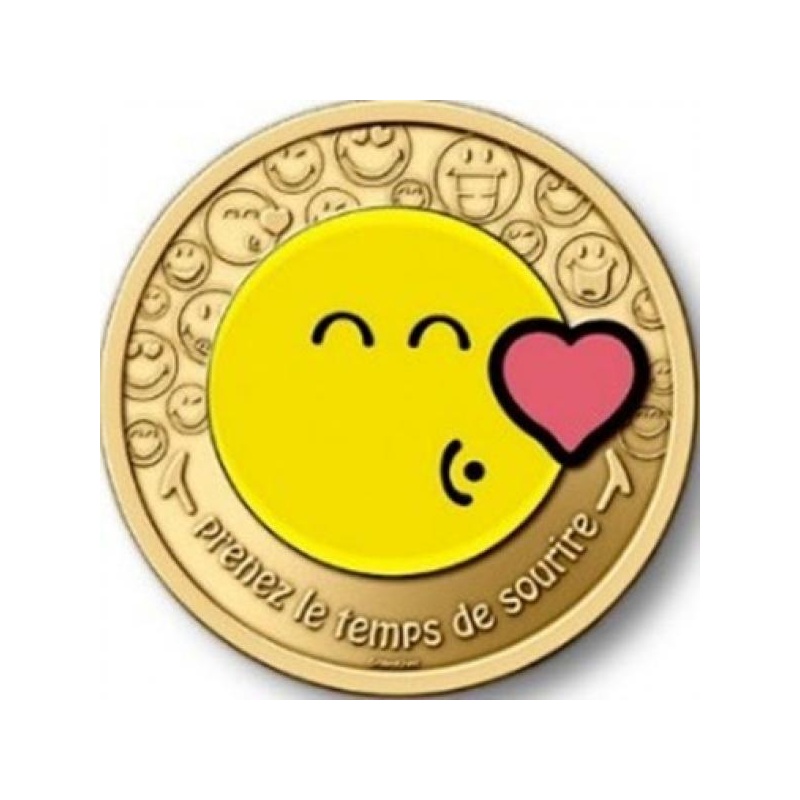
Smiley mini - medal. set of 5 different medals
Price:
39,00 €
30,00 €
Metal: NordicGold
Weight: 15,80 g
Diameter: 34 mm
Mintage: 10 000
In 2022, Smiley celebrates its fifth decade of smiles and optimism.
The emblematic yellow, round face of the brand was born on 1st, January 1972 in France, when journalist Franklin Loufrani used this infectious smile in the newspaper France-soir in order to highlight stories which brought positive news and cheered up French people’s spirit. This operation, called « Take the time to smile » was an immediate success.
In 1996, the logo is relaunched and developed in other forms : a new 3D version is created and new expressions are added in. Nowadays, from the smiley to the emoticon, smiling takes multiple forms, becoming a representative of cheerfulness !
Since the creation of the yellow smile in 1972, Smiley diversified the range of its expressions, conveying over a hundred émotions. From the smiley to the emoticon, smiling takes multiple forms.
Each mini-medal highlights a particular emotion : love, gratitude, gluttony, joy and laughing.
The medals are packaged in a coloured packaging, to treat to someone or to yourself.
Weight: 15,80 g
Diameter: 34 mm
Mintage: 10 000
In 2022, Smiley celebrates its fifth decade of smiles and optimism.
The emblematic yellow, round face of the brand was born on 1st, January 1972 in France, when journalist Franklin Loufrani used this infectious smile in the newspaper France-soir in order to highlight stories which brought positive news and cheered up French people’s spirit. This operation, called « Take the time to smile » was an immediate success.
In 1996, the logo is relaunched and developed in other forms : a new 3D version is created and new expressions are added in. Nowadays, from the smiley to the emoticon, smiling takes multiple forms, becoming a representative of cheerfulness !
Since the creation of the yellow smile in 1972, Smiley diversified the range of its expressions, conveying over a hundred émotions. From the smiley to the emoticon, smiling takes multiple forms.
Each mini-medal highlights a particular emotion : love, gratitude, gluttony, joy and laughing.
The medals are packaged in a coloured packaging, to treat to someone or to yourself.
Similar products
Face value: 5 €
Diameter: 34 mm
Weight: 19.1 g
Metal: Brass
Mintage: 45,000
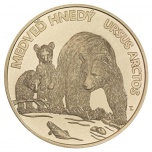
The obverse of this euro collector coin is dominated by the head of a brown bear in profile. Centrally positioned above the head is the Slovak coat of arms. The denomination and currency ‘5 EURO’ appear along the lower left edge. Inscribed along the upper edge are the name of the issuing country and the year of issuance: ‘SLOVENSKO 2023’. At the right edge is the mint mark of the Kremnica Mint (Mincovňa Kremnica), consisting of the letters ‘MK’ placed between two dies.
Reverse:
On the reverse is a depiction of a female bear and her two cubs hunting fish. Inscribed along the upper edge are the Slovak name for the brown bear ‘MEDVEĎ HNEDÝ’ and the animal’s scientific name ‘URSUS ARCTOS’. At the lower right edge are the stylised initials ‘TL’, referring to the coin’s designer Tomáš Lamač.
The brown bear is Slovakia’s largest predator. It has a stocky body, small eyes and ears, a short tail, pronounced claws, and thick fur that is 8 to 12 cm long and comes in a wide range of shades from light brown to almost black. The adult male can weigh up to 350 kg. Brown bears in Slovakia are concentrated in the central, northern and north-eastern mountain areas. The brown bear is an omnivore that prefers to live in mixed and coniferous forests. Its diet is 90% vegetable matter with the remaining 10% consisting of carrion, smaller animals, insects and, occasionally, sick or injured hooved game. Bears hibernate in dens from around early November to April. Female bears and their cubs are the first to enter the dens and the last to emerge from them. Male bears seek out females only during the mating season, usually from the end of April to the beginning of August. The cubs are born during January and February in the safety of the winter den. At birth they are blind, have short fur and weigh less than 500 g. Bears in the wild can live to be more than 30 years old.
Diameter: 34 mm
Weight: 19.1 g
Metal: Brass
Mintage: 45,000
The obverse of this euro collector coin is dominated by the head of a brown bear in profile. Centrally positioned above the head is the Slovak coat of arms. The denomination and currency ‘5 EURO’ appear along the lower left edge. Inscribed along the upper edge are the name of the issuing country and the year of issuance: ‘SLOVENSKO 2023’. At the right edge is the mint mark of the Kremnica Mint (Mincovňa Kremnica), consisting of the letters ‘MK’ placed between two dies.
Reverse:
On the reverse is a depiction of a female bear and her two cubs hunting fish. Inscribed along the upper edge are the Slovak name for the brown bear ‘MEDVEĎ HNEDÝ’ and the animal’s scientific name ‘URSUS ARCTOS’. At the lower right edge are the stylised initials ‘TL’, referring to the coin’s designer Tomáš Lamač.
The brown bear is Slovakia’s largest predator. It has a stocky body, small eyes and ears, a short tail, pronounced claws, and thick fur that is 8 to 12 cm long and comes in a wide range of shades from light brown to almost black. The adult male can weigh up to 350 kg. Brown bears in Slovakia are concentrated in the central, northern and north-eastern mountain areas. The brown bear is an omnivore that prefers to live in mixed and coniferous forests. Its diet is 90% vegetable matter with the remaining 10% consisting of carrion, smaller animals, insects and, occasionally, sick or injured hooved game. Bears hibernate in dens from around early November to April. Female bears and their cubs are the first to enter the dens and the last to emerge from them. Male bears seek out females only during the mating season, usually from the end of April to the beginning of August. The cubs are born during January and February in the safety of the winter den. At birth they are blind, have short fur and weigh less than 500 g. Bears in the wild can live to be more than 30 years old.
14,90 €
Quality: Special Uncirculated
Face Value: 5 Euro
Diameter: 28,5 mm
Copper: 99,9%
Total Weight: 8,5 g
Comes without packaging
The New Year Coin 2024 is a special coin for a very special year. With 366 days instead of the usual 365, 2024 is a leap year and this limited-mintage coin is designed to remind you that the extra day should be enjoyed amid the hustle and bustle of everyday life.
The extra day in a leap year keeps the calendar year synchronised with the solar year and thus with the cosmic order. You should accept it as a heavenly gift and treat it as an extra portion of luck. The extra day is a day with great potential on which you can allow yourself a little more ‘me time’, dedicate more time than usual to someone else, or do something you have always wanted to do. Or if you have resolved to tackle something completely new by the end of the year, why not use the extra day for that? Everyday life tends to demand a great deal from us without making any concessions, but that is not the case in 2024 when we are given a whole extra day to enjoy.
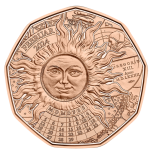
The reverse of the nine-sided coin is dedicated to the Gregorian calendar, which was introduced by Pope Gregory XIII in 1582 to bring the calendar back into line with the solar year. Pope Gregory XIII features on the right edge of the coin next to a large, flame-haired human manifestation of the Sun. Below the Sun is the calendar page for the month of February showing the 29th of February – the extra day. At the top is the zodiac sign Pisces, which corresponds to late February. The coin’s obverse shows the coats of arms of the nine provinces of Austria.
Face Value: 5 Euro
Diameter: 28,5 mm
Copper: 99,9%
Total Weight: 8,5 g
Comes without packaging
The New Year Coin 2024 is a special coin for a very special year. With 366 days instead of the usual 365, 2024 is a leap year and this limited-mintage coin is designed to remind you that the extra day should be enjoyed amid the hustle and bustle of everyday life.
The extra day in a leap year keeps the calendar year synchronised with the solar year and thus with the cosmic order. You should accept it as a heavenly gift and treat it as an extra portion of luck. The extra day is a day with great potential on which you can allow yourself a little more ‘me time’, dedicate more time than usual to someone else, or do something you have always wanted to do. Or if you have resolved to tackle something completely new by the end of the year, why not use the extra day for that? Everyday life tends to demand a great deal from us without making any concessions, but that is not the case in 2024 when we are given a whole extra day to enjoy.
The reverse of the nine-sided coin is dedicated to the Gregorian calendar, which was introduced by Pope Gregory XIII in 1582 to bring the calendar back into line with the solar year. Pope Gregory XIII features on the right edge of the coin next to a large, flame-haired human manifestation of the Sun. Below the Sun is the calendar page for the month of February showing the 29th of February – the extra day. At the top is the zodiac sign Pisces, which corresponds to late February. The coin’s obverse shows the coats of arms of the nine provinces of Austria.
15,00 €
Face value: Samoa 0,25$
Weight: 40gr
Diameter: 40 mm
Mintage: 6666
Proof copper coin with partial gold plating
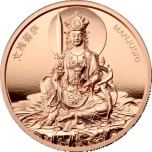
In East Asian Buddhism, the Twelve Heavenly Generals or Twelve Divine Generals are the protective deities.
Weight: 40gr
Diameter: 40 mm
Mintage: 6666
Proof copper coin with partial gold plating
In East Asian Buddhism, the Twelve Heavenly Generals or Twelve Divine Generals are the protective deities.
39,00 €
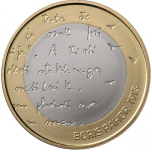
Slovenia 3 € commemorative coin 2023 -110th anniversary of the birth of Slovenian writer Boris Pahor
Face vakue: 3 euro
Diameter; 32 mm
Weight: 15,0 g
Alloy: Bimetal;CuNi, nordic gold
Quality: UNC
Diameter; 32 mm
Weight: 15,0 g
Alloy: Bimetal;CuNi, nordic gold
Quality: UNC
9,00 €
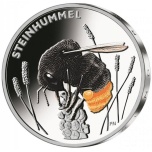
Materiall: CuNi
Weight: 9g
Diameter: 26,9 mm
Mintage: 100 000
The German government has decided to mint a €5 collectors’ coin entitled “Red mason bee”, to be issed at 7 September 2023. It is the fourth coin issued as part of the “Wonderful world of insects” series, which will see a total of nine coins with partially coloured motifs issued over the period 2022-24. The series is intended to bring into focus – especially in light of current developments (insect extinction) – a special group of animals that make up a significant part of our natural heritage.
The €5 collectors’ coin “Red-tailed bumblebee” is made of a cupronickel alloy. It weighs 9.68 g, measures 27.25 mm in diameter and will be available both in mint condition and with a proof-like finish. The mint condition coins will be brought into circulation at their face value (€5). The collector quality coins with a proof-like finish will be higher than their face value and will be issued by the Münze Deutschland (Germany’s official sales agency for collector coins).
The coin was designed by Patrick Niesel, an artist based in Röthenbach an der Pegnitz (picture side), and Andre Witting, a Berlin-based artist (reverse).
The reverse, which will be used for all coins in the series, features an eagle, the words “BUNDESREPUBLIK DEUTSCHLAND”, the value and denomination, the year 2024, the twelve stars of Europe and the letter “J” for the State Mint of Hamburg.
Its smooth edge is engraved with the inscription: “WUNDERWELT INSEKTEN” (WONDERFUL WORLD OF INSECTS).
Weight: 9g
Diameter: 26,9 mm
Mintage: 100 000
The German government has decided to mint a €5 collectors’ coin entitled “Red mason bee”, to be issed at 7 September 2023. It is the fourth coin issued as part of the “Wonderful world of insects” series, which will see a total of nine coins with partially coloured motifs issued over the period 2022-24. The series is intended to bring into focus – especially in light of current developments (insect extinction) – a special group of animals that make up a significant part of our natural heritage.
The €5 collectors’ coin “Red-tailed bumblebee” is made of a cupronickel alloy. It weighs 9.68 g, measures 27.25 mm in diameter and will be available both in mint condition and with a proof-like finish. The mint condition coins will be brought into circulation at their face value (€5). The collector quality coins with a proof-like finish will be higher than their face value and will be issued by the Münze Deutschland (Germany’s official sales agency for collector coins).
The coin was designed by Patrick Niesel, an artist based in Röthenbach an der Pegnitz (picture side), and Andre Witting, a Berlin-based artist (reverse).
The reverse, which will be used for all coins in the series, features an eagle, the words “BUNDESREPUBLIK DEUTSCHLAND”, the value and denomination, the year 2024, the twelve stars of Europe and the letter “J” for the State Mint of Hamburg.
Its smooth edge is engraved with the inscription: “WUNDERWELT INSEKTEN” (WONDERFUL WORLD OF INSECTS).
14,90 €