




Easter Coin. The Waggle Dance - Austria 5 € 2023 copper coin, 8,5 g
Price:
19,00 €
Quality: Special Uncirculated
Face Value: 5 Euro
Diameter: 28,5 mm
Copper: 99,9%
Total Weight: 8,5 g
Mintage: 50 000
Comes without packaging
Why talk when you can dance instead? That’s how bees communicate. Their ‘waggle dance’ is a wonderful phenomenon and one that not only bees themselves benefit from. Other living creatures, including humans, do so too, because bees are a vital part of our ecosystem: their welfare is our welfare.
In the early 20th century, the unusual behaviour of honeybees piqued the curiosity of behavioural scientist Karl von Frisch (1886–1982), who grew up in Vienna. He was intrigued by the way the insects sometimes move in circles and perform a figure of-eight ‘waggle dance’. In time, von Frisch discovered that when doing so, bees are in fact ‘speaking’ a dance language to the other members of their hive to show them where they can find pollen and nectar. Although originally disputed by other scientists, von Frisch’s theory eventually earned him the Nobel Prize in 1973.
The ‘round dance’, in which bees walks in a circle, turn around, then walk the same circle in the opposite direction, tells watching bees that there are flowers with pollen in the immediate vicinity of the hive. When the food source is further away, the waggle dance tells the watching bees how far it is and in which direction they can find it. A representation of the waggle dance is shown in the background on the coin’s reverse, behind a bee in flight and above a decorative honeycomb deign. The obverse of the nine-sided coin shows the coats of arms of all the provinces of Austria. Not just for nature lovers, whether in copper or silver, Waggle Dance makes for a great spring or Easter gift.
In the early 20th century, the unusual behavior of honey bees piqued the curiosity of behavioral scientist Karl von Frisch (1886–1982), who grew up in Vienna. He was intrigued by the way the insects sometimes move in circles and perform a figure-of-eight ‘waggle dance’. In time, von Frisch discovered that when doing so, bees are in fact ‘speaking’ a dance language to the other members of their hive to show them where they can find pollen and nectar. Although originally disputed by other scientists, von Frisch’s theory eventually earned him the Nobel Prize in 1973 for achievements in comparative behavioural physiology and pioneering work in communication between insects. It is not just bees themselves that benefit from this wonderful phenomenon, as other living creatures, including humans, do so too. Honey bees, wild bees and bumble bees are a vital part of the ecosystem: their welfare is our welfare.
Face Value: 5 Euro
Diameter: 28,5 mm
Copper: 99,9%
Total Weight: 8,5 g
Mintage: 50 000
Comes without packaging
Why talk when you can dance instead? That’s how bees communicate. Their ‘waggle dance’ is a wonderful phenomenon and one that not only bees themselves benefit from. Other living creatures, including humans, do so too, because bees are a vital part of our ecosystem: their welfare is our welfare.
In the early 20th century, the unusual behaviour of honeybees piqued the curiosity of behavioural scientist Karl von Frisch (1886–1982), who grew up in Vienna. He was intrigued by the way the insects sometimes move in circles and perform a figure of-eight ‘waggle dance’. In time, von Frisch discovered that when doing so, bees are in fact ‘speaking’ a dance language to the other members of their hive to show them where they can find pollen and nectar. Although originally disputed by other scientists, von Frisch’s theory eventually earned him the Nobel Prize in 1973.
The ‘round dance’, in which bees walks in a circle, turn around, then walk the same circle in the opposite direction, tells watching bees that there are flowers with pollen in the immediate vicinity of the hive. When the food source is further away, the waggle dance tells the watching bees how far it is and in which direction they can find it. A representation of the waggle dance is shown in the background on the coin’s reverse, behind a bee in flight and above a decorative honeycomb deign. The obverse of the nine-sided coin shows the coats of arms of all the provinces of Austria. Not just for nature lovers, whether in copper or silver, Waggle Dance makes for a great spring or Easter gift.
In the early 20th century, the unusual behavior of honey bees piqued the curiosity of behavioral scientist Karl von Frisch (1886–1982), who grew up in Vienna. He was intrigued by the way the insects sometimes move in circles and perform a figure-of-eight ‘waggle dance’. In time, von Frisch discovered that when doing so, bees are in fact ‘speaking’ a dance language to the other members of their hive to show them where they can find pollen and nectar. Although originally disputed by other scientists, von Frisch’s theory eventually earned him the Nobel Prize in 1973 for achievements in comparative behavioural physiology and pioneering work in communication between insects. It is not just bees themselves that benefit from this wonderful phenomenon, as other living creatures, including humans, do so too. Honey bees, wild bees and bumble bees are a vital part of the ecosystem: their welfare is our welfare.
Similar products
The 2.5 euro coin is minted in BU-quality and is issued in two language versions. On the coincard, a close-up of a beer will quench your thirst. On the coin you will see the Belgian beer culture in a nutshell; each beer has its own matching type of glass!
Details
• Official issue to commemorate 5 years of Belgian beer culture
• Thirst quenching packaging in two language versions
• Limited mintage of max. 20,000 coins
• Legal tender in Belgium, not for circulation
Specifications
• Metal: Brass
• Weight: 10.50 g
• Diameter: 25.65 mm
• Quality: Brilliant Uncirculated (BU) / FDC
• Design: Iris Bruijns (obverse), Luc Luycx (reverse)
• Max. mintage: 20,000 coins worldwide (distributed in 2 language versions in a coincard and 7,500 coins are included in the annual FDC set 2021)
Details
• Official issue to commemorate 5 years of Belgian beer culture
• Thirst quenching packaging in two language versions
• Limited mintage of max. 20,000 coins
• Legal tender in Belgium, not for circulation
Specifications
• Metal: Brass
• Weight: 10.50 g
• Diameter: 25.65 mm
• Quality: Brilliant Uncirculated (BU) / FDC
• Design: Iris Bruijns (obverse), Luc Luycx (reverse)
• Max. mintage: 20,000 coins worldwide (distributed in 2 language versions in a coincard and 7,500 coins are included in the annual FDC set 2021)
19,00 €
Materiall: CuNi
Weight: 9g
Diameter: 26,9 mm
Mintage: 100 000
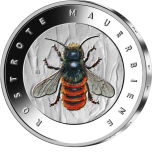
The German government has decided to mint a €5 collectors’ coin entitled “Red mason bee”, to be issed at 7 September 2023. It is the fourth coin issued as part of the “Wonderful world of insects” series, which will see a total of nine coins with partially coloured motifs issued over the period 2022-24. The series is intended to bring into focus – especially in light of current developments (insect extinction) – a special group of animals that make up a significant part of our natural heritage.
The €5 collectors’ coin “Red mason bee” is made of a cupronickel alloy. It weighs 9.68 g, measures 27.25 mm in diameter and will be available both in mint condition and with a proof-like finish. The mint condition coins will be brought into circulation at their face value (€5). The collector quality coins with a proof-like finish will be higher than their face value and will be issued by the Münze Deutschland (Germany’s official sales agency for collector coins).
The coin was designed by Claudius Riedmiller, an artist based in Stuttgart (picture side), and Andre Witting, a Berlin-based artist (reverse).
The reverse, which will be used for all coins in the series, features an eagle, the words “BUNDESREPUBLIK DEUTSCHLAND”, the value and denomination, the year 2023, the twelve stars of Europe and the letter “D” for the State Mint of Munich.
Its smooth edge is engraved with the inscription: “WUNDERWELT INSEKTEN” (WONDERFUL WORLD OF INSECTS)
Weight: 9g
Diameter: 26,9 mm
Mintage: 100 000
The German government has decided to mint a €5 collectors’ coin entitled “Red mason bee”, to be issed at 7 September 2023. It is the fourth coin issued as part of the “Wonderful world of insects” series, which will see a total of nine coins with partially coloured motifs issued over the period 2022-24. The series is intended to bring into focus – especially in light of current developments (insect extinction) – a special group of animals that make up a significant part of our natural heritage.
The €5 collectors’ coin “Red mason bee” is made of a cupronickel alloy. It weighs 9.68 g, measures 27.25 mm in diameter and will be available both in mint condition and with a proof-like finish. The mint condition coins will be brought into circulation at their face value (€5). The collector quality coins with a proof-like finish will be higher than their face value and will be issued by the Münze Deutschland (Germany’s official sales agency for collector coins).
The coin was designed by Claudius Riedmiller, an artist based in Stuttgart (picture side), and Andre Witting, a Berlin-based artist (reverse).
The reverse, which will be used for all coins in the series, features an eagle, the words “BUNDESREPUBLIK DEUTSCHLAND”, the value and denomination, the year 2023, the twelve stars of Europe and the letter “D” for the State Mint of Munich.
Its smooth edge is engraved with the inscription: “WUNDERWELT INSEKTEN” (WONDERFUL WORLD OF INSECTS)
14,90 €
Quality: Special Uncirculated
Face Value: 5 Euro
Diameter: 28,5 mm
Copper: 99,9%
Total Weight: 8,5 g
Comes without packaging
The New Year Coin 2024 is a special coin for a very special year. With 366 days instead of the usual 365, 2024 is a leap year and this limited-mintage coin is designed to remind you that the extra day should be enjoyed amid the hustle and bustle of everyday life.
The extra day in a leap year keeps the calendar year synchronised with the solar year and thus with the cosmic order. You should accept it as a heavenly gift and treat it as an extra portion of luck. The extra day is a day with great potential on which you can allow yourself a little more ‘me time’, dedicate more time than usual to someone else, or do something you have always wanted to do. Or if you have resolved to tackle something completely new by the end of the year, why not use the extra day for that? Everyday life tends to demand a great deal from us without making any concessions, but that is not the case in 2024 when we are given a whole extra day to enjoy.
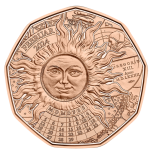
The reverse of the nine-sided coin is dedicated to the Gregorian calendar, which was introduced by Pope Gregory XIII in 1582 to bring the calendar back into line with the solar year. Pope Gregory XIII features on the right edge of the coin next to a large, flame-haired human manifestation of the Sun. Below the Sun is the calendar page for the month of February showing the 29th of February – the extra day. At the top is the zodiac sign Pisces, which corresponds to late February. The coin’s obverse shows the coats of arms of the nine provinces of Austria.
Face Value: 5 Euro
Diameter: 28,5 mm
Copper: 99,9%
Total Weight: 8,5 g
Comes without packaging
The New Year Coin 2024 is a special coin for a very special year. With 366 days instead of the usual 365, 2024 is a leap year and this limited-mintage coin is designed to remind you that the extra day should be enjoyed amid the hustle and bustle of everyday life.
The extra day in a leap year keeps the calendar year synchronised with the solar year and thus with the cosmic order. You should accept it as a heavenly gift and treat it as an extra portion of luck. The extra day is a day with great potential on which you can allow yourself a little more ‘me time’, dedicate more time than usual to someone else, or do something you have always wanted to do. Or if you have resolved to tackle something completely new by the end of the year, why not use the extra day for that? Everyday life tends to demand a great deal from us without making any concessions, but that is not the case in 2024 when we are given a whole extra day to enjoy.
The reverse of the nine-sided coin is dedicated to the Gregorian calendar, which was introduced by Pope Gregory XIII in 1582 to bring the calendar back into line with the solar year. Pope Gregory XIII features on the right edge of the coin next to a large, flame-haired human manifestation of the Sun. Below the Sun is the calendar page for the month of February showing the 29th of February – the extra day. At the top is the zodiac sign Pisces, which corresponds to late February. The coin’s obverse shows the coats of arms of the nine provinces of Austria.
15,00 €
Face value: Samoa 0,25$
Weight: 47 gr
Diameter: 40 mm
Mintage: 3 000
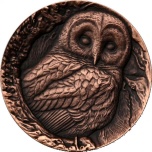
The tawny owl (Strix aluco), also called the brown owl, is commonly found in woodlands across Europe to western Siberia, and has seven recognized subspecies. It is a stocky, medium-sized owl, whose underparts are pale with dark streaks, and whose upper body may be either brown or grey. (In several subspecies, individuals may be of either color.) The tawny owl typically makes its nest in a tree hollow where it can protect its eggs and young against potential predators. It is non-migratory and highly territorial: as a result, when young birds grow up and leave the parental nest, if they cannot find a vacant territory to claim as their own, they will often starve
Weight: 47 gr
Diameter: 40 mm
Mintage: 3 000
The tawny owl (Strix aluco), also called the brown owl, is commonly found in woodlands across Europe to western Siberia, and has seven recognized subspecies. It is a stocky, medium-sized owl, whose underparts are pale with dark streaks, and whose upper body may be either brown or grey. (In several subspecies, individuals may be of either color.) The tawny owl typically makes its nest in a tree hollow where it can protect its eggs and young against potential predators. It is non-migratory and highly territorial: as a result, when young birds grow up and leave the parental nest, if they cannot find a vacant territory to claim as their own, they will often starve
39,00 €
Issuing Country: France
Face value: 5 €
Metal: Copper/Nickel
Diameter: 29 mm
Quality: B.U.
Mintage: 25 000
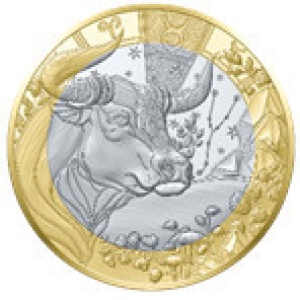
The wheel of the zodiac signs is engraved on the coin's gold-colored crown. One sign stands out from the background because it is larger than the others and has a sandblasted background, different from the smoother one of the others. It is the symbol of the Taurus. A pattern of leaves, mushrooms and crystals, reminiscent of the sign's element, earth, surrounds the imposing bust of a bull. The animal's horns and forehead are adorned with arabesques. The starry sky in the background features the Taurus constellation.
Face value: 5 €
Metal: Copper/Nickel
Diameter: 29 mm
Quality: B.U.
Mintage: 25 000
The wheel of the zodiac signs is engraved on the coin's gold-colored crown. One sign stands out from the background because it is larger than the others and has a sandblasted background, different from the smoother one of the others. It is the symbol of the Taurus. A pattern of leaves, mushrooms and crystals, reminiscent of the sign's element, earth, surrounds the imposing bust of a bull. The animal's horns and forehead are adorned with arabesques. The starry sky in the background features the Taurus constellation.
20,00 €