



"Honey Bee Watercolour " Solomon Island 0,5$ 2026 Silverplated coin, selective colour print, 10 g.
Price:
25,00 €
Country: Salomon Islands
Year: 2026
Face Value: 0,5 Dollar
Weight: 10 g
Diameter: 32 mm
Quality: B.U.
Mintage: 5.000 pcs
Celebrate one of nature's most remarkable pollinators with the Honey Bee Watercolour Commemorative Coin. Combining delicate watercolour artwork with brilliant silver plating, this beautiful release captures the grace, colour and importance of the honey bee in a fresh and contemporary design. Soft pastel blooms flow across the coin, while the detailed honey bee takes centre stage, creating the appearance of a hand-painted illustration framed by the shine of polished silver. The subtle honeycomb pattern adds depth and texture, bringing together modern minting with the timeless beauty of watercolour art. Struck as a Brilliant Uncirculated (BU) commemorative coin and finished in silver plating, this piece has been designed as an affordable and eye-catching collectible that appeals to nature lovers, art enthusiasts and coin collectors alike. With a limited mintage of just 5,000 pieces worldwide, the Honey Bee Watercolour Commemorative Coin is a charming addition to any collection, celebrating both the beauty of the natural world and the artistry of modern coin design.
Sarnased tooted
Materiall: CuNi
Weight: 9g
Diameter: 26,9 mm
Mintage: 100 000
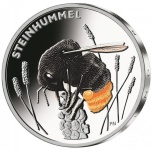
The German government has decided to mint a €5 collectors’ coin entitled “Red mason bee”, to be issed at 7 September 2023. It is the fourth coin issued as part of the “Wonderful world of insects” series, which will see a total of nine coins with partially coloured motifs issued over the period 2022-24. The series is intended to bring into focus – especially in light of current developments (insect extinction) – a special group of animals that make up a significant part of our natural heritage.
The €5 collectors’ coin “Red-tailed bumblebee” is made of a cupronickel alloy. It weighs 9.68 g, measures 27.25 mm in diameter and will be available both in mint condition and with a proof-like finish. The mint condition coins will be brought into circulation at their face value (€5). The collector quality coins with a proof-like finish will be higher than their face value and will be issued by the Münze Deutschland (Germany’s official sales agency for collector coins).
The coin was designed by Patrick Niesel, an artist based in Röthenbach an der Pegnitz (picture side), and Andre Witting, a Berlin-based artist (reverse).
The reverse, which will be used for all coins in the series, features an eagle, the words “BUNDESREPUBLIK DEUTSCHLAND”, the value and denomination, the year 2024, the twelve stars of Europe and the letter “J” for the State Mint of Hamburg.
Its smooth edge is engraved with the inscription: “WUNDERWELT INSEKTEN” (WONDERFUL WORLD OF INSECTS).
14,90 €
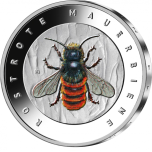
Materiall: CuNi
Weight: 9g
Diameter: 26,9 mm
Mintage: 100 000
The German government has decided to mint a €5 collectors’ coin entitled “Red mason bee”, to be issed at 7 September 2023. It is the fourth coin issued as part of the “Wonderful world of insects” series, which will see a total of nine coins with partially coloured motifs issued over the period 2022-24. The series is intended to bring into focus – especially in light of current developments (insect extinction) – a special group of animals that make up a significant part of our natural heritage.
The €5 collectors’ coin “Red mason bee” is made of a cupronickel alloy. It weighs 9.68 g, measures 27.25 mm in diameter and will be available both in mint condition and with a proof-like finish. The mint condition coins will be brought into circulation at their face value (€5). The collector quality coins with a proof-like finish will be higher than their face value and will be issued by the Münze Deutschland (Germany’s official sales agency for collector coins).
The coin was designed by Claudius Riedmiller, an artist based in Stuttgart (picture side), and Andre Witting, a Berlin-based artist (reverse).
The reverse, which will be used for all coins in the series, features an eagle, the words “BUNDESREPUBLIK DEUTSCHLAND”, the value and denomination, the year 2023, the twelve stars of Europe and the letter “D” for the State Mint of Munich.
Its smooth edge is engraved with the inscription: “WUNDERWELT INSEKTEN” (WONDERFUL WORLD OF INSECTS)
14,90 €

Issuing Country: Solomon Islands
Weight: 0,031 g
Gold: .999
Diameter: 27 x 19 mm
Quality: Proof like
Mintage: 5 000
The Honey Bee has long been admired as a symbol of harmony, resilience and the incredible beauty of the natural world. This finely detailed 1/1000th Gold Honey Bee captures the elegance of this remarkable pollinator in a timeless miniature design inspired by the delicate patterns found within the hive. Featuring intricate engraved details across the bee's wings and body, the design celebrates the craftsmanship of nature itself. Set against a presentation card with flowing honeycomb elements and warm golden tones, the artwork reflects the bee's connection to honey, flowers and the landscapes it helps sustain. More than just a collectible, this release is a tribute to the small creature that plays such a vital role in ecosystems around the world. Its classic styling and nature-inspired design make it a meaningful keepsake for collectors and bee enthusiasts alike. With a limited worldwide mintage of just 5,000 pieces, the 1/1000th Gold Honey Bee is a charming addition to any collection and a celebration of one of nature's most extraordinary creations.
79,00 €
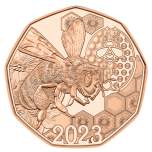
Quality: Special Uncirculated
Face Value: 5 Euro
Diameter: 28,5 mm
Copper: 99,9%
Total Weight: 8,5 g
Mintage: 50 000
Comes without packaging
Why talk when you can dance instead? That’s how bees communicate. Their ‘waggle dance’ is a wonderful phenomenon and one that not only bees themselves benefit from. Other living creatures, including humans, do so too, because bees are a vital part of our ecosystem: their welfare is our welfare.
In the early 20th century, the unusual behaviour of honeybees piqued the curiosity of behavioural scientist Karl von Frisch (1886–1982), who grew up in Vienna. He was intrigued by the way the insects sometimes move in circles and perform a figure of-eight ‘waggle dance’. In time, von Frisch discovered that when doing so, bees are in fact ‘speaking’ a dance language to the other members of their hive to show them where they can find pollen and nectar. Although originally disputed by other scientists, von Frisch’s theory eventually earned him the Nobel Prize in 1973.
The ‘round dance’, in which bees walks in a circle, turn around, then walk the same circle in the opposite direction, tells watching bees that there are flowers with pollen in the immediate vicinity of the hive. When the food source is further away, the waggle dance tells the watching bees how far it is and in which direction they can find it. A representation of the waggle dance is shown in the background on the coin’s reverse, behind a bee in flight and above a decorative honeycomb deign. The obverse of the nine-sided coin shows the coats of arms of all the provinces of Austria. Not just for nature lovers, whether in copper or silver, Waggle Dance makes for a great spring or Easter gift.
In the early 20th century, the unusual behavior of honey bees piqued the curiosity of behavioral scientist Karl von Frisch (1886–1982), who grew up in Vienna. He was intrigued by the way the insects sometimes move in circles and perform a figure-of-eight ‘waggle dance’. In time, von Frisch discovered that when doing so, bees are in fact ‘speaking’ a dance language to the other members of their hive to show them where they can find pollen and nectar. Although originally disputed by other scientists, von Frisch’s theory eventually earned him the Nobel Prize in 1973 for achievements in comparative behavioural physiology and pioneering work in communication between insects. It is not just bees themselves that benefit from this wonderful phenomenon, as other living creatures, including humans, do so too. Honey bees, wild bees and bumble bees are a vital part of the ecosystem: their welfare is our welfare.
19,00 €
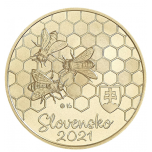
Face value: 5 €
Diameter: 34 mm
Weight: 19.1 g
Metal: Brass
Mintage: 45,000
The first coin from the series “Fauna and Flora of Slovakia”.
Bees are a social insect characterized by division of labor, collective care for their offspring, and the ability to survive adverse periods through colony thermoregulation and stockpiling.
The obverse of the coin depicts three bees on a honeycomb, the lower right part of which is covered with the coat of arms of Slovakia. Also indicated is the name of the issuing state “SLOVENSKO”, the year of issue of the coin, the mark of the Kremnica mint, consisting of the letters “MK” and the letter “KL” (initials of the coin designer Karol Lichko)
The reverse depicts two flowers, the largest of which is a bee. The denomination of the coin is indicated at the top. Below – the theme of the coin – “včela medonosná” (“honey bee”).
14,90 €
Similar products

Metal: NordicGold
Weight: 15,80 g
Diameter: 34 mm
Mintage: 10 000
In 2022, Smiley celebrates its fifth decade of smiles and optimism.
The emblematic yellow, round face of the brand was born on 1st, January 1972 in France, when journalist Franklin Loufrani used this infectious smile in the newspaper France-soir in order to highlight stories which brought positive news and cheered up French people’s spirit. This operation, called « Take the time to smile » was an immediate success.
In 1996, the logo is relaunched and developed in other forms : a new 3D version is created and new expressions are added in. Nowadays, from the smiley to the emoticon, smiling takes multiple forms, becoming a representative of cheerfulness !
Since the creation of the yellow smile in 1972, Smiley diversified the range of its expressions, conveying over a hundred émotions. From the smiley to the emoticon, smiling takes multiple forms.
Each mini-medal highlights a particular emotion : love, gratitude, gluttony, joy and laughing.
The medals are packaged in a coloured packaging, to treat to someone or to yourself.
9,90 €
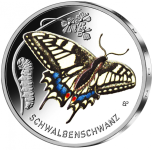
Materiall: CuNi
Weight: 9g
Diameter: 26,9 mm
Mintage: 100 000
It is the third coin issued as part of the “Wonderful world of insects” series, which will see a total of nine coins with partially coloured motifs issued over the period 2022-24. The series is intended to bring into focus – especially in light of current developments (insect extinction) – a special group of animals that make up a significant part of our natural heritage.
The €5 collectors’ coin “Swallowtail” is made of a cupronickel alloy. It weighs 9.68 g, measures 27.25 mm in diameter and will be available both in mint condition and with a proof-like finish. The mint condition coins will be brought into circulation at their face value (€5). The collector quality coins with a proof-like finish will be higher than their face value and will be issued by the Münze Deutschland (Germany’s official sales agency for collector coins).
The coin was designed by Bastian Prillwitz, an artist based in Berlin (picture side), and Andre Witting, a Berlin-based artist (reverse).
The reverse, which will be used for all coins in the series, features an eagle, the words “BUNDESREPUBLIK DEUTSCHLAND”, the value and denomination, the year 2023, the twelve stars of Europe and the letter “G” for the State Mint of Karlsruhe.
Its smooth edge is engraved with the inscription: “WUNDERWELT INSEKTEN” (WONDERFUL WORLD OF INSECTS).
14,90 €
Face value: 5 €
Diameter: 34 mm
Weight: 19.1 g
Metal: Brass
Mintage: 45,000
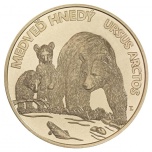
The obverse of this euro collector coin is dominated by the head of a brown bear in profile. Centrally positioned above the head is the Slovak coat of arms. The denomination and currency ‘5 EURO’ appear along the lower left edge. Inscribed along the upper edge are the name of the issuing country and the year of issuance: ‘SLOVENSKO 2023’. At the right edge is the mint mark of the Kremnica Mint (Mincovňa Kremnica), consisting of the letters ‘MK’ placed between two dies.
Reverse:
On the reverse is a depiction of a female bear and her two cubs hunting fish. Inscribed along the upper edge are the Slovak name for the brown bear ‘MEDVEĎ HNEDÝ’ and the animal’s scientific name ‘URSUS ARCTOS’. At the lower right edge are the stylised initials ‘TL’, referring to the coin’s designer Tomáš Lamač.
The brown bear is Slovakia’s largest predator. It has a stocky body, small eyes and ears, a short tail, pronounced claws, and thick fur that is 8 to 12 cm long and comes in a wide range of shades from light brown to almost black. The adult male can weigh up to 350 kg. Brown bears in Slovakia are concentrated in the central, northern and north-eastern mountain areas. The brown bear is an omnivore that prefers to live in mixed and coniferous forests. Its diet is 90% vegetable matter with the remaining 10% consisting of carrion, smaller animals, insects and, occasionally, sick or injured hooved game. Bears hibernate in dens from around early November to April. Female bears and their cubs are the first to enter the dens and the last to emerge from them. Male bears seek out females only during the mating season, usually from the end of April to the beginning of August. The cubs are born during January and February in the safety of the winter den. At birth they are blind, have short fur and weigh less than 500 g. Bears in the wild can live to be more than 30 years old.
14,90 €

Materiall: CuNi
Weight: 9g
Diameter: 26,9 mm
Mintage: 100 000
The German government has decided to mint a €5 collectors’ coin entitled “Marmelade hoverfly”, to be issed at 13 June 2024. It is the seventh coin issued as part of the “Wonderful world of insects” series, which will see a total of nine coins with partially coloured motifs issued over the period 2022-24. The series is intended to bring into focus – especially in light of current developments (insect extinction) – a special group of animals that make up a significant part of our natural heritage.
The €5 collectors’ coin “Marmelade hoverfly” is made of a cupronickel alloy. It weighs 9.68g, measures 27.25mm in diameter and will be available both in mint condition and with a proof-like finish. The mint condition coins will be brought into circulation at their face value (€5). The collector quality coins with a proof-like finish will be higher than their face value and will be issued by the Münze Deutschland (Germany’s official sales agency for collector coins).
The coin was designed by Anna Martha Napp, an artist based in aus Maßlow (picture side), and Andre Witting, a Berlin-based artist (reverse).
The reverse, which will be used for all coins in the series, features an eagle, the words “BUNDESREPUBLIK DEUTSCHLAND”, the value and denomination, the year 2024, the twelve stars of Europe and the letter “F” for the State Mint of Stuttgart.
Its smooth edge is engraved with the inscription: “WUNDERWELT INSEKTEN” (WONDERFUL WORLD OF INSECTS).
14,90 €
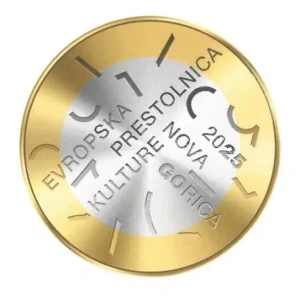
Face vakue: 3 euro
Diameter; 32 mm
Weight: 15,0 g
Alloy: Bimetal;CuNi, nordic gold
Quality: UNC
Mintage: 60 000
Diameter; 32 mm
Weight: 15,0 g
Alloy: Bimetal;CuNi, nordic gold
Quality: UNC
Mintage: 60 000
9,00 €