
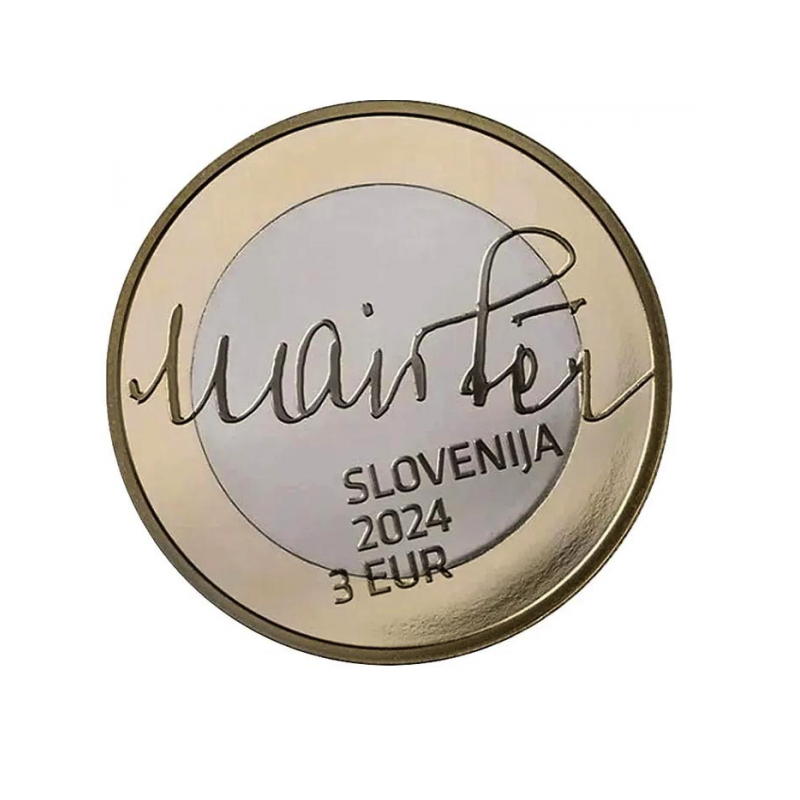
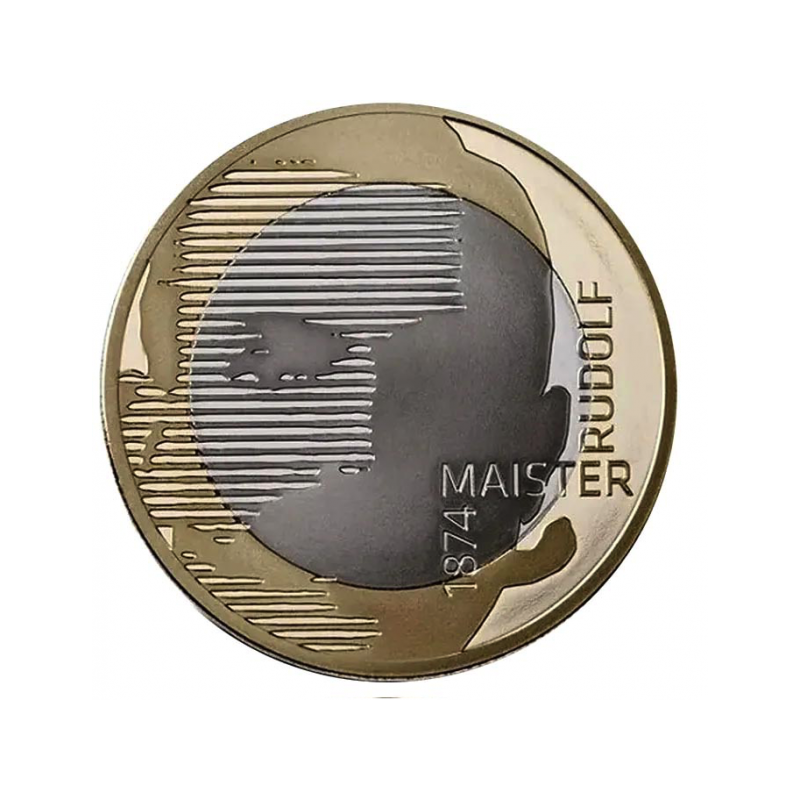
Slovenia 3 € commemorative coin 2024 - 150th birthday of Rudolf Maister
Price:
9,00 €
Face vakue: 3 euro
Diameter; 32 mm
Weight: 15,0 g
Alloy: Bimetal;CuNi, nordic gold
Quality: UNC
Commemorative coin dedicated to the Day of Slovenian Sport.
• The Day of Slovenian Sports is a national holiday celebrating the international successes of Slovenian athletes.
Diameter; 32 mm
Weight: 15,0 g
Alloy: Bimetal;CuNi, nordic gold
Quality: UNC
Commemorative coin dedicated to the Day of Slovenian Sport.
• The Day of Slovenian Sports is a national holiday celebrating the international successes of Slovenian athletes.
Kollektsioon
Slovenia 3 € commemorative coin 2023 -110th anniversary of the birth of Slovenian writer Boris Pahor
Face vakue: 3 euro
Diameter; 32 mm
Weight: 15,0 g
Alloy: Bimetal;CuNi, nordic gold
Quality: UNC
Diameter; 32 mm
Weight: 15,0 g
Alloy: Bimetal;CuNi, nordic gold
Quality: UNC
9,00 €
Face vakue: 3 euro
Diameter; 32 mm
Weight: 15,0 g
Alloy: Bimetal;CuNi, nordic gold
Quality: UNC
Commemorative coin dedicated to the Day of Slovenian Sport.
• The Day of Slovenian Sports is a national holiday celebrating the international successes of Slovenian athletes.
Diameter; 32 mm
Weight: 15,0 g
Alloy: Bimetal;CuNi, nordic gold
Quality: UNC
Commemorative coin dedicated to the Day of Slovenian Sport.
• The Day of Slovenian Sports is a national holiday celebrating the international successes of Slovenian athletes.
9,00 €
Similar products
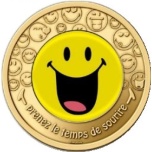
Metal: NordicGold
Weight: 15,80 g
Diameter: 34 mm
Mintage: 10 000
In 2022, Smiley celebrates its fifth decade of smiles and optimism.
The emblematic yellow, round face of the brand was born on 1st, January 1972 in France, when journalist Franklin Loufrani used this infectious smile in the newspaper France-soir in order to highlight stories which brought positive news and cheered up French people’s spirit. This operation, called « Take the time to smile » was an immediate success.
In 1996, the logo is relaunched and developed in other forms : a new 3D version is created and new expressions are added in. Nowadays, from the smiley to the emoticon, smiling takes multiple forms, becoming a representative of cheerfulness !
Since the creation of the yellow smile in 1972, Smiley diversified the range of its expressions, conveying over a hundred émotions. From the smiley to the emoticon, smiling takes multiple forms.
Each mini-medal highlights a particular emotion : love, gratitude, gluttony, joy and laughing.
The medals are packaged in a coloured packaging, to treat to someone or to yourself.
Weight: 15,80 g
Diameter: 34 mm
Mintage: 10 000
In 2022, Smiley celebrates its fifth decade of smiles and optimism.
The emblematic yellow, round face of the brand was born on 1st, January 1972 in France, when journalist Franklin Loufrani used this infectious smile in the newspaper France-soir in order to highlight stories which brought positive news and cheered up French people’s spirit. This operation, called « Take the time to smile » was an immediate success.
In 1996, the logo is relaunched and developed in other forms : a new 3D version is created and new expressions are added in. Nowadays, from the smiley to the emoticon, smiling takes multiple forms, becoming a representative of cheerfulness !
Since the creation of the yellow smile in 1972, Smiley diversified the range of its expressions, conveying over a hundred émotions. From the smiley to the emoticon, smiling takes multiple forms.
Each mini-medal highlights a particular emotion : love, gratitude, gluttony, joy and laughing.
The medals are packaged in a coloured packaging, to treat to someone or to yourself.
9,90 €
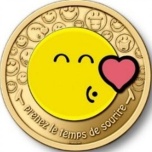
Metal: NordicGold
Weight: 15,80 g
Diameter: 34 mm
Mintage: 10 000
In 2022, Smiley celebrates its fifth decade of smiles and optimism.
The emblematic yellow, round face of the brand was born on 1st, January 1972 in France, when journalist Franklin Loufrani used this infectious smile in the newspaper France-soir in order to highlight stories which brought positive news and cheered up French people’s spirit. This operation, called « Take the time to smile » was an immediate success.
In 1996, the logo is relaunched and developed in other forms : a new 3D version is created and new expressions are added in. Nowadays, from the smiley to the emoticon, smiling takes multiple forms, becoming a representative of cheerfulness !
Since the creation of the yellow smile in 1972, Smiley diversified the range of its expressions, conveying over a hundred émotions. From the smiley to the emoticon, smiling takes multiple forms.
Each mini-medal highlights a particular emotion : love, gratitude, gluttony, joy and laughing.
The medals are packaged in a coloured packaging, to treat to someone or to yourself.
Weight: 15,80 g
Diameter: 34 mm
Mintage: 10 000
In 2022, Smiley celebrates its fifth decade of smiles and optimism.
The emblematic yellow, round face of the brand was born on 1st, January 1972 in France, when journalist Franklin Loufrani used this infectious smile in the newspaper France-soir in order to highlight stories which brought positive news and cheered up French people’s spirit. This operation, called « Take the time to smile » was an immediate success.
In 1996, the logo is relaunched and developed in other forms : a new 3D version is created and new expressions are added in. Nowadays, from the smiley to the emoticon, smiling takes multiple forms, becoming a representative of cheerfulness !
Since the creation of the yellow smile in 1972, Smiley diversified the range of its expressions, conveying over a hundred émotions. From the smiley to the emoticon, smiling takes multiple forms.
Each mini-medal highlights a particular emotion : love, gratitude, gluttony, joy and laughing.
The medals are packaged in a coloured packaging, to treat to someone or to yourself.
9,90 €
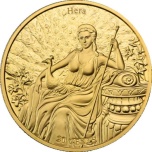
Face value: 0.2 $
Issuing country: Samoa
Weight: 25 g
Diameter: 40 mm
Hera is described as taking the sign of Aquarius due to her opposition to her husband , which I take both literally meaning their personalities as well as the simple fact that the two signs are opposite in the Zodiac. Leo and Aquarius are the signs most associated with humanitarian traits: Leo is the leader, the king, while Aquarius is associated with intellectual drives and understanding. As represented by the King and Queen of the gods, both are necessary for society’s functioning, for stability and peace to prosper via righteousness and understanding. Both are also associated with personal pride, with Leo being the more emotional narcissism while Aquarius is a more detached vanity. Both are also associated with the natural forces of the sky: whereas Leo is the bright midday Sun, Aquarius is associated with clouds and mist. Fitting, thus, that Hera and Zeus are the gods that rule the heavens and Olympos, Zeus being the bright Aether and Hera the sky rains, both being the main agents of storms and of calm weather.
Issuing country: Samoa
Weight: 25 g
Diameter: 40 mm
Hera is described as taking the sign of Aquarius due to her opposition to her husband , which I take both literally meaning their personalities as well as the simple fact that the two signs are opposite in the Zodiac. Leo and Aquarius are the signs most associated with humanitarian traits: Leo is the leader, the king, while Aquarius is associated with intellectual drives and understanding. As represented by the King and Queen of the gods, both are necessary for society’s functioning, for stability and peace to prosper via righteousness and understanding. Both are also associated with personal pride, with Leo being the more emotional narcissism while Aquarius is a more detached vanity. Both are also associated with the natural forces of the sky: whereas Leo is the bright midday Sun, Aquarius is associated with clouds and mist. Fitting, thus, that Hera and Zeus are the gods that rule the heavens and Olympos, Zeus being the bright Aether and Hera the sky rains, both being the main agents of storms and of calm weather.
35,00 €
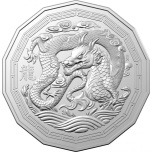
Face valie 0,5 AUD
Metal: copper/nickel
Weight: 15,37 g
Diameter: 31,51 mm
Mintage: unlimited
In 2024 we celebrate the Lunar of the Dragon. People who are born under this sign are said to be enthusiastic, confident and 'natural born leaders'. This 2024 50c Uncirculated Tetradecagon Coin, with it's traditional and auspicious design, will make an honored and traditional gift for Chinese New Year.
Metal: copper/nickel
Weight: 15,37 g
Diameter: 31,51 mm
Mintage: unlimited
In 2024 we celebrate the Lunar of the Dragon. People who are born under this sign are said to be enthusiastic, confident and 'natural born leaders'. This 2024 50c Uncirculated Tetradecagon Coin, with it's traditional and auspicious design, will make an honored and traditional gift for Chinese New Year.
29,00 €
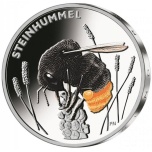
Materiall: CuNi
Weight: 9g
Diameter: 26,9 mm
Mintage: 100 000
The German government has decided to mint a €5 collectors’ coin entitled “Red mason bee”, to be issed at 7 September 2023. It is the fourth coin issued as part of the “Wonderful world of insects” series, which will see a total of nine coins with partially coloured motifs issued over the period 2022-24. The series is intended to bring into focus – especially in light of current developments (insect extinction) – a special group of animals that make up a significant part of our natural heritage.
The €5 collectors’ coin “Red-tailed bumblebee” is made of a cupronickel alloy. It weighs 9.68 g, measures 27.25 mm in diameter and will be available both in mint condition and with a proof-like finish. The mint condition coins will be brought into circulation at their face value (€5). The collector quality coins with a proof-like finish will be higher than their face value and will be issued by the Münze Deutschland (Germany’s official sales agency for collector coins).
The coin was designed by Patrick Niesel, an artist based in Röthenbach an der Pegnitz (picture side), and Andre Witting, a Berlin-based artist (reverse).
The reverse, which will be used for all coins in the series, features an eagle, the words “BUNDESREPUBLIK DEUTSCHLAND”, the value and denomination, the year 2024, the twelve stars of Europe and the letter “J” for the State Mint of Hamburg.
Its smooth edge is engraved with the inscription: “WUNDERWELT INSEKTEN” (WONDERFUL WORLD OF INSECTS).
Weight: 9g
Diameter: 26,9 mm
Mintage: 100 000
The German government has decided to mint a €5 collectors’ coin entitled “Red mason bee”, to be issed at 7 September 2023. It is the fourth coin issued as part of the “Wonderful world of insects” series, which will see a total of nine coins with partially coloured motifs issued over the period 2022-24. The series is intended to bring into focus – especially in light of current developments (insect extinction) – a special group of animals that make up a significant part of our natural heritage.
The €5 collectors’ coin “Red-tailed bumblebee” is made of a cupronickel alloy. It weighs 9.68 g, measures 27.25 mm in diameter and will be available both in mint condition and with a proof-like finish. The mint condition coins will be brought into circulation at their face value (€5). The collector quality coins with a proof-like finish will be higher than their face value and will be issued by the Münze Deutschland (Germany’s official sales agency for collector coins).
The coin was designed by Patrick Niesel, an artist based in Röthenbach an der Pegnitz (picture side), and Andre Witting, a Berlin-based artist (reverse).
The reverse, which will be used for all coins in the series, features an eagle, the words “BUNDESREPUBLIK DEUTSCHLAND”, the value and denomination, the year 2024, the twelve stars of Europe and the letter “J” for the State Mint of Hamburg.
Its smooth edge is engraved with the inscription: “WUNDERWELT INSEKTEN” (WONDERFUL WORLD OF INSECTS).
14,90 €