




The Twelve Olympians in the Zodiac - Hera & Aquarius Samoa 0.20 $ 2022 Gold plated Copper/Nickel coin
Price:
35,00 €
Face value: 0.2 $
Issuing country: Samoa
Weight: 25 g
Diameter: 40 mm
Hera is described as taking the sign of Aquarius due to her opposition to her husband , which I take both literally meaning their personalities as well as the simple fact that the two signs are opposite in the Zodiac. Leo and Aquarius are the signs most associated with humanitarian traits: Leo is the leader, the king, while Aquarius is associated with intellectual drives and understanding. As represented by the King and Queen of the gods, both are necessary for society’s functioning, for stability and peace to prosper via righteousness and understanding. Both are also associated with personal pride, with Leo being the more emotional narcissism while Aquarius is a more detached vanity. Both are also associated with the natural forces of the sky: whereas Leo is the bright midday Sun, Aquarius is associated with clouds and mist. Fitting, thus, that Hera and Zeus are the gods that rule the heavens and Olympos, Zeus being the bright Aether and Hera the sky rains, both being the main agents of storms and of calm weather.
Kollektsioon
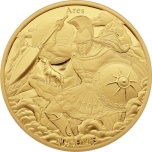
The Twelve Olympians in the Zodiac - Ares & Scorpio Samoa 0.20 $ 2021 Gold plated Copper/Nickel coin
Face value: 0.2 $
Issuing country: Samoa
Weight: 25 g
Diameter: 40 mm
Scorpio is the second Mars sign, and the one that most relates to Ares: while the fiery aspects of Aries might relate to him to some extent, it’s the more emotional Scorpio that resonates closer to him and his primal nature. As the later Autumn sign, Scorpio is related to Winter’s start, and thus to sunset-like conditions: as the Sun dims, so does life. Scorpio is defined by it’s loyalty bordering on possessiveness, as well as a rather strong impulsive nature but consciously made subtle or even outright hidden. Ares displays a surprising amount of loyalty to his family, even when most of Olympus doesn’t like him very much, and while numerous, his affairs are occult, unlike Zeus’ or Apollo’s. This reflects water as darkness: driven by strong impulses, but with the element of mystery and hidden nature. Due to Scorpio’s vindictiveness and hidden nature, it is often considered the most malign of the signs, just as Ares is the most distrusted of the Olympians, but neither are “evil” and while unpleasant they are necessary for the inner workings of nature. Darkness is after all important to health in it’s Melatonin friendliness, especially when it’s connected to water.
35,00 €

Face value: 0.2 $
Issuing country: Samoa
Weight: 25 g
Diameter: 40 mm
Artemis still remains intrinsic to the Sagittarius sign to this day: after all, who among the Olympians is the archer goddess, associated with the forests and the primeval might of the centaur? Like her brother Apollo, Artemis is a goddess of fiery arrows, illuminating the darkness and destroying those who offend her, and her role in this department might even be more relevant than her brother's. Sagittarius is also the first sign of the night as the beginning of the winter, relating to Artemis' intrinsic nature as a goddess of moonlight. The association of Sagittarius with Artemis also relates to her cult's rivalry with primitive Christianity: Sagittarius is the sign of truth and knowledge, and Artemis is the light bearer.
35,00 €
Face value: 0.2 $
Issuing country: Samoa
Weight: 25 g
Diameter: 40 mm
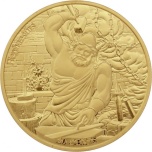
Hephaestus‘ correspondence with Libra is derived from his role as the smith god. By crafting fire, he made the weapons that the gods use to impose justice, down to the scales of Dike, the goddess of justice, often thought to be the woman depicted in the sign. As just, Hephaestus is a god of innovation, taming the chaos of the flames to produce items to impose civilization.
35,00 €
Face value: 0.2 $
Issuing country: Samoa
Weight: 25 g
Diameter: 40 mm
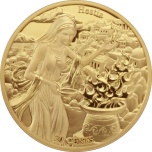
Hestia's main sign if Capricorn, which stresses her more subtle but relevant nature. Capricorn, like Sagittarius, also stresses order, stability and stoicness. More so, it takes theses traits further and is a sign associated with practicality, hard work, strong will and stubbornness. Hestia, as the perpetual tender of the flames, is definitely a very hard working and practical goddess, and while I by no means would refer to her as “stubborn”, she does have a strong will in what little myths she appears in. Capricorn is also relevant in it’s role in the Zodiac. It’s the sign that covers the Winter Solstice, when the Sun is at it’s lowest, being opposite to Cancer. Thus, not only does it coincide with the time of the year where Hestia’s influence is most important, as well as to her role as the center, it also coincides with a liminal time in the Zodiac, when the Sun is reborn.
35,00 €

Face value: 0.2 $
Issuing country: Samoa
Weight: 25 g
Diameter: 40 mm
Poseidon, as the god of water and of the sea, is the lord of sea creatures, so the sign of the pair of fish is more than appropriate. Pisces, however, also dives deeper in Poseidon’s realm. For starters, it is associated with the feet, and Poseidon is also a god of the earth, of tremors and geological processes, closely tied to water eroding rocks. The sea is also considered to be where the pillars of the universe are located in most western Eurasian religions, and in Greek thought Poseidon’s realm extends even to the Underworld, where the four rivers run, a connection particularly important in the more chthonic versions of Hellenic religion. If Cancer is the Moon and it’s spiritual essence while Scorpio is blood and the impulses, with Aquarius also representing sky waters, Pisces is simply the pure nature of water as an element, symbolizing the immensity of the seas and the many freshwater bodies. It’s the sign of mutability and change, resonating with water’s classical attribute as well as the very real quick and natural changes into ice, liquid, gas or cloud and also the currents. It also symbolizes Spring waters, be them from rains or melting snow and ice, feeding the fields and civilization, acting as water changing the surrounding environment.
35,00 €
Similar products
Face value: 5 €
Diameter: 34 mm
Weight: 19.1 g
Metal: Brass
Mintage: 45,000
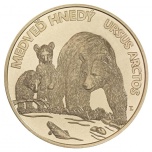
The obverse of this euro collector coin is dominated by the head of a brown bear in profile. Centrally positioned above the head is the Slovak coat of arms. The denomination and currency ‘5 EURO’ appear along the lower left edge. Inscribed along the upper edge are the name of the issuing country and the year of issuance: ‘SLOVENSKO 2023’. At the right edge is the mint mark of the Kremnica Mint (Mincovňa Kremnica), consisting of the letters ‘MK’ placed between two dies.
Reverse:
On the reverse is a depiction of a female bear and her two cubs hunting fish. Inscribed along the upper edge are the Slovak name for the brown bear ‘MEDVEĎ HNEDÝ’ and the animal’s scientific name ‘URSUS ARCTOS’. At the lower right edge are the stylised initials ‘TL’, referring to the coin’s designer Tomáš Lamač.
The brown bear is Slovakia’s largest predator. It has a stocky body, small eyes and ears, a short tail, pronounced claws, and thick fur that is 8 to 12 cm long and comes in a wide range of shades from light brown to almost black. The adult male can weigh up to 350 kg. Brown bears in Slovakia are concentrated in the central, northern and north-eastern mountain areas. The brown bear is an omnivore that prefers to live in mixed and coniferous forests. Its diet is 90% vegetable matter with the remaining 10% consisting of carrion, smaller animals, insects and, occasionally, sick or injured hooved game. Bears hibernate in dens from around early November to April. Female bears and their cubs are the first to enter the dens and the last to emerge from them. Male bears seek out females only during the mating season, usually from the end of April to the beginning of August. The cubs are born during January and February in the safety of the winter den. At birth they are blind, have short fur and weigh less than 500 g. Bears in the wild can live to be more than 30 years old.
14,90 €

Issuing Country: France
Face value: 5 €
Metal: Copper/Nickel
Diameter: 29 mm
Quality: B.U.
Mintage: 25 000
The wheel of the zodiac signs is engraved on the coin's gold-colored crown. One sign stands out from the background because it is larger than the others and has a sandblasted background, different from the smoother one of the others. It is the Lion symbol. Part of the wheel is hidden by flames, a reminder of the element of the Leo sign, fire. The circular space is dominated by the bust of a Lion with a masterly mane, a sun on his forehead and a noble gaze. The background features a starry sky with the constellation Leo.
20,00 €
Denomination: 0,25 €
Alloy: Cupro-nickel Nordicgold
Weight: 15,8 g
Diameter: 34 mm
Quality Brilliant Uncirculated
Year: 2026
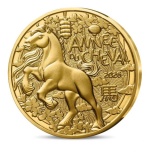
Surrounded by plum blossom, a symbol much used in Chinese history and art, and lanterns, the horse is depicted in a joyful, childlike manner. The inscription ‘Year of the Horse’ followed by the year 2026 appears in the centre of the coin. The ideogram of the horse appears at the bottom right of the coin. On the reverse, all the animals of the Chinese zodiac are drawn in a childlike way around the Ying and Yang symbol. A complete cycle of the Chinese zodiac begins in 2018 and lasts until 2029. Each of the twelve years in this period is represented by one of the zodiac animals. The face value is visible in the centre of the denomination and the wording ‘RF’.
9,90 €
Face Value: 3 Euro
Quality: B.U,
Diameter: 34 mm
Metal: Copper/nickel
Weight: 16 g
Mintage: 65 000
Comes without packaging
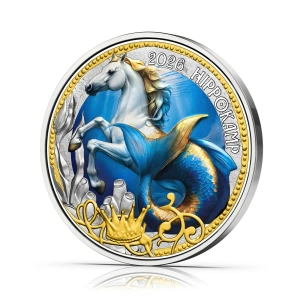
The Mythical Creatures series continues its journey into the world of legends with the 3-euro Hippocampus coin. The hippocampus is an ancient hybrid creature, part horse and part fish, which, according to mythology, pulled the chariot of Poseidon, god of the sea. Its name is derived from the Greek words for horse (hippos) and sea monster (kampos). On the colour-printed coin, a white horse with a shimmering fish tail rears up, surrounded by seaweed and coral. Under UV light, the motif appears to come to life. The obverse shows an ornately decorated key with the letter F for mythical creature and a stylised sun.
39,00 €
Face Value: 3 Euro
Quality: B.U,
Diameter: 34 mm
Metal: Copper/nickel
Weight: 16 g
Mintage: 65 000
Comes without packaging
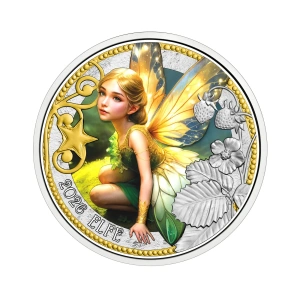
A fleeting being flits through the air, an exquisitely delicate creature. But then it alights for a moment. And allows itself to be admired. – The coin allows you to become closely acquainted with a lovable elf.
The third coin in the ‘Magical and Mythical Creatures’ series depicts a colourful elf with butterfly wings. – Especially when ultraviolet light sweeps across her, she seems to come alive. – “Elves remind us that there’s more than we see with the naked eye alone. There’s the wood elf, the wind elf, the sun elf, the moon elf – and then there’s your elf.” (Thomas Brezina)
Elven Myths
Depending on which myth and which era we look at, a different image of elves prevails. The terms ‘elf’ and ‘fairy’ are often used interchangeably in everyday language today, but they have different mythological origins.
Elves come from Norse and Celtic mythology. They played an important role in medieval superstition. Elves were also frequently equated or confused with dwarves or demons.
In 19th-century children’s books, a friendlier image of elves began to take hold. It became common to imagine elves as small magical beings that live among flowers and flit about in nature.
In Iceland they are actually invisible. The so-called huldufólk – or the hidden people – are firmly rooted in local folklore. In legends and fairy tales, they populate wild and untouched nature. Nowadays, very few people in Iceland believe in elves in the literal sense. But for the vast majority, they certainly have significance as part of the cultural heritage. Today, a belief in elves primarily expresses appreciation for an ancient storytelling tradition and a close connection with nature. In Icelandic planning approval procedures, one aspect considered alongside others is whether a project would cause damage to cultural heritage. This includes features of the landscape such as large stones or rocks, which are regarded in Icelandic folklore as being inhabited by elves.
Coin motif
A winged elf in a little greenish dress has alighted on the coin. To her right, strawberries together with their blossoms and leaves can be seen in the foreground. To the left, an ornament printed in gold and a star are visible. A band around the edge, also printed in gold, is interrupted in places by the relief. – The colours of the mythical creature and the inscription ‘ELFE’ change in ultraviolet light, enhancing the magical effect of the motif.
The obverse features an intricately decorated key with the letter ‘F’ – ‘F’ as in fairy tale. In the background, a sun is depicted in the style of a silhouette, recessed into a circular relief with a subtle texture. The stars sparkling at the edge and all around, as well as the irregularly shaped letters, create a magical effect.
39,00 €