


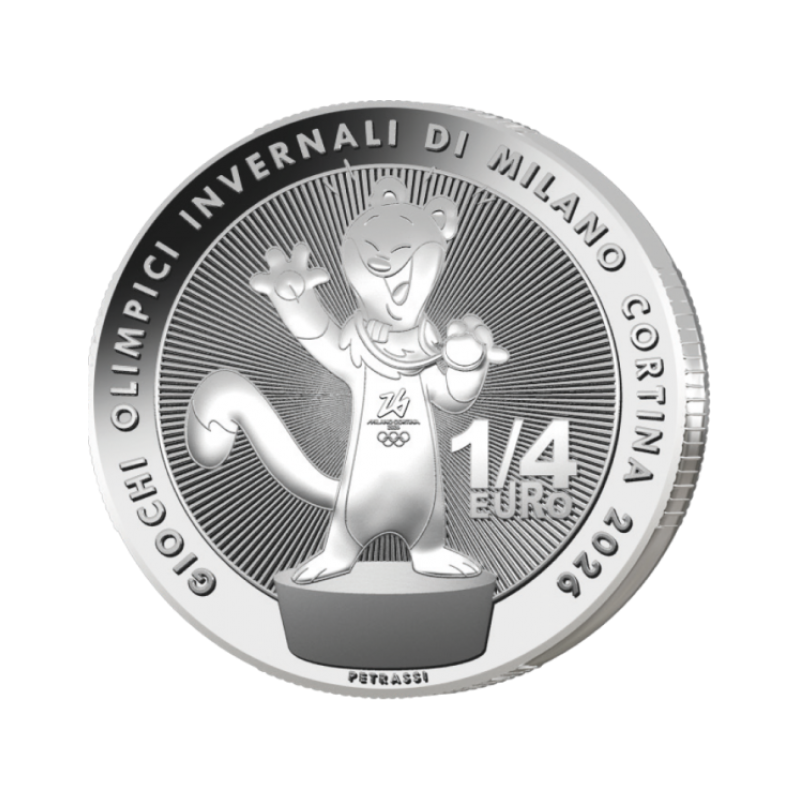

"Milano Cortina 2026 Winter Olympic Games - Mascot Tina . Italy 1/4 € base metal coin
Price:
8,00 €
Materiall: CuNi
Weight: 7 g
Diameter: 22,25 mm
Mintage:
An extraordinary collection accompanies the approach to the Olympic and Paralympic Winter Games of Milan Cortina 2026 and celebrates its spirit through its most iconic symbols: the logo of the event, the journey of the flame, the mascot and the winter disciplines associated with the host locations. Each coin in the collection is a tribute to the magic of sport and to Italy.
Obverse: In the centre, the official logo of the Milano Cortina 2026 Winter Olympic Games. Arch-shaped, the inscription "Repubblica Italiana". In the right field, the "R", identifying the Mint of Rome and "2025", the year of the coin’s issue.
Reverse: In the centre, Tina, official mascot of the Olympic Games, standing on a podium while celebrating the victory of the medal. Arch-shaped, the inscription “GIOCHI OLIMPICI INVERNALI DI MILANO CORTINA 2026”; bottom right “1/4 EURO”, the coin’s value. Below “PETRASSI”, signature of the designer. In the background a sunburst decoration.
Weight: 7 g
Diameter: 22,25 mm
Mintage:
An extraordinary collection accompanies the approach to the Olympic and Paralympic Winter Games of Milan Cortina 2026 and celebrates its spirit through its most iconic symbols: the logo of the event, the journey of the flame, the mascot and the winter disciplines associated with the host locations. Each coin in the collection is a tribute to the magic of sport and to Italy.
Obverse: In the centre, the official logo of the Milano Cortina 2026 Winter Olympic Games. Arch-shaped, the inscription "Repubblica Italiana". In the right field, the "R", identifying the Mint of Rome and "2025", the year of the coin’s issue.
Reverse: In the centre, Tina, official mascot of the Olympic Games, standing on a podium while celebrating the victory of the medal. Arch-shaped, the inscription “GIOCHI OLIMPICI INVERNALI DI MILANO CORTINA 2026”; bottom right “1/4 EURO”, the coin’s value. Below “PETRASSI”, signature of the designer. In the background a sunburst decoration.
Kollektsioon
Materiall: CuNi
Weight: 7 g
Diameter: 22,25 mm
Mintage:
An extraordinary collection accompanies the approach to the Olympic and Paralympic Winter Games of Milan Cortina 2026 and celebrates its spirit through its most iconic symbols: the logo of the event, the journey of the flame, the mascot and the winter disciplines associated with the host locations. Each coin in the collection is a tribute to the magic of sport and to Italy.
Obverse: In the centre, the official logo of the Milano Cortina 2026 Winter Olympic Games. Arch-shaped, the inscription “Repubblica Italiana”. In the right field, the “R”, identifying the Mint of Rome and “2025”, the year of the coin’s issue.
Reverse: In the centre, a stylised frontal perspective of the Milan Cathedral. Arch-shaped the inscription “MILANO CORTINA 2026 WINTER OLYMPIC GAMES”; On the left “A.VECCHIO,” signature of the designer Antonio Vecchio; at the bottom centre “1/4 EURO”, coin’s value.
Weight: 7 g
Diameter: 22,25 mm
Mintage:
An extraordinary collection accompanies the approach to the Olympic and Paralympic Winter Games of Milan Cortina 2026 and celebrates its spirit through its most iconic symbols: the logo of the event, the journey of the flame, the mascot and the winter disciplines associated with the host locations. Each coin in the collection is a tribute to the magic of sport and to Italy.
Obverse: In the centre, the official logo of the Milano Cortina 2026 Winter Olympic Games. Arch-shaped, the inscription “Repubblica Italiana”. In the right field, the “R”, identifying the Mint of Rome and “2025”, the year of the coin’s issue.
Reverse: In the centre, a stylised frontal perspective of the Milan Cathedral. Arch-shaped the inscription “MILANO CORTINA 2026 WINTER OLYMPIC GAMES”; On the left “A.VECCHIO,” signature of the designer Antonio Vecchio; at the bottom centre “1/4 EURO”, coin’s value.
8,00 €
Materiall: CuNi
Weight: 7 g
Diameter: 22,25 mm
Mintage:
An extraordinary collection accompanies the approach to the Olympic and Paralympic Winter Games of Milan Cortina 2026 and celebrates its spirit through its most iconic symbols: the logo of the event, the journey of the flame, the mascot and the winter disciplines associated with the host locations. Each coin in the collection is a tribute to the magic of sport and to Italy.
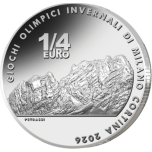
Obverse: In the centre, the official logo of the Milano Cortina 2026 Winter Olympic Games. Arch-shaped, the inscription “Repubblica Italiana”. In the right field, the “R”, identifying the Mint of Rome and “2025”, the year of the coin’s issue.
Reverse: In the centre, a stylised frontal perspective of the Milan Cathedral. Arch-shaped the inscription “MILANO CORTINA 2026 WINTER OLYMPIC GAMES”; On the left “A.VECCHIO,” signature of the designer Antonio Vecchio; at the bottom centre “1/4 EURO”, coin’s value.
Weight: 7 g
Diameter: 22,25 mm
Mintage:
An extraordinary collection accompanies the approach to the Olympic and Paralympic Winter Games of Milan Cortina 2026 and celebrates its spirit through its most iconic symbols: the logo of the event, the journey of the flame, the mascot and the winter disciplines associated with the host locations. Each coin in the collection is a tribute to the magic of sport and to Italy.
Obverse: In the centre, the official logo of the Milano Cortina 2026 Winter Olympic Games. Arch-shaped, the inscription “Repubblica Italiana”. In the right field, the “R”, identifying the Mint of Rome and “2025”, the year of the coin’s issue.
Reverse: In the centre, a stylised frontal perspective of the Milan Cathedral. Arch-shaped the inscription “MILANO CORTINA 2026 WINTER OLYMPIC GAMES”; On the left “A.VECCHIO,” signature of the designer Antonio Vecchio; at the bottom centre “1/4 EURO”, coin’s value.
8,00 €
Similar products
Face value: 0.2 $
Issuing country: Samoa
Weight: 25 g
Diameter: 40 mm
Mintage: 3000
Issuing country: Samoa
Weight: 25 g
Diameter: 40 mm
Mintage: 3000
35,00 €
Face value: 5 €
Diameter: 34 mm
Weight: 19.1 g
Metal: Brass
Mintage: 35,000
3. coin from the series “Fauna and Flora of Slovakia”.
Obverse:
The obverse of this euro collector coin shows a Tatra chamois standing on a rock on which several edelweiss flowers, protected under Slovak law, are growing. The name of the issuing country ‘SLOVENSKO’ appears in the lower right of the design, above the Slovak coat of arms and, to the right of it, the year of issuance ‘2022’. The denomination and currency ‘5 euro’ are inscribed in the upper part. Next to the left edge are the mint mark of the Kremnica Mint (Mincovňa Kremnica), consisting of the letters ‘MK’ placed between two dies, and the stylised letters ‘KL’, referring to the coin’s designer Karol Ličko.
Reverse:
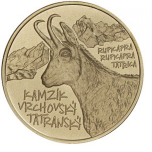
The reverse features the head and upper body of a Tatra chamois, with the head bisecting the background depiction of a rocky mountain range. The Slovak and scientific names of the chamois are each inscribed on three lines, with ‘KAMZÍK VRCHOVSKÝ TATRANSKÝ’ appearing to the left of the chamois and ‘RUPICAPRA RUPICAPRA TATRICA’ to the right.
Just as the Tatras are a symbol of Slovakia, so the chamois is a symbol of the Tatras. The Tatra mountain ranges are among the world’s smallest alpine ranges and are evidently suitable places for a creature as remarkable as the chamois to live in safety. It is not by chance that the Tatra national parks of both Slovakia and Poland feature the chamois in their logos. The Tatras’ deep valleys, rocky ridges, sharp peaks and mountain lakes have been the cradle and grave of chamois for millennia. The Tatra chamois is one of a few living links to the last ice age, its population being what experts call a ‘glacial relict’. The chamois live in herds with a social way of life. Some herds comprise more than 50 individuals. The total population of chamois on the Slovak and Polish sides of the Tatras currently numbers around 1,400. The Tatra chamois, or Rupicapra rupicapra tatrica, was classified as a separate subspecies in 1971 (by Milič Blahout). In Slovakia, pure Tatra chamois are found only in the High Tatras, Western Tatras and Belianske Tatras. The chamois are a cultural treasure, a symbol of both the Tatras and Slovakia as a whole. It is of the utmost importance to keep their Tatra habitats as undisturbed as possible and to behave responsibly and respectfully when present there.
Diameter: 34 mm
Weight: 19.1 g
Metal: Brass
Mintage: 35,000
3. coin from the series “Fauna and Flora of Slovakia”.
Obverse:
The obverse of this euro collector coin shows a Tatra chamois standing on a rock on which several edelweiss flowers, protected under Slovak law, are growing. The name of the issuing country ‘SLOVENSKO’ appears in the lower right of the design, above the Slovak coat of arms and, to the right of it, the year of issuance ‘2022’. The denomination and currency ‘5 euro’ are inscribed in the upper part. Next to the left edge are the mint mark of the Kremnica Mint (Mincovňa Kremnica), consisting of the letters ‘MK’ placed between two dies, and the stylised letters ‘KL’, referring to the coin’s designer Karol Ličko.
Reverse:
The reverse features the head and upper body of a Tatra chamois, with the head bisecting the background depiction of a rocky mountain range. The Slovak and scientific names of the chamois are each inscribed on three lines, with ‘KAMZÍK VRCHOVSKÝ TATRANSKÝ’ appearing to the left of the chamois and ‘RUPICAPRA RUPICAPRA TATRICA’ to the right.
Just as the Tatras are a symbol of Slovakia, so the chamois is a symbol of the Tatras. The Tatra mountain ranges are among the world’s smallest alpine ranges and are evidently suitable places for a creature as remarkable as the chamois to live in safety. It is not by chance that the Tatra national parks of both Slovakia and Poland feature the chamois in their logos. The Tatras’ deep valleys, rocky ridges, sharp peaks and mountain lakes have been the cradle and grave of chamois for millennia. The Tatra chamois is one of a few living links to the last ice age, its population being what experts call a ‘glacial relict’. The chamois live in herds with a social way of life. Some herds comprise more than 50 individuals. The total population of chamois on the Slovak and Polish sides of the Tatras currently numbers around 1,400. The Tatra chamois, or Rupicapra rupicapra tatrica, was classified as a separate subspecies in 1971 (by Milič Blahout). In Slovakia, pure Tatra chamois are found only in the High Tatras, Western Tatras and Belianske Tatras. The chamois are a cultural treasure, a symbol of both the Tatras and Slovakia as a whole. It is of the utmost importance to keep their Tatra habitats as undisturbed as possible and to behave responsibly and respectfully when present there.
14,90 €
Quality: Special Uncirculated
Face Value: 5 Euro
Diameter: 28,5 mm
Copper: 99,9%
Total Weight: 8,5 g
Comes without packaging
Few animals have had a bigger impact on humans than the horse. Its power, beauty and sensitivity make the horse one of the most beloved members of the animal kingdom, not least among young female riders, many of whom form a profound and enduring bond with their loyal steed. The Easter Coin 2020 celebrates this unique bond.
From being the subject of countless prehistoric cave paintings, to the leading form of human transport for more than five millennia, the horse has played an unparalleled role in the development of society. The most iconic of all European horse breeds is the Lipizzaner, made world famous through its connection with the Spanish Riding School in Vienna. Originally from Slovenia, the Lipizzaner has been bred since 1920 at the stud farm at Piber in the Austrian province of Styria, where some 40 foals come into the world every year. Within minutes of their birth, new born foals can stand and, though initially unsteady, are soon galloping joyfully across the alpine meadows.
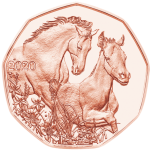
The coin features a foal in the foreground frolicking happily through a meadow while its mother keeps a watchful eye close behind. The lower part of the coin is decorated with an assortment of spring flowers.
Face Value: 5 Euro
Diameter: 28,5 mm
Copper: 99,9%
Total Weight: 8,5 g
Comes without packaging
Few animals have had a bigger impact on humans than the horse. Its power, beauty and sensitivity make the horse one of the most beloved members of the animal kingdom, not least among young female riders, many of whom form a profound and enduring bond with their loyal steed. The Easter Coin 2020 celebrates this unique bond.
From being the subject of countless prehistoric cave paintings, to the leading form of human transport for more than five millennia, the horse has played an unparalleled role in the development of society. The most iconic of all European horse breeds is the Lipizzaner, made world famous through its connection with the Spanish Riding School in Vienna. Originally from Slovenia, the Lipizzaner has been bred since 1920 at the stud farm at Piber in the Austrian province of Styria, where some 40 foals come into the world every year. Within minutes of their birth, new born foals can stand and, though initially unsteady, are soon galloping joyfully across the alpine meadows.
The coin features a foal in the foreground frolicking happily through a meadow while its mother keeps a watchful eye close behind. The lower part of the coin is decorated with an assortment of spring flowers.
15,00 €
Face value: 5 €
Diameter: 34 mm
Weight: 19.1 g
Metal: Brass
Mintage: 40,000
The black stork is an unmistakable bird species. The adult has mainly black plumage with white underparts, long coral red legs and a long pointed beak. The beak and eye areas are the same colour as the legs, and the black plumage has an intense greenish-purple sheen. Adults weigh between around 2.4 kg and 3.2 kg. Black storks are distributed throughout most of Europe and Asia, and most forest areas of Slovakia are nesting sites for these birds. They typically nest in mature deciduous and mixed forests, preferring areas with wetlands and watercourses where they can forage for food. They select large trees with strong horizontal branches and show high fidelity to breeding sites and nesting trees. The base of the nest is formed by thick branches, while the interior is lined with twigs, clumps of grass, lichens and moss. The female lays two to four eggs. Both parents feed the fledglings by regurgitating food onto the nest floor. Black storks feed on smaller fish, amphibians, insects, gastropods, small mammals and small birds. They migrate to wintering grounds mainly in August and September. In Slovakia, the black stork is a protected species.
Obverse:
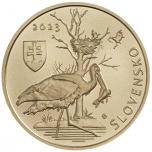
The obverse of the euro collector coin depicts a black stork hunting on a body of water. In the background is a tree with a stork’s nest. An adult stork is depicted flying towards a chick in the nest, carrying food in its beak. On the upper left side is the Slovak coat of arms and, above it, the year of issuance ‘2023’. On the right side is the mint mark of the Kremnica Mint (Mincovňa Kremnica), consisting of the letters ‘MK’ placed between two dies. Inscribed along part of the right edge is the name of the issuing country ‘SLOVENSKO’.
Reverse:
The reverse design depicts a black stork taking flight. To the right of this image are the denomination ‘5’ and currency ‘EURO’, one above the other. In the lower part of the design, next to the stork’s legs, are the stylised initials ‘MŠ’, referring to the coin’s designer Marie Šeborová. Inscribed along the lower edge and separated by a medial dot are the Slovak and scientific names for the black stork: ‘BOCIAN ČIERNY’ and ‘CICONIA NIGRA’.
Diameter: 34 mm
Weight: 19.1 g
Metal: Brass
Mintage: 40,000
The black stork is an unmistakable bird species. The adult has mainly black plumage with white underparts, long coral red legs and a long pointed beak. The beak and eye areas are the same colour as the legs, and the black plumage has an intense greenish-purple sheen. Adults weigh between around 2.4 kg and 3.2 kg. Black storks are distributed throughout most of Europe and Asia, and most forest areas of Slovakia are nesting sites for these birds. They typically nest in mature deciduous and mixed forests, preferring areas with wetlands and watercourses where they can forage for food. They select large trees with strong horizontal branches and show high fidelity to breeding sites and nesting trees. The base of the nest is formed by thick branches, while the interior is lined with twigs, clumps of grass, lichens and moss. The female lays two to four eggs. Both parents feed the fledglings by regurgitating food onto the nest floor. Black storks feed on smaller fish, amphibians, insects, gastropods, small mammals and small birds. They migrate to wintering grounds mainly in August and September. In Slovakia, the black stork is a protected species.
Obverse:
The obverse of the euro collector coin depicts a black stork hunting on a body of water. In the background is a tree with a stork’s nest. An adult stork is depicted flying towards a chick in the nest, carrying food in its beak. On the upper left side is the Slovak coat of arms and, above it, the year of issuance ‘2023’. On the right side is the mint mark of the Kremnica Mint (Mincovňa Kremnica), consisting of the letters ‘MK’ placed between two dies. Inscribed along part of the right edge is the name of the issuing country ‘SLOVENSKO’.
Reverse:
The reverse design depicts a black stork taking flight. To the right of this image are the denomination ‘5’ and currency ‘EURO’, one above the other. In the lower part of the design, next to the stork’s legs, are the stylised initials ‘MŠ’, referring to the coin’s designer Marie Šeborová. Inscribed along the lower edge and separated by a medial dot are the Slovak and scientific names for the black stork: ‘BOCIAN ČIERNY’ and ‘CICONIA NIGRA’.
14,90 €
Denomination: 0,25 €
Alloy: Cupro-nickel Nordicgold
Weight: 15,8 g
Diameter: 34 mm
Quality Brilliant Uncirculated
Year: 2025
In Chinese culture, the snake is the most enigmatic animal of the zodiac.
Natives of the Snake sign are rather secretive and cautious. They are renowned for their wise and calm nature.
According to legend, during the race to select the animals of the zodiac, the cunning serpent secretly slipped onto the horse's hoof and took sixth place. This story reflects his strategic intelligence.
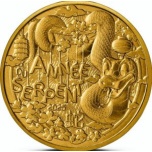
Surrounded by plum blossom, a popular symbol in Chinese history, art, and lanterns, the snake depiction appeals to children. The inscription 'Year of the snake’ and the yeardate appear at the center of the coin. The ideogram of the snake appears below.
On the reverse side, all the animals of the Chinese zodiac are drawn in a cartoon-like way around the Ying and Yang symbol. A complete cycle of the Chinese zodiac will be composed from 2018 to 2029. Each of these twelve years features an animal from this calendar. The face value is visible in the center of the coin as well as the symbol "RF".
Alloy: Cupro-nickel Nordicgold
Weight: 15,8 g
Diameter: 34 mm
Quality Brilliant Uncirculated
Year: 2025
In Chinese culture, the snake is the most enigmatic animal of the zodiac.
Natives of the Snake sign are rather secretive and cautious. They are renowned for their wise and calm nature.
According to legend, during the race to select the animals of the zodiac, the cunning serpent secretly slipped onto the horse's hoof and took sixth place. This story reflects his strategic intelligence.
Surrounded by plum blossom, a popular symbol in Chinese history, art, and lanterns, the snake depiction appeals to children. The inscription 'Year of the snake’ and the yeardate appear at the center of the coin. The ideogram of the snake appears below.
On the reverse side, all the animals of the Chinese zodiac are drawn in a cartoon-like way around the Ying and Yang symbol. A complete cycle of the Chinese zodiac will be composed from 2018 to 2029. Each of these twelve years features an animal from this calendar. The face value is visible in the center of the coin as well as the symbol "RF".
9,90 €