




UNESCO - NOTRE-DAME CATHEDRAL OF PARIS, BANKS OF THE SEINE France 1/4€ 2025 BU Coin in blister
Price:
15,00 €
Denomination: 1/4 €
Alloy: Common metal
Weight: 15,8 g
Diameter: 34 mm
Quality BU
Year: 2025
Notre-Dame Cathedral in Paris is a Gothic cathedral in the heart of the French capital, on the Île de la Cité. Built in the 12th century, its stained glass windows, gargoyles and flying buttresses have inspired many literary works such as Victor Hugo's novel. In April 2019, a violent fire ravaged a significant part of its structure, including its spire and roof. Restoration work then quickly began, in order to rebuild the monument identically.
On the front, in the foreground, a stonemason from the medieval period symbolizing the craftsmen who built the cathedral. In the background, the left part of the cathedral in detailed view and the right part, as well as the spire, in schematic outline of the structure to evoke its construction/reconstruction.
The reverse is common to all coins in the UNESCO series of this year 2025. It represents the terrestrial globe with the parallels and meridians on the left side and the inscriptions of major sites classified as UNESCO World Heritage on the right side. These inscriptions are as if engraved in stone, which echoes the Rosetta Stone. The left side of the globe is surrounded by the UNESCO logo as well as the marking "World Heritage". The face value is inscribed on the left side of the globe, blending perfectly with the parallels and meridians.
Alloy: Common metal
Weight: 15,8 g
Diameter: 34 mm
Quality BU
Year: 2025
Notre-Dame Cathedral in Paris is a Gothic cathedral in the heart of the French capital, on the Île de la Cité. Built in the 12th century, its stained glass windows, gargoyles and flying buttresses have inspired many literary works such as Victor Hugo's novel. In April 2019, a violent fire ravaged a significant part of its structure, including its spire and roof. Restoration work then quickly began, in order to rebuild the monument identically.
On the front, in the foreground, a stonemason from the medieval period symbolizing the craftsmen who built the cathedral. In the background, the left part of the cathedral in detailed view and the right part, as well as the spire, in schematic outline of the structure to evoke its construction/reconstruction.
The reverse is common to all coins in the UNESCO series of this year 2025. It represents the terrestrial globe with the parallels and meridians on the left side and the inscriptions of major sites classified as UNESCO World Heritage on the right side. These inscriptions are as if engraved in stone, which echoes the Rosetta Stone. The left side of the globe is surrounded by the UNESCO logo as well as the marking "World Heritage". The face value is inscribed on the left side of the globe, blending perfectly with the parallels and meridians.
Similar products
Issuing Country: France
Face value: 5 €
Metal: Copper/Nickel
Diameter: 29 mm
Quality: B.U.
Mintage: 25 000
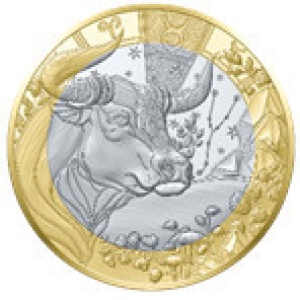
The wheel of the zodiac signs is engraved on the coin's gold-colored crown. One sign stands out from the background because it is larger than the others and has a sandblasted background, different from the smoother one of the others. It is the symbol of the Taurus. A pattern of leaves, mushrooms and crystals, reminiscent of the sign's element, earth, surrounds the imposing bust of a bull. The animal's horns and forehead are adorned with arabesques. The starry sky in the background features the Taurus constellation.
Face value: 5 €
Metal: Copper/Nickel
Diameter: 29 mm
Quality: B.U.
Mintage: 25 000
The wheel of the zodiac signs is engraved on the coin's gold-colored crown. One sign stands out from the background because it is larger than the others and has a sandblasted background, different from the smoother one of the others. It is the symbol of the Taurus. A pattern of leaves, mushrooms and crystals, reminiscent of the sign's element, earth, surrounds the imposing bust of a bull. The animal's horns and forehead are adorned with arabesques. The starry sky in the background features the Taurus constellation.
20,00 €
Face value: Samoa 0,25$
Weight: 40gr
Diameter: 40 mm
Mintage: 6666
Proof copper coin with partial gold plating
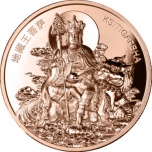
In East Asian Buddhism, the Twelve Heavenly Generals or Twelve Divine Generals are the protective deities.
Weight: 40gr
Diameter: 40 mm
Mintage: 6666
Proof copper coin with partial gold plating
In East Asian Buddhism, the Twelve Heavenly Generals or Twelve Divine Generals are the protective deities.
39,00 €
Materiall: CuNi
Weight: 7 g
Diameter: 22,25 mm
Mintage:
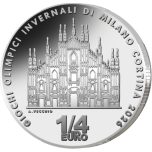
An extraordinary collection accompanies the approach to the Olympic and Paralympic Winter Games of Milan Cortina 2026 and celebrates its spirit through its most iconic symbols: the logo of the event, the journey of the flame, the mascot and the winter disciplines associated with the host locations. Each coin in the collection is a tribute to the magic of sport and to Italy.
Obverse: In the centre, the official logo of the Milano Cortina 2026 Winter Olympic Games. Arch-shaped, the inscription “Repubblica Italiana”. In the right field, the “R”, identifying the Mint of Rome and “2025”, the year of the coin’s issue.
Reverse: In the centre, a stylised frontal perspective of the Milan Cathedral. Arch-shaped the inscription “MILANO CORTINA 2026 WINTER OLYMPIC GAMES”; On the left “A.VECCHIO,” signature of the designer Antonio Vecchio; at the bottom centre “1/4 EURO”, coin’s value.
Weight: 7 g
Diameter: 22,25 mm
Mintage:
An extraordinary collection accompanies the approach to the Olympic and Paralympic Winter Games of Milan Cortina 2026 and celebrates its spirit through its most iconic symbols: the logo of the event, the journey of the flame, the mascot and the winter disciplines associated with the host locations. Each coin in the collection is a tribute to the magic of sport and to Italy.
Obverse: In the centre, the official logo of the Milano Cortina 2026 Winter Olympic Games. Arch-shaped, the inscription “Repubblica Italiana”. In the right field, the “R”, identifying the Mint of Rome and “2025”, the year of the coin’s issue.
Reverse: In the centre, a stylised frontal perspective of the Milan Cathedral. Arch-shaped the inscription “MILANO CORTINA 2026 WINTER OLYMPIC GAMES”; On the left “A.VECCHIO,” signature of the designer Antonio Vecchio; at the bottom centre “1/4 EURO”, coin’s value.
8,00 €
Face value: 5 €
Diameter: 34 mm
Weight: 19.1 g
Metal: Brass
Mintage: 55,000
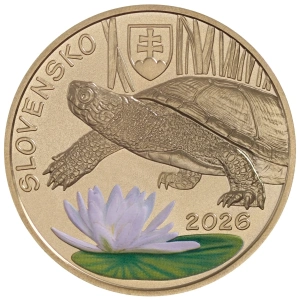
The European pond turtle (Emys orbicularis) is an aquatic turtle species. Native to Slovakia, the pond turtle was once widespread throughout the south of the country, but today its strongest populations are found in the Eastern Slovak Lowland and the Danubian Lowland. It is a protected reptile species that can live for more than 100 years. The pond turtle inhabits still or slowly flowing waters with muddy bottoms and rich vegetation, such as oxbow lakes, canals, ponds, lakes, and marshes. It is an excellent swimmer and diver and often basks in the sun on banks, tree trunks, or stones. Sandy areas are essential for egg laying. After overwintering, the hatchlings dig their way out and move to the water. Adults hibernate underwater, buried in mud. The pond turtle’s diet consists mainly of aquatic invertebrates, but it also feeds on frogs, tadpoles, fish, algae, and plants. Appropriate measures to support its conservation include the restoration of wetlands and nesting sites in their surroundings, as well as preventing the release of non-native invasive turtle species into the wild.
Obverse:
The obverse depicts a European pond turtle (Emys orbicularis) in its natural habitat. The bottom of the field features a white water lily rendered in colour. Above the turtle is the Slovak coat of arms, and below it, in the lower right, is the year of issuance ‘2026’. The name of the issuing country ‘SLOVENSKO’ is inscribed along the upper left edge.
Reverse:
The reverse design consists of two European pond turtles swimming in water. To their left are the coin’s denomination ‘5’ and currency ‘EURO’, one above the other. The inscription ‘KORYTNAČKA MOČIARNA’, the Slovak name of the European pond turtle, runs along the edge of the field from the upper left to the lower right, while the scientific name ‘EMYS ORBICULARIS’ is inscribed along the lower left edge. On the right side, among the bubbles between the turtles’ heads, are the stylised initials ‘KL’ of the coin’s designer, Karol Ličko, and the mint mark of the Kremnica Mint (Mincovňa Kremnica), consisting of the letters ‘MK’ between two dies.
Diameter: 34 mm
Weight: 19.1 g
Metal: Brass
Mintage: 55,000
The European pond turtle (Emys orbicularis) is an aquatic turtle species. Native to Slovakia, the pond turtle was once widespread throughout the south of the country, but today its strongest populations are found in the Eastern Slovak Lowland and the Danubian Lowland. It is a protected reptile species that can live for more than 100 years. The pond turtle inhabits still or slowly flowing waters with muddy bottoms and rich vegetation, such as oxbow lakes, canals, ponds, lakes, and marshes. It is an excellent swimmer and diver and often basks in the sun on banks, tree trunks, or stones. Sandy areas are essential for egg laying. After overwintering, the hatchlings dig their way out and move to the water. Adults hibernate underwater, buried in mud. The pond turtle’s diet consists mainly of aquatic invertebrates, but it also feeds on frogs, tadpoles, fish, algae, and plants. Appropriate measures to support its conservation include the restoration of wetlands and nesting sites in their surroundings, as well as preventing the release of non-native invasive turtle species into the wild.
Obverse:
The obverse depicts a European pond turtle (Emys orbicularis) in its natural habitat. The bottom of the field features a white water lily rendered in colour. Above the turtle is the Slovak coat of arms, and below it, in the lower right, is the year of issuance ‘2026’. The name of the issuing country ‘SLOVENSKO’ is inscribed along the upper left edge.
Reverse:
The reverse design consists of two European pond turtles swimming in water. To their left are the coin’s denomination ‘5’ and currency ‘EURO’, one above the other. The inscription ‘KORYTNAČKA MOČIARNA’, the Slovak name of the European pond turtle, runs along the edge of the field from the upper left to the lower right, while the scientific name ‘EMYS ORBICULARIS’ is inscribed along the lower left edge. On the right side, among the bubbles between the turtles’ heads, are the stylised initials ‘KL’ of the coin’s designer, Karol Ličko, and the mint mark of the Kremnica Mint (Mincovňa Kremnica), consisting of the letters ‘MK’ between two dies.
19,00 €
Face Value: 1$
Diameter:65 mm
Copper: 99,9%
Total Weight: 155,5 g
Auality: B.U.
Mintage: 999
Comes in box
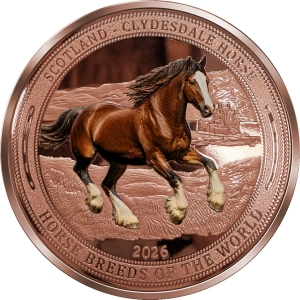
The third release in the Horse Breeds of the World series celebrates Scotland's iconic Clydesdale Horse. Struck in 5 oz of copper with vibrant colour, it beautifully captures the power and grace of this legendary breed.
Diameter:65 mm
Copper: 99,9%
Total Weight: 155,5 g
Auality: B.U.
Mintage: 999
Comes in box
The third release in the Horse Breeds of the World series celebrates Scotland's iconic Clydesdale Horse. Struck in 5 oz of copper with vibrant colour, it beautifully captures the power and grace of this legendary breed.
99,00 €