



"Milano Cortina 2026 Winter Olympic Games - MILAN Italy 1/4 € base metal coin
Price:
8,00 €
Materiall: CuNi
Weight: 7 g
Diameter: 22,25 mm
Mintage:
An extraordinary collection accompanies the approach to the Olympic and Paralympic Winter Games of Milan Cortina 2026 and celebrates its spirit through its most iconic symbols: the logo of the event, the journey of the flame, the mascot and the winter disciplines associated with the host locations. Each coin in the collection is a tribute to the magic of sport and to Italy.
Obverse: In the centre, the official logo of the Milano Cortina 2026 Winter Olympic Games. Arch-shaped, the inscription “Repubblica Italiana”. In the right field, the “R”, identifying the Mint of Rome and “2025”, the year of the coin’s issue.
Reverse: In the centre, a stylised frontal perspective of the Milan Cathedral. Arch-shaped the inscription “MILANO CORTINA 2026 WINTER OLYMPIC GAMES”; On the left “A.VECCHIO,” signature of the designer Antonio Vecchio; at the bottom centre “1/4 EURO”, coin’s value.
Weight: 7 g
Diameter: 22,25 mm
Mintage:
An extraordinary collection accompanies the approach to the Olympic and Paralympic Winter Games of Milan Cortina 2026 and celebrates its spirit through its most iconic symbols: the logo of the event, the journey of the flame, the mascot and the winter disciplines associated with the host locations. Each coin in the collection is a tribute to the magic of sport and to Italy.
Obverse: In the centre, the official logo of the Milano Cortina 2026 Winter Olympic Games. Arch-shaped, the inscription “Repubblica Italiana”. In the right field, the “R”, identifying the Mint of Rome and “2025”, the year of the coin’s issue.
Reverse: In the centre, a stylised frontal perspective of the Milan Cathedral. Arch-shaped the inscription “MILANO CORTINA 2026 WINTER OLYMPIC GAMES”; On the left “A.VECCHIO,” signature of the designer Antonio Vecchio; at the bottom centre “1/4 EURO”, coin’s value.
Kollektsioon
Materiall: CuNi
Weight: 7 g
Diameter: 22,25 mm
Mintage:
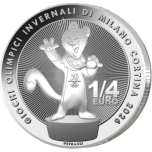
An extraordinary collection accompanies the approach to the Olympic and Paralympic Winter Games of Milan Cortina 2026 and celebrates its spirit through its most iconic symbols: the logo of the event, the journey of the flame, the mascot and the winter disciplines associated with the host locations. Each coin in the collection is a tribute to the magic of sport and to Italy.
Obverse: In the centre, the official logo of the Milano Cortina 2026 Winter Olympic Games. Arch-shaped, the inscription "Repubblica Italiana". In the right field, the "R", identifying the Mint of Rome and "2025", the year of the coin’s issue.
Reverse: In the centre, Tina, official mascot of the Olympic Games, standing on a podium while celebrating the victory of the medal. Arch-shaped, the inscription “GIOCHI OLIMPICI INVERNALI DI MILANO CORTINA 2026”; bottom right “1/4 EURO”, the coin’s value. Below “PETRASSI”, signature of the designer. In the background a sunburst decoration.
Weight: 7 g
Diameter: 22,25 mm
Mintage:
An extraordinary collection accompanies the approach to the Olympic and Paralympic Winter Games of Milan Cortina 2026 and celebrates its spirit through its most iconic symbols: the logo of the event, the journey of the flame, the mascot and the winter disciplines associated with the host locations. Each coin in the collection is a tribute to the magic of sport and to Italy.
Obverse: In the centre, the official logo of the Milano Cortina 2026 Winter Olympic Games. Arch-shaped, the inscription "Repubblica Italiana". In the right field, the "R", identifying the Mint of Rome and "2025", the year of the coin’s issue.
Reverse: In the centre, Tina, official mascot of the Olympic Games, standing on a podium while celebrating the victory of the medal. Arch-shaped, the inscription “GIOCHI OLIMPICI INVERNALI DI MILANO CORTINA 2026”; bottom right “1/4 EURO”, the coin’s value. Below “PETRASSI”, signature of the designer. In the background a sunburst decoration.
8,00 €
Similar products
Denomination: 0,25 €
Alloy: Cupro-nickel Nordicgold
Weight: 15,8 g
Diameter: 34 mm
Quality Brilliant Uncirculated
Year: 2023
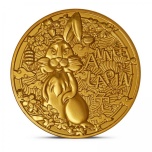
Surrounded by plum blossom, a popular symbol in Chinese history, art, and lanterns, the rabbit’s depiction appeals to children. The inscription 'Year of the rabbit’ and the year date appear at the center of the coin. The ideogram of the rabbit appears below.
Alloy: Cupro-nickel Nordicgold
Weight: 15,8 g
Diameter: 34 mm
Quality Brilliant Uncirculated
Year: 2023
Surrounded by plum blossom, a popular symbol in Chinese history, art, and lanterns, the rabbit’s depiction appeals to children. The inscription 'Year of the rabbit’ and the year date appear at the center of the coin. The ideogram of the rabbit appears below.
9,90 €

Materiall: CuNi
Weight: 9g
Diameter: 26,9 mm
Mintage: 100 000
The German government has decided to mint a €5 collectors’ coin entitled “Red mason bee”, to be issed at 7 September 2023. It is the fourth coin issued as part of the “Wonderful world of insects” series, which will see a total of nine coins with partially coloured motifs issued over the period 2022-24. The series is intended to bring into focus – especially in light of current developments (insect extinction) – a special group of animals that make up a significant part of our natural heritage.
The €5 collectors’ coin “Red mason bee” is made of a cupronickel alloy. It weighs 9.68 g, measures 27.25 mm in diameter and will be available both in mint condition and with a proof-like finish. The mint condition coins will be brought into circulation at their face value (€5). The collector quality coins with a proof-like finish will be higher than their face value and will be issued by the Münze Deutschland (Germany’s official sales agency for collector coins).
The coin was designed by Claudius Riedmiller, an artist based in Stuttgart (picture side), and Andre Witting, a Berlin-based artist (reverse).
The reverse, which will be used for all coins in the series, features an eagle, the words “BUNDESREPUBLIK DEUTSCHLAND”, the value and denomination, the year 2023, the twelve stars of Europe and the letter “D” for the State Mint of Munich.
Its smooth edge is engraved with the inscription: “WUNDERWELT INSEKTEN” (WONDERFUL WORLD OF INSECTS)
Weight: 9g
Diameter: 26,9 mm
Mintage: 100 000
The German government has decided to mint a €5 collectors’ coin entitled “Red mason bee”, to be issed at 7 September 2023. It is the fourth coin issued as part of the “Wonderful world of insects” series, which will see a total of nine coins with partially coloured motifs issued over the period 2022-24. The series is intended to bring into focus – especially in light of current developments (insect extinction) – a special group of animals that make up a significant part of our natural heritage.
The €5 collectors’ coin “Red mason bee” is made of a cupronickel alloy. It weighs 9.68 g, measures 27.25 mm in diameter and will be available both in mint condition and with a proof-like finish. The mint condition coins will be brought into circulation at their face value (€5). The collector quality coins with a proof-like finish will be higher than their face value and will be issued by the Münze Deutschland (Germany’s official sales agency for collector coins).
The coin was designed by Claudius Riedmiller, an artist based in Stuttgart (picture side), and Andre Witting, a Berlin-based artist (reverse).
The reverse, which will be used for all coins in the series, features an eagle, the words “BUNDESREPUBLIK DEUTSCHLAND”, the value and denomination, the year 2023, the twelve stars of Europe and the letter “D” for the State Mint of Munich.
Its smooth edge is engraved with the inscription: “WUNDERWELT INSEKTEN” (WONDERFUL WORLD OF INSECTS)
14,90 €
Denomination: 5£
Alloy: cu/ni
Weight: 28.28 g
Diameter: 38,6 mm
Quality Brilliant Uncirculated
Year: 2024
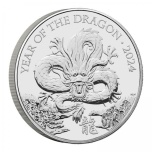
A beautiful celebration of the most significant symbol in Chinese culture
The first Lunar coin to feature the official coinage portrait of His Majesty The King
In 2024, Chinese New Year, The Year of the Dragon starts on 10 February. A joyful time that is marked by communities all over the world, friends and family will gather to enjoy traditional food, watch firework displays and gift children money in red envelopes. Each year is characterised by one of 12 zodiac animals, and 2024 sees the dragon in the ascendancy. Wise and powerful, the dragon is China’s most important cultural symbol and has come to represent confidence, courage and adventurousness. People born under its zodiac sign are said to possess these traits
Alloy: cu/ni
Weight: 28.28 g
Diameter: 38,6 mm
Quality Brilliant Uncirculated
Year: 2024
A beautiful celebration of the most significant symbol in Chinese culture
The first Lunar coin to feature the official coinage portrait of His Majesty The King
In 2024, Chinese New Year, The Year of the Dragon starts on 10 February. A joyful time that is marked by communities all over the world, friends and family will gather to enjoy traditional food, watch firework displays and gift children money in red envelopes. Each year is characterised by one of 12 zodiac animals, and 2024 sees the dragon in the ascendancy. Wise and powerful, the dragon is China’s most important cultural symbol and has come to represent confidence, courage and adventurousness. People born under its zodiac sign are said to possess these traits
25,00 €
Issuing Country: France
Face value: 5 €
Metal: Copper/Nickel
Diameter: 29 mm
Quality: B.U.
Mintage: 25 000
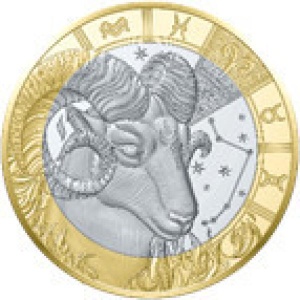
The wheel of the zodiac signs is engraved on the coin's gold-colored crown. One sign stands out from the rest, as it is larger than the others and has a sandblasted background, different from the smoother one of the others. It is the symbol of Aries. Part of the wheel is hidden by flames, a reminder of the element of the Aries sign, fire. The bust of a ram with majestic horns and a serene air occupies most of the central space on the obverse of the coin. The background features a starry sky in which the Aries constellation is outlined.
Face value: 5 €
Metal: Copper/Nickel
Diameter: 29 mm
Quality: B.U.
Mintage: 25 000
The wheel of the zodiac signs is engraved on the coin's gold-colored crown. One sign stands out from the rest, as it is larger than the others and has a sandblasted background, different from the smoother one of the others. It is the symbol of Aries. Part of the wheel is hidden by flames, a reminder of the element of the Aries sign, fire. The bust of a ram with majestic horns and a serene air occupies most of the central space on the obverse of the coin. The background features a starry sky in which the Aries constellation is outlined.
20,00 €
Face value: Samoa 0,25$
Weight: 40gr
Diameter: 40 mm
Mintage: 6666
Proof copper coin with partial gold plating
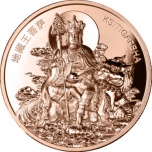
In East Asian Buddhism, the Twelve Heavenly Generals or Twelve Divine Generals are the protective deities.
Weight: 40gr
Diameter: 40 mm
Mintage: 6666
Proof copper coin with partial gold plating
In East Asian Buddhism, the Twelve Heavenly Generals or Twelve Divine Generals are the protective deities.
39,00 €