


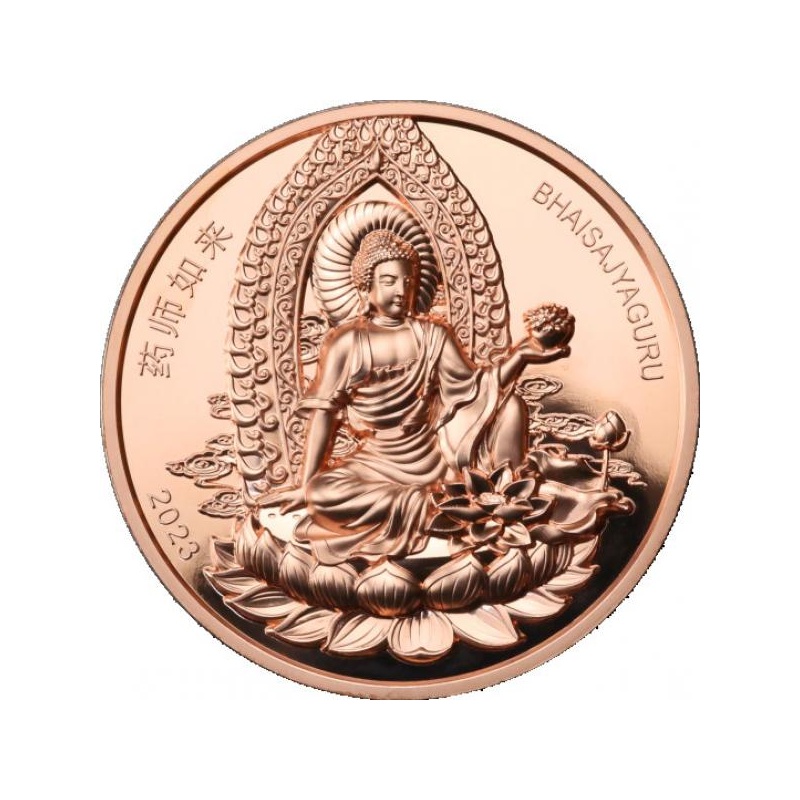
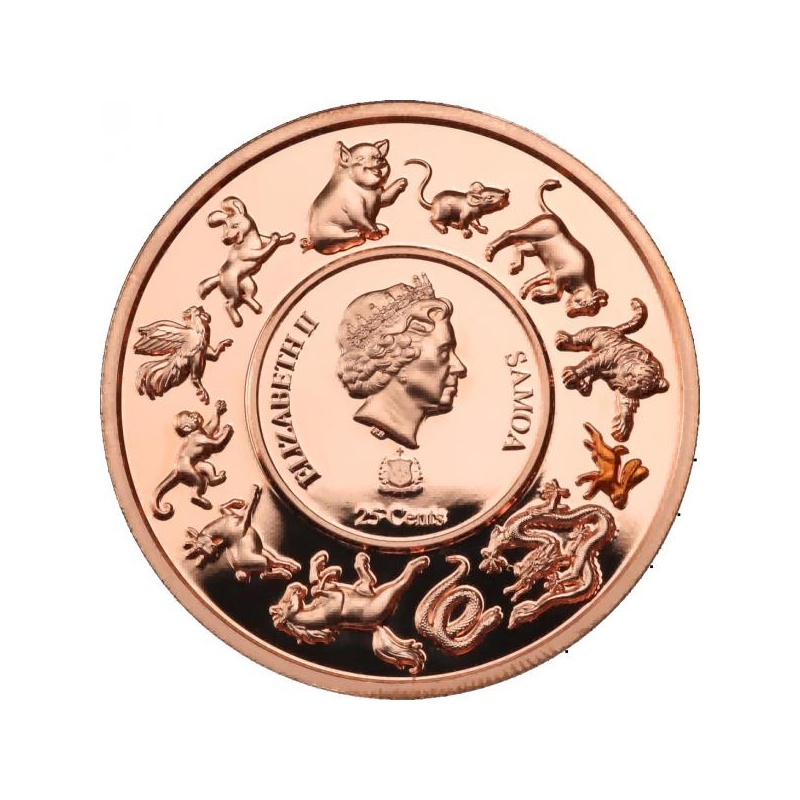
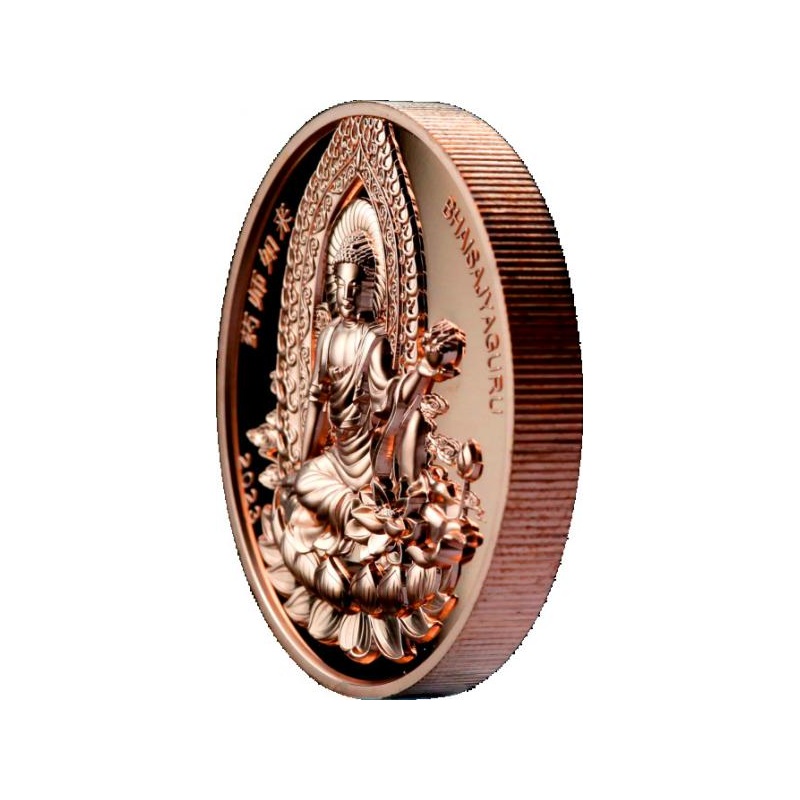
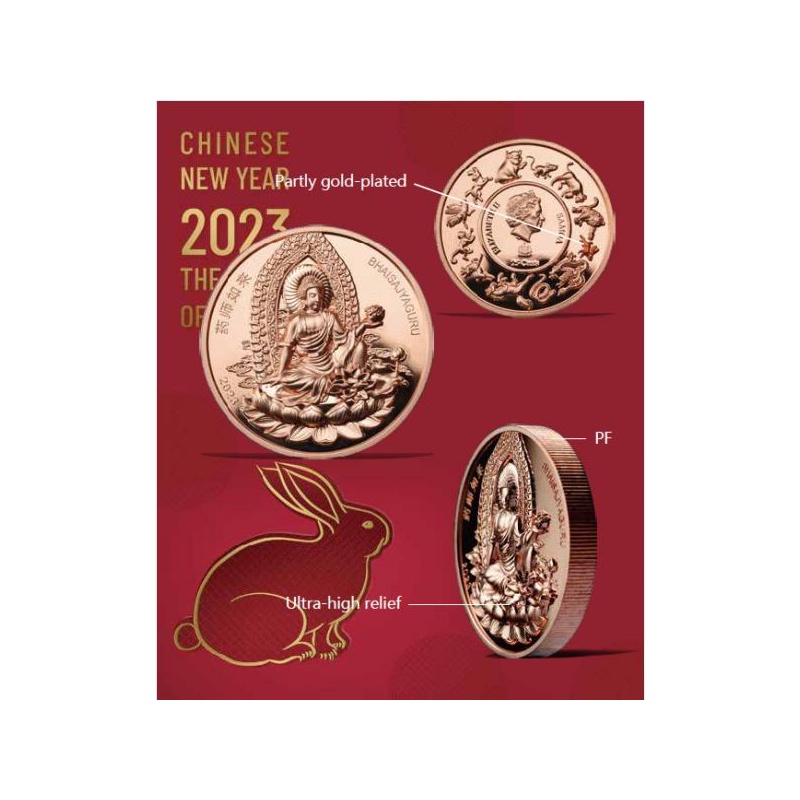
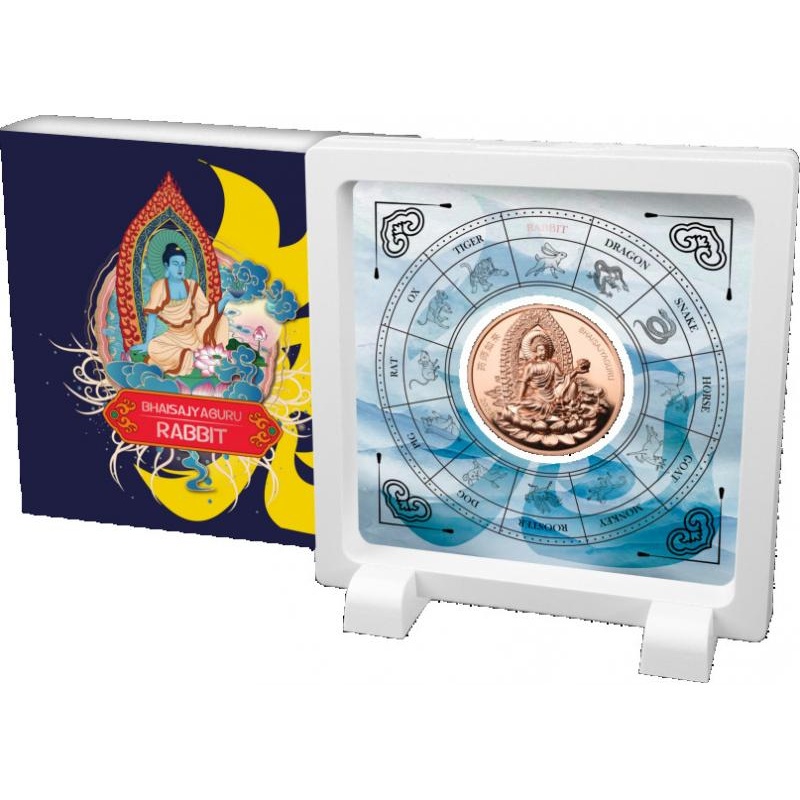
Twelve Heavenly Generals in the Chinese Zodiac - Bhaisajyaguru VS Rabbit -Samoa 0,25$ 2023 copper coin, 45 g
Unit: tk
Price:
39,00 €
Face value: Samoa 0,25$
Weight: 40gr
Diameter: 40 mm
Mintage: 6666
Proof copper coin with partial gold plating
In East Asian Buddhism, the Twelve Heavenly Generals or Twelve Divine Generals are the protective deities, or yaksha, of Bhaisajyaguru, the buddha of healing. They are introduced in the Bhai?ajyaguruvaiduryaprabharaja Sutra. They are collectively named Shí'èr Shén Jiang Mahala--Honji to this General is Bhaisajyaguru, It is the protective deity of zodiac rabbit.
Weight: 40gr
Diameter: 40 mm
Mintage: 6666
Proof copper coin with partial gold plating
In East Asian Buddhism, the Twelve Heavenly Generals or Twelve Divine Generals are the protective deities, or yaksha, of Bhaisajyaguru, the buddha of healing. They are introduced in the Bhai?ajyaguruvaiduryaprabharaja Sutra. They are collectively named Shí'èr Shén Jiang Mahala--Honji to this General is Bhaisajyaguru, It is the protective deity of zodiac rabbit.
Similar products
Materiall: CuNi
Weight: 9g
Diameter: 26,9 mm
Mintage: 100 000
The German government has decided to mint a €5 collectors’ coin entitled “Red mason bee”, to be issed at 7 September 2023. It is the fourth coin issued as part of the “Wonderful world of insects” series, which will see a total of nine coins with partially coloured motifs issued over the period 2022-24. The series is intended to bring into focus – especially in light of current developments (insect extinction) – a special group of animals that make up a significant part of our natural heritage.
The €5 collectors’ coin “Red mason bee” is made of a cupronickel alloy. It weighs 9.68 g, measures 27.25 mm in diameter and will be available both in mint condition and with a proof-like finish. The mint condition coins will be brought into circulation at their face value (€5). The collector quality coins with a proof-like finish will be higher than their face value and will be issued by the Münze Deutschland (Germany’s official sales agency for collector coins).
The coin was designed by Claudius Riedmiller, an artist based in Stuttgart (picture side), and Andre Witting, a Berlin-based artist (reverse).
The reverse, which will be used for all coins in the series, features an eagle, the words “BUNDESREPUBLIK DEUTSCHLAND”, the value and denomination, the year 2023, the twelve stars of Europe and the letter “D” for the State Mint of Munich.
Its smooth edge is engraved with the inscription: “WUNDERWELT INSEKTEN” (WONDERFUL WORLD OF INSECTS)
Weight: 9g
Diameter: 26,9 mm
Mintage: 100 000
The German government has decided to mint a €5 collectors’ coin entitled “Red mason bee”, to be issed at 7 September 2023. It is the fourth coin issued as part of the “Wonderful world of insects” series, which will see a total of nine coins with partially coloured motifs issued over the period 2022-24. The series is intended to bring into focus – especially in light of current developments (insect extinction) – a special group of animals that make up a significant part of our natural heritage.
The €5 collectors’ coin “Red mason bee” is made of a cupronickel alloy. It weighs 9.68 g, measures 27.25 mm in diameter and will be available both in mint condition and with a proof-like finish. The mint condition coins will be brought into circulation at their face value (€5). The collector quality coins with a proof-like finish will be higher than their face value and will be issued by the Münze Deutschland (Germany’s official sales agency for collector coins).
The coin was designed by Claudius Riedmiller, an artist based in Stuttgart (picture side), and Andre Witting, a Berlin-based artist (reverse).
The reverse, which will be used for all coins in the series, features an eagle, the words “BUNDESREPUBLIK DEUTSCHLAND”, the value and denomination, the year 2023, the twelve stars of Europe and the letter “D” for the State Mint of Munich.
Its smooth edge is engraved with the inscription: “WUNDERWELT INSEKTEN” (WONDERFUL WORLD OF INSECTS)
14,90 €
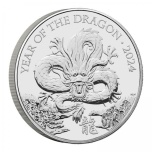
Denomination: 5£
Alloy: cu/ni
Weight: 28.28 g
Diameter: 38,6 mm
Quality Brilliant Uncirculated
Year: 2024
A beautiful celebration of the most significant symbol in Chinese culture
The first Lunar coin to feature the official coinage portrait of His Majesty The King
In 2024, Chinese New Year, The Year of the Dragon starts on 10 February. A joyful time that is marked by communities all over the world, friends and family will gather to enjoy traditional food, watch firework displays and gift children money in red envelopes. Each year is characterised by one of 12 zodiac animals, and 2024 sees the dragon in the ascendancy. Wise and powerful, the dragon is China’s most important cultural symbol and has come to represent confidence, courage and adventurousness. People born under its zodiac sign are said to possess these traits
Alloy: cu/ni
Weight: 28.28 g
Diameter: 38,6 mm
Quality Brilliant Uncirculated
Year: 2024
A beautiful celebration of the most significant symbol in Chinese culture
The first Lunar coin to feature the official coinage portrait of His Majesty The King
In 2024, Chinese New Year, The Year of the Dragon starts on 10 February. A joyful time that is marked by communities all over the world, friends and family will gather to enjoy traditional food, watch firework displays and gift children money in red envelopes. Each year is characterised by one of 12 zodiac animals, and 2024 sees the dragon in the ascendancy. Wise and powerful, the dragon is China’s most important cultural symbol and has come to represent confidence, courage and adventurousness. People born under its zodiac sign are said to possess these traits
25,00 €
Face value: 5 €
Diameter: 34 mm
Weight: 19.1 g
Metal: Brass
Mintage: 45,000
Obverse:
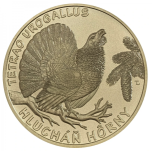
The obverse depicts a male western capercaillie in a heathland environment, together with a female of the species in the lower right of the design. In the background are conifer trees and an upright, splintered tree trunk. The Slovak coat of arms appears on the right side of the design, below the coin’s denomination and currency: ‘5 EURO’. Inscribed along the top edge are the name of the issuing country and the year of issuance: ‘SLOVENSKO 2024’. Next to the right edge is the mint mark of the Kremnica Mint (Mincovňa Kremnica), consisting of the letters ‘MK’ placed between two dies.
Reverse:
The reverse is dominated by an image of a male western capercaillie perched on a branch. The Slovak name of the species, ‘HLUCHÁŇ HÔRNY’, is inscribed along the bottom edge of the design, while the scientific name, ‘TETRAO UROGALLUS’, appears along the upper left edge. To the right of the capercaillie is the tip of a pine branch with a cone, next to which are the stylised letters ‘TL’, referring to the coin’s designer Tomáš Lamač.
The western capercaillie is one of the largest bird species in Slovakia. The cock is black except for a bluish-green metallic sheen on the chest and for chestnut-brown wings with a white spot on the bow. The feathers below the beak are elongated and protruding, and above each eye there is a bright red spot of skin. The relatively long black tail feathers have whitish spots and broaden at the end. The hen is plainer, with a chestnut-brown, mottled plumage and a noticeable rust-coloured breast patch. The young are similar in appearance to the hen, though with somewhat less pronounced mottling. In Slovakia, the western capercaillie is found in coniferous and mixed forests at altitudes from 600 to 1,550 metres above sea level. The species thrives in scattered swathes of old, primeval-like mountain forest. The western capercaillie nests on the ground, in a shallow depression lined with dry leaves, twigs, and grass blades or pine needles. Egg-laying occurs in April-May, with the hen typically laying six to nine yellowish-brown speckled eggs. In winter and early spring, the western capercaillie feeds almost entirely on pine needles, shoots and buds, while in the summer its diet extends to various berries and plant leaves, plus an animal component consisting mainly of insects. The western capercaillie is a solitary creature, except when the two sexes come together in the mating season. During courting, the cock postures himself with raised and fanned tail feathers, erect neck, and beak pointed skywards. The western capercaillie is a protected species in Slovakia.
Diameter: 34 mm
Weight: 19.1 g
Metal: Brass
Mintage: 45,000
Obverse:
The obverse depicts a male western capercaillie in a heathland environment, together with a female of the species in the lower right of the design. In the background are conifer trees and an upright, splintered tree trunk. The Slovak coat of arms appears on the right side of the design, below the coin’s denomination and currency: ‘5 EURO’. Inscribed along the top edge are the name of the issuing country and the year of issuance: ‘SLOVENSKO 2024’. Next to the right edge is the mint mark of the Kremnica Mint (Mincovňa Kremnica), consisting of the letters ‘MK’ placed between two dies.
Reverse:
The reverse is dominated by an image of a male western capercaillie perched on a branch. The Slovak name of the species, ‘HLUCHÁŇ HÔRNY’, is inscribed along the bottom edge of the design, while the scientific name, ‘TETRAO UROGALLUS’, appears along the upper left edge. To the right of the capercaillie is the tip of a pine branch with a cone, next to which are the stylised letters ‘TL’, referring to the coin’s designer Tomáš Lamač.
The western capercaillie is one of the largest bird species in Slovakia. The cock is black except for a bluish-green metallic sheen on the chest and for chestnut-brown wings with a white spot on the bow. The feathers below the beak are elongated and protruding, and above each eye there is a bright red spot of skin. The relatively long black tail feathers have whitish spots and broaden at the end. The hen is plainer, with a chestnut-brown, mottled plumage and a noticeable rust-coloured breast patch. The young are similar in appearance to the hen, though with somewhat less pronounced mottling. In Slovakia, the western capercaillie is found in coniferous and mixed forests at altitudes from 600 to 1,550 metres above sea level. The species thrives in scattered swathes of old, primeval-like mountain forest. The western capercaillie nests on the ground, in a shallow depression lined with dry leaves, twigs, and grass blades or pine needles. Egg-laying occurs in April-May, with the hen typically laying six to nine yellowish-brown speckled eggs. In winter and early spring, the western capercaillie feeds almost entirely on pine needles, shoots and buds, while in the summer its diet extends to various berries and plant leaves, plus an animal component consisting mainly of insects. The western capercaillie is a solitary creature, except when the two sexes come together in the mating season. During courting, the cock postures himself with raised and fanned tail feathers, erect neck, and beak pointed skywards. The western capercaillie is a protected species in Slovakia.
14,90 €
Face value: 5 €
Diameter: 34 mm
Weight: 19.1 g
Metal: Brass
Mintage: 40,000
The black stork is an unmistakable bird species. The adult has mainly black plumage with white underparts, long coral red legs and a long pointed beak. The beak and eye areas are the same colour as the legs, and the black plumage has an intense greenish-purple sheen. Adults weigh between around 2.4 kg and 3.2 kg. Black storks are distributed throughout most of Europe and Asia, and most forest areas of Slovakia are nesting sites for these birds. They typically nest in mature deciduous and mixed forests, preferring areas with wetlands and watercourses where they can forage for food. They select large trees with strong horizontal branches and show high fidelity to breeding sites and nesting trees. The base of the nest is formed by thick branches, while the interior is lined with twigs, clumps of grass, lichens and moss. The female lays two to four eggs. Both parents feed the fledglings by regurgitating food onto the nest floor. Black storks feed on smaller fish, amphibians, insects, gastropods, small mammals and small birds. They migrate to wintering grounds mainly in August and September. In Slovakia, the black stork is a protected species.
Obverse:
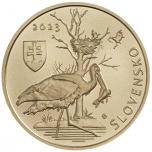
The obverse of the euro collector coin depicts a black stork hunting on a body of water. In the background is a tree with a stork’s nest. An adult stork is depicted flying towards a chick in the nest, carrying food in its beak. On the upper left side is the Slovak coat of arms and, above it, the year of issuance ‘2023’. On the right side is the mint mark of the Kremnica Mint (Mincovňa Kremnica), consisting of the letters ‘MK’ placed between two dies. Inscribed along part of the right edge is the name of the issuing country ‘SLOVENSKO’.
Reverse:
The reverse design depicts a black stork taking flight. To the right of this image are the denomination ‘5’ and currency ‘EURO’, one above the other. In the lower part of the design, next to the stork’s legs, are the stylised initials ‘MŠ’, referring to the coin’s designer Marie Šeborová. Inscribed along the lower edge and separated by a medial dot are the Slovak and scientific names for the black stork: ‘BOCIAN ČIERNY’ and ‘CICONIA NIGRA’.
Diameter: 34 mm
Weight: 19.1 g
Metal: Brass
Mintage: 40,000
The black stork is an unmistakable bird species. The adult has mainly black plumage with white underparts, long coral red legs and a long pointed beak. The beak and eye areas are the same colour as the legs, and the black plumage has an intense greenish-purple sheen. Adults weigh between around 2.4 kg and 3.2 kg. Black storks are distributed throughout most of Europe and Asia, and most forest areas of Slovakia are nesting sites for these birds. They typically nest in mature deciduous and mixed forests, preferring areas with wetlands and watercourses where they can forage for food. They select large trees with strong horizontal branches and show high fidelity to breeding sites and nesting trees. The base of the nest is formed by thick branches, while the interior is lined with twigs, clumps of grass, lichens and moss. The female lays two to four eggs. Both parents feed the fledglings by regurgitating food onto the nest floor. Black storks feed on smaller fish, amphibians, insects, gastropods, small mammals and small birds. They migrate to wintering grounds mainly in August and September. In Slovakia, the black stork is a protected species.
Obverse:
The obverse of the euro collector coin depicts a black stork hunting on a body of water. In the background is a tree with a stork’s nest. An adult stork is depicted flying towards a chick in the nest, carrying food in its beak. On the upper left side is the Slovak coat of arms and, above it, the year of issuance ‘2023’. On the right side is the mint mark of the Kremnica Mint (Mincovňa Kremnica), consisting of the letters ‘MK’ placed between two dies. Inscribed along part of the right edge is the name of the issuing country ‘SLOVENSKO’.
Reverse:
The reverse design depicts a black stork taking flight. To the right of this image are the denomination ‘5’ and currency ‘EURO’, one above the other. In the lower part of the design, next to the stork’s legs, are the stylised initials ‘MŠ’, referring to the coin’s designer Marie Šeborová. Inscribed along the lower edge and separated by a medial dot are the Slovak and scientific names for the black stork: ‘BOCIAN ČIERNY’ and ‘CICONIA NIGRA’.
14,90 €
Issuing Country: France
Face value: 5 €
Metal: Copper/Nickel
Diameter: 29 mm
Quality: B.U.
Mintage: 25 000
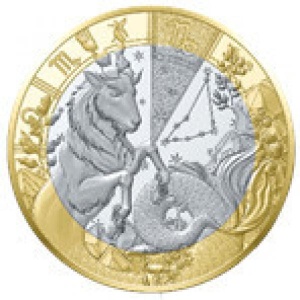
The wheel of the zodiac signs is engraved on the coin's gold-colored crown. One sign stands out from the background because of its larger size and a sandblasted background, different from the smoother one of the others. It is the symbol of Capricorn. Part of the wheel is hidden by crystals, leaves and mushrooms, in reference to the sign's element, earth. A Capricorn, half-goat, half-fish, rears up in the middle of the scene. In the background, there's a starry sky in which the Capricorn constellation is outlined.
Face value: 5 €
Metal: Copper/Nickel
Diameter: 29 mm
Quality: B.U.
Mintage: 25 000
The wheel of the zodiac signs is engraved on the coin's gold-colored crown. One sign stands out from the background because of its larger size and a sandblasted background, different from the smoother one of the others. It is the symbol of Capricorn. Part of the wheel is hidden by crystals, leaves and mushrooms, in reference to the sign's element, earth. A Capricorn, half-goat, half-fish, rears up in the middle of the scene. In the background, there's a starry sky in which the Capricorn constellation is outlined.
20,00 €