

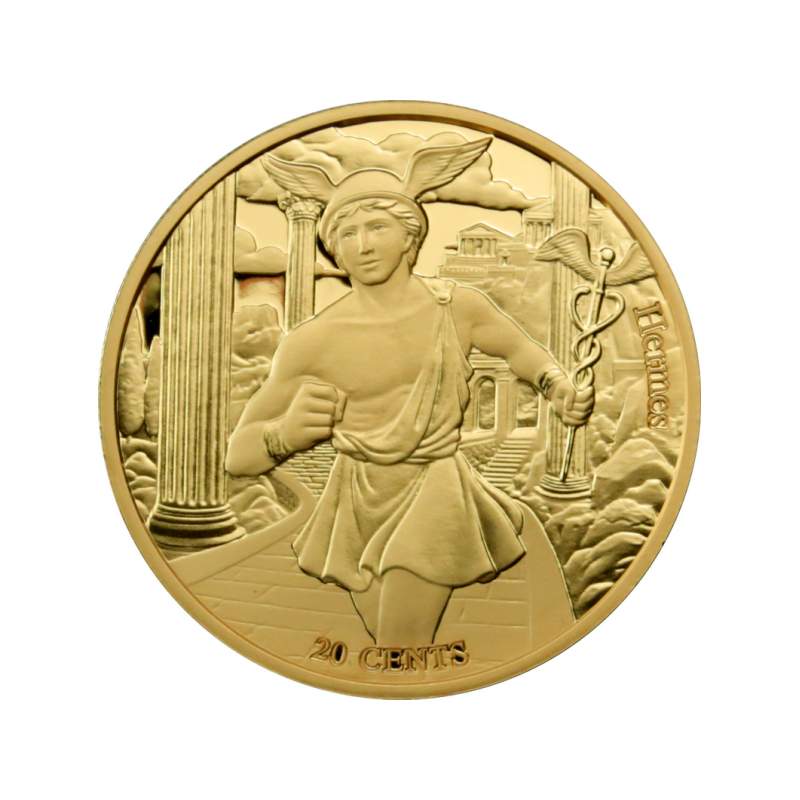
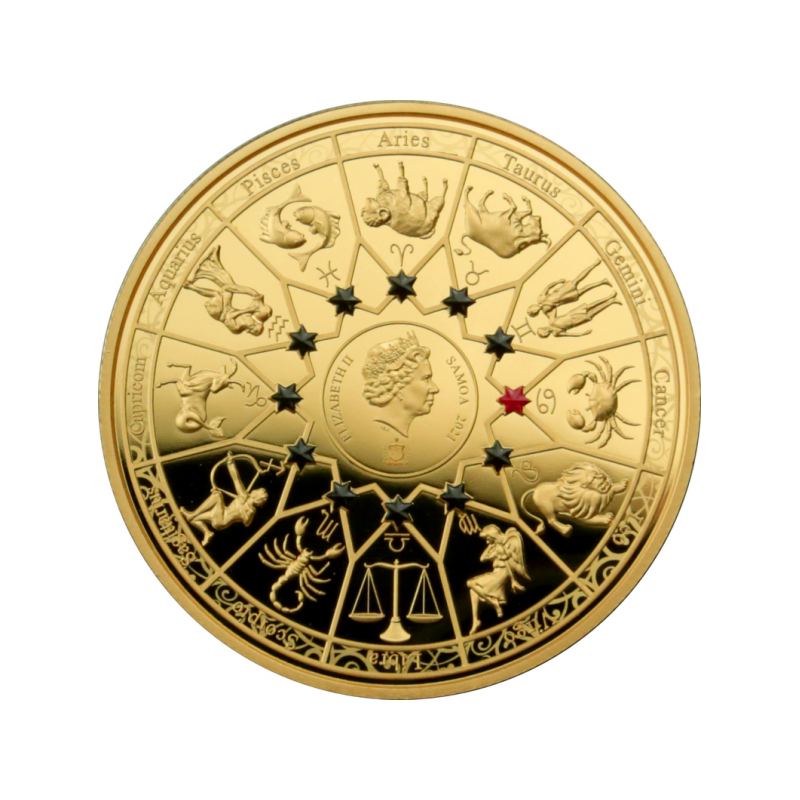
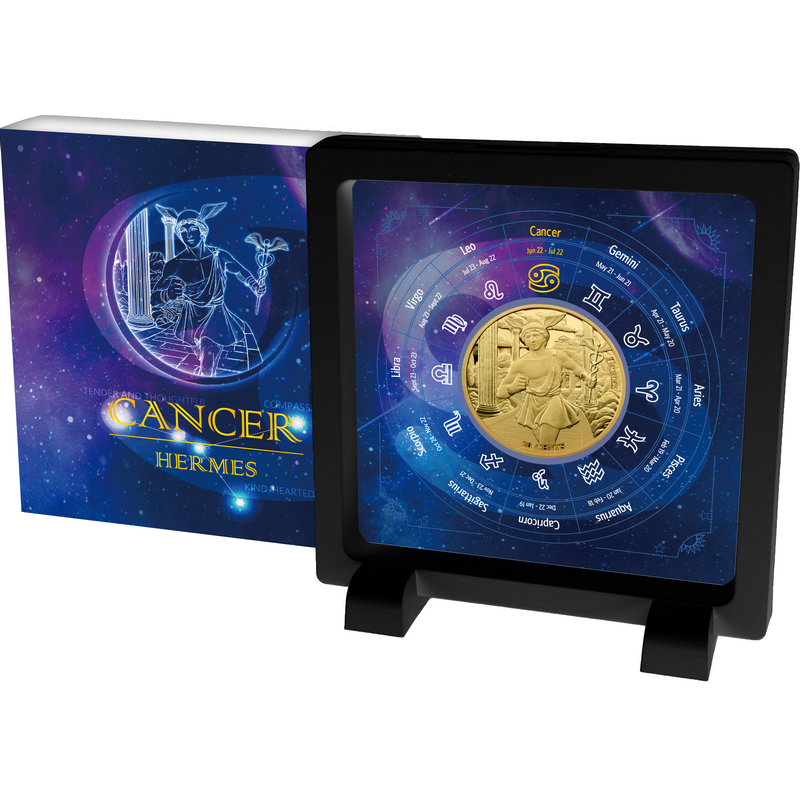
The Twelve Olympians in the Zodiac - Hermes & Cancer. Samoa 0.20 $ 2021 Gold plated Copper/Nickel coin
Price:
35,00 €
Face value: 0.2 $
Issuing country: Samoa
Weight: 25 g
Diameter: 40 mm
Mintage: 3000
Issuing country: Samoa
Weight: 25 g
Diameter: 40 mm
Mintage: 3000
Kollektsioon
The Twelve Olympians in the Zodiac - Ares & Scorpio Samoa 0.20 $ 2021 Gold plated Copper/Nickel coin
Face value: 0.2 $
Issuing country: Samoa
Weight: 25 g
Diameter: 40 mm
Scorpio is the second Mars sign, and the one that most relates to Ares: while the fiery aspects of Aries might relate to him to some extent, it’s the more emotional Scorpio that resonates closer to him and his primal nature. As the later Autumn sign, Scorpio is related to Winter’s start, and thus to sunset-like conditions: as the Sun dims, so does life. Scorpio is defined by it’s loyalty bordering on possessiveness, as well as a rather strong impulsive nature but consciously made subtle or even outright hidden. Ares displays a surprising amount of loyalty to his family, even when most of Olympus doesn’t like him very much, and while numerous, his affairs are occult, unlike Zeus’ or Apollo’s. This reflects water as darkness: driven by strong impulses, but with the element of mystery and hidden nature. Due to Scorpio’s vindictiveness and hidden nature, it is often considered the most malign of the signs, just as Ares is the most distrusted of the Olympians, but neither are “evil” and while unpleasant they are necessary for the inner workings of nature. Darkness is after all important to health in it’s Melatonin friendliness, especially when it’s connected to water.
Issuing country: Samoa
Weight: 25 g
Diameter: 40 mm
Scorpio is the second Mars sign, and the one that most relates to Ares: while the fiery aspects of Aries might relate to him to some extent, it’s the more emotional Scorpio that resonates closer to him and his primal nature. As the later Autumn sign, Scorpio is related to Winter’s start, and thus to sunset-like conditions: as the Sun dims, so does life. Scorpio is defined by it’s loyalty bordering on possessiveness, as well as a rather strong impulsive nature but consciously made subtle or even outright hidden. Ares displays a surprising amount of loyalty to his family, even when most of Olympus doesn’t like him very much, and while numerous, his affairs are occult, unlike Zeus’ or Apollo’s. This reflects water as darkness: driven by strong impulses, but with the element of mystery and hidden nature. Due to Scorpio’s vindictiveness and hidden nature, it is often considered the most malign of the signs, just as Ares is the most distrusted of the Olympians, but neither are “evil” and while unpleasant they are necessary for the inner workings of nature. Darkness is after all important to health in it’s Melatonin friendliness, especially when it’s connected to water.
35,00 €
Face value: 0.2 $
Issuing country: Samoa
Weight: 25 g
Diameter: 40 mm
Hephaestus‘ correspondence with Libra is derived from his role as the smith god. By crafting fire, he made the weapons that the gods use to impose justice, down to the scales of Dike, the goddess of justice, often thought to be the woman depicted in the sign. As just, Hephaestus is a god of innovation, taming the chaos of the flames to produce items to impose civilization.
Issuing country: Samoa
Weight: 25 g
Diameter: 40 mm
Hephaestus‘ correspondence with Libra is derived from his role as the smith god. By crafting fire, he made the weapons that the gods use to impose justice, down to the scales of Dike, the goddess of justice, often thought to be the woman depicted in the sign. As just, Hephaestus is a god of innovation, taming the chaos of the flames to produce items to impose civilization.
35,00 €
Similar products
Denomination: 5 £
Alloy: Cupper/Nickel
Weight: 28.28 g
Diameter: 38.61 mm
Year: 2022
The first coin in a collection honouring ten heraldic Royal Beasts
Celebrate the matrimonial union of Henry VIII and Jane Seymour
Commemorate the heraldic beasts of the Tudor dynasty
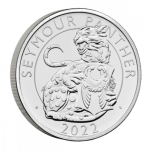
The first coin in the Royal Tudor Beasts Collection features the Seymour Panther, which was given to Jane Seymour by the king from the royal treasury of beasts. Depicted with flames coming out of its mouth and ears and known for its intoxicating fragrant breath, the fiery beast represents the union between a committed consort and a mighty monarch.
Alloy: Cupper/Nickel
Weight: 28.28 g
Diameter: 38.61 mm
Year: 2022
The first coin in a collection honouring ten heraldic Royal Beasts
Celebrate the matrimonial union of Henry VIII and Jane Seymour
Commemorate the heraldic beasts of the Tudor dynasty
The first coin in the Royal Tudor Beasts Collection features the Seymour Panther, which was given to Jane Seymour by the king from the royal treasury of beasts. Depicted with flames coming out of its mouth and ears and known for its intoxicating fragrant breath, the fiery beast represents the union between a committed consort and a mighty monarch.
25,00 €
Silver: 99.99%
Nominal value 1 $
Weight: 1 oz
Dimensions: 45,3 x 30,3 mm
Maximum Mintage 1 000
Coin Finish: Proof
The silver coin of the Czech Mint from the gift series with the motifs of the 12 zodiac signs will become not only beautiful, but also a valuable talisman for anyone born under the sign of Capricorn.
The constellation of Capricorn takes the form of a mythical creature with a goat's head and a fish's tail. According to ancient legend, this is the god of forests, fields, herds and shepherds, called Pan by the ancient Greeks and Faun by the Romans. He was immortalised in the sky by Zeus in thanks for his help in fighting the terrible monster Typhon, who wanted to destroy all the Olympians. Those born under the sign of Capricorn tend to be calm, patient and persistent. Their consistency goes hand in hand with ambition. Although their ambitions are not small, they have no problem achieving their goals thanks to iron discipline.
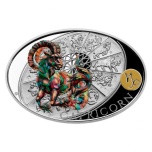
The unusual oval-shaped coin bears a coloured image of Capricorn on the reverse side. No photographs or computer graphics were used as a template for the colouring - the author of the coin, Asamat Baltaev, DiS., created an original watercolour painting. The relief in the background behind Capricorn presents a disc with a dozen zodiac signs. The composition of the reverse side is supplemented with the Latin inscription CAPRICORN and the corresponding astrological symbol. As the coins of the Czech Mint are issued with the foreign licence of the island of Niue, the obverse side bears its national emblem, the nominal value of ONE DOLLAR (NZD) and the year of issue 2021, all surrounded by twelve astrological signs.
The coin is stored in an elegant box.
Nominal value 1 $
Weight: 1 oz
Dimensions: 45,3 x 30,3 mm
Maximum Mintage 1 000
Coin Finish: Proof
The silver coin of the Czech Mint from the gift series with the motifs of the 12 zodiac signs will become not only beautiful, but also a valuable talisman for anyone born under the sign of Capricorn.
The constellation of Capricorn takes the form of a mythical creature with a goat's head and a fish's tail. According to ancient legend, this is the god of forests, fields, herds and shepherds, called Pan by the ancient Greeks and Faun by the Romans. He was immortalised in the sky by Zeus in thanks for his help in fighting the terrible monster Typhon, who wanted to destroy all the Olympians. Those born under the sign of Capricorn tend to be calm, patient and persistent. Their consistency goes hand in hand with ambition. Although their ambitions are not small, they have no problem achieving their goals thanks to iron discipline.
The unusual oval-shaped coin bears a coloured image of Capricorn on the reverse side. No photographs or computer graphics were used as a template for the colouring - the author of the coin, Asamat Baltaev, DiS., created an original watercolour painting. The relief in the background behind Capricorn presents a disc with a dozen zodiac signs. The composition of the reverse side is supplemented with the Latin inscription CAPRICORN and the corresponding astrological symbol. As the coins of the Czech Mint are issued with the foreign licence of the island of Niue, the obverse side bears its national emblem, the nominal value of ONE DOLLAR (NZD) and the year of issue 2021, all surrounded by twelve astrological signs.
The coin is stored in an elegant box.
129,00 €
Face value: 5 €
Diameter: 34 mm
Weight: 19.1 g
Metal: Brass
Mintage: 35,000
3. coin from the series “Fauna and Flora of Slovakia”.
Obverse:
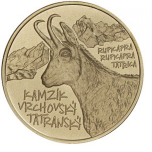
The obverse of this euro collector coin shows a Tatra chamois standing on a rock on which several edelweiss flowers, protected under Slovak law, are growing. The name of the issuing country ‘SLOVENSKO’ appears in the lower right of the design, above the Slovak coat of arms and, to the right of it, the year of issuance ‘2022’. The denomination and currency ‘5 euro’ are inscribed in the upper part. Next to the left edge are the mint mark of the Kremnica Mint (Mincovňa Kremnica), consisting of the letters ‘MK’ placed between two dies, and the stylised letters ‘KL’, referring to the coin’s designer Karol Ličko.
Reverse:
The reverse features the head and upper body of a Tatra chamois, with the head bisecting the background depiction of a rocky mountain range. The Slovak and scientific names of the chamois are each inscribed on three lines, with ‘KAMZÍK VRCHOVSKÝ TATRANSKÝ’ appearing to the left of the chamois and ‘RUPICAPRA RUPICAPRA TATRICA’ to the right.
Just as the Tatras are a symbol of Slovakia, so the chamois is a symbol of the Tatras. The Tatra mountain ranges are among the world’s smallest alpine ranges and are evidently suitable places for a creature as remarkable as the chamois to live in safety. It is not by chance that the Tatra national parks of both Slovakia and Poland feature the chamois in their logos. The Tatras’ deep valleys, rocky ridges, sharp peaks and mountain lakes have been the cradle and grave of chamois for millennia. The Tatra chamois is one of a few living links to the last ice age, its population being what experts call a ‘glacial relict’. The chamois live in herds with a social way of life. Some herds comprise more than 50 individuals. The total population of chamois on the Slovak and Polish sides of the Tatras currently numbers around 1,400. The Tatra chamois, or Rupicapra rupicapra tatrica, was classified as a separate subspecies in 1971 (by Milič Blahout). In Slovakia, pure Tatra chamois are found only in the High Tatras, Western Tatras and Belianske Tatras. The chamois are a cultural treasure, a symbol of both the Tatras and Slovakia as a whole. It is of the utmost importance to keep their Tatra habitats as undisturbed as possible and to behave responsibly and respectfully when present there.
Diameter: 34 mm
Weight: 19.1 g
Metal: Brass
Mintage: 35,000
3. coin from the series “Fauna and Flora of Slovakia”.
Obverse:
The obverse of this euro collector coin shows a Tatra chamois standing on a rock on which several edelweiss flowers, protected under Slovak law, are growing. The name of the issuing country ‘SLOVENSKO’ appears in the lower right of the design, above the Slovak coat of arms and, to the right of it, the year of issuance ‘2022’. The denomination and currency ‘5 euro’ are inscribed in the upper part. Next to the left edge are the mint mark of the Kremnica Mint (Mincovňa Kremnica), consisting of the letters ‘MK’ placed between two dies, and the stylised letters ‘KL’, referring to the coin’s designer Karol Ličko.
Reverse:
The reverse features the head and upper body of a Tatra chamois, with the head bisecting the background depiction of a rocky mountain range. The Slovak and scientific names of the chamois are each inscribed on three lines, with ‘KAMZÍK VRCHOVSKÝ TATRANSKÝ’ appearing to the left of the chamois and ‘RUPICAPRA RUPICAPRA TATRICA’ to the right.
Just as the Tatras are a symbol of Slovakia, so the chamois is a symbol of the Tatras. The Tatra mountain ranges are among the world’s smallest alpine ranges and are evidently suitable places for a creature as remarkable as the chamois to live in safety. It is not by chance that the Tatra national parks of both Slovakia and Poland feature the chamois in their logos. The Tatras’ deep valleys, rocky ridges, sharp peaks and mountain lakes have been the cradle and grave of chamois for millennia. The Tatra chamois is one of a few living links to the last ice age, its population being what experts call a ‘glacial relict’. The chamois live in herds with a social way of life. Some herds comprise more than 50 individuals. The total population of chamois on the Slovak and Polish sides of the Tatras currently numbers around 1,400. The Tatra chamois, or Rupicapra rupicapra tatrica, was classified as a separate subspecies in 1971 (by Milič Blahout). In Slovakia, pure Tatra chamois are found only in the High Tatras, Western Tatras and Belianske Tatras. The chamois are a cultural treasure, a symbol of both the Tatras and Slovakia as a whole. It is of the utmost importance to keep their Tatra habitats as undisturbed as possible and to behave responsibly and respectfully when present there.
14,90 €
Materiall: CuNi
Weight: 9g
Diameter: 26,9 mm
Mintage: 100 000
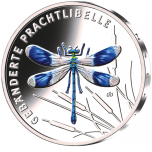
The German government has decided to mint a €5 collectors’ coin entitled “Banded demoiselle”, to be issed at 9 November 2023. It is the fifth coin issued as part of the “Wonderful world of insects” series, which will see a total of nine coins with partially coloured motifs issued over the period 2022-24. The series is intended to bring into focus – especially in light of current developments (insect extinction) – a special group of animals that make up a significant part of our natural heritage.
The €5 collectors’ coin “Banded demoiselle” is made of a cupronickel alloy. It weighs 9.68 g, measures 27.25 mm in diameter and will be available both in mint condition and with a proof-like finish. The mint condition coins will be brought into circulation at their face value (€5). The collector quality coins with a proof-like finish will be higher than their face value and will be issued by the Münze Deutschland (Germany’s official sales agency for collector coins).
The coin was designed by Detlef Behr, an artist based in Cologne (picture side), and Andre Witting, a Berlin-based artist (reverse).
The reverse, which will be used for all coins in the series, features an eagle, the words “BUNDESREPUBLIK DEUTSCHLAND”, the value and denomination, the year 2023, the twelve stars of Europe and the letter “J” for the State Mint of Hamburg.
Its smooth edge is engraved with the inscription: “WUNDERWELT INSEKTEN” (WONDERFUL WORLD OF INSECTS)
Weight: 9g
Diameter: 26,9 mm
Mintage: 100 000
The German government has decided to mint a €5 collectors’ coin entitled “Banded demoiselle”, to be issed at 9 November 2023. It is the fifth coin issued as part of the “Wonderful world of insects” series, which will see a total of nine coins with partially coloured motifs issued over the period 2022-24. The series is intended to bring into focus – especially in light of current developments (insect extinction) – a special group of animals that make up a significant part of our natural heritage.
The €5 collectors’ coin “Banded demoiselle” is made of a cupronickel alloy. It weighs 9.68 g, measures 27.25 mm in diameter and will be available both in mint condition and with a proof-like finish. The mint condition coins will be brought into circulation at their face value (€5). The collector quality coins with a proof-like finish will be higher than their face value and will be issued by the Münze Deutschland (Germany’s official sales agency for collector coins).
The coin was designed by Detlef Behr, an artist based in Cologne (picture side), and Andre Witting, a Berlin-based artist (reverse).
The reverse, which will be used for all coins in the series, features an eagle, the words “BUNDESREPUBLIK DEUTSCHLAND”, the value and denomination, the year 2023, the twelve stars of Europe and the letter “J” for the State Mint of Hamburg.
Its smooth edge is engraved with the inscription: “WUNDERWELT INSEKTEN” (WONDERFUL WORLD OF INSECTS)
14,90 €
Issuing Country: France
Face value: 5 €
Metal: Copper/Nickel
Diameter: 29 mm
Quality: B.U.
Mintage: 25 000
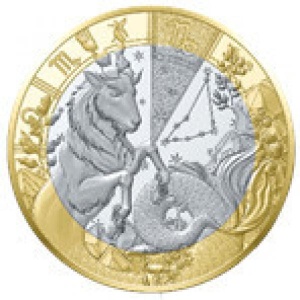
The wheel of the zodiac signs is engraved on the coin's gold-colored crown. One sign stands out from the background because of its larger size and a sandblasted background, different from the smoother one of the others. It is the symbol of Capricorn. Part of the wheel is hidden by crystals, leaves and mushrooms, in reference to the sign's element, earth. A Capricorn, half-goat, half-fish, rears up in the middle of the scene. In the background, there's a starry sky in which the Capricorn constellation is outlined.
Face value: 5 €
Metal: Copper/Nickel
Diameter: 29 mm
Quality: B.U.
Mintage: 25 000
The wheel of the zodiac signs is engraved on the coin's gold-colored crown. One sign stands out from the background because of its larger size and a sandblasted background, different from the smoother one of the others. It is the symbol of Capricorn. Part of the wheel is hidden by crystals, leaves and mushrooms, in reference to the sign's element, earth. A Capricorn, half-goat, half-fish, rears up in the middle of the scene. In the background, there's a starry sky in which the Capricorn constellation is outlined.
20,00 €