

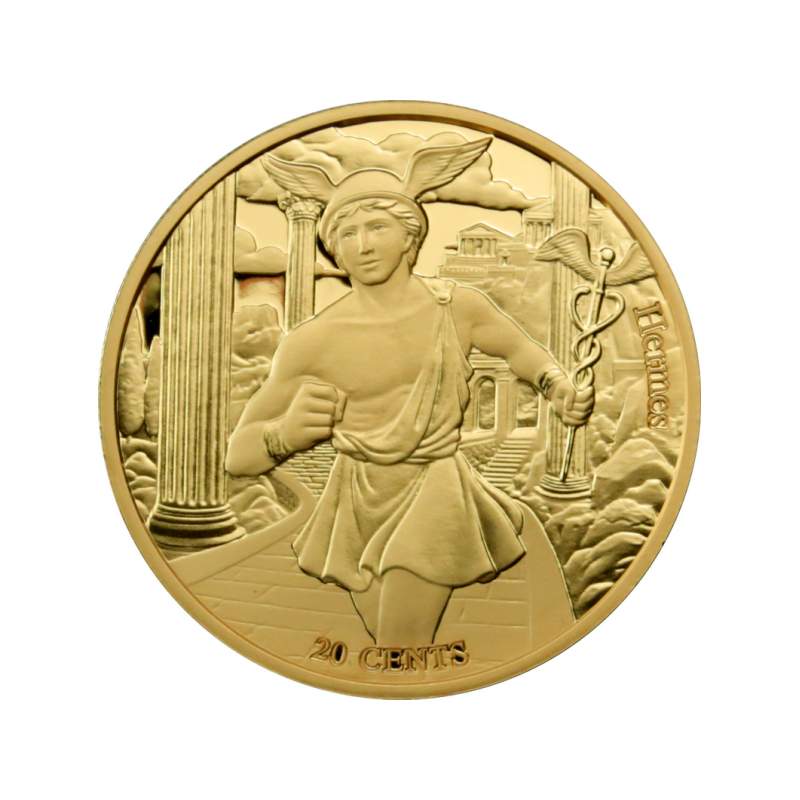
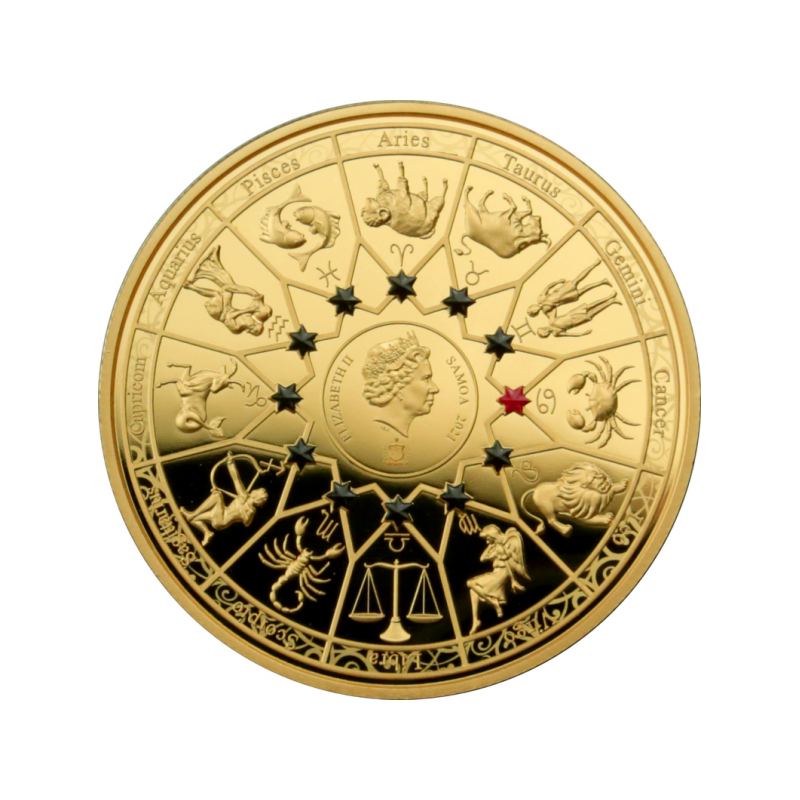
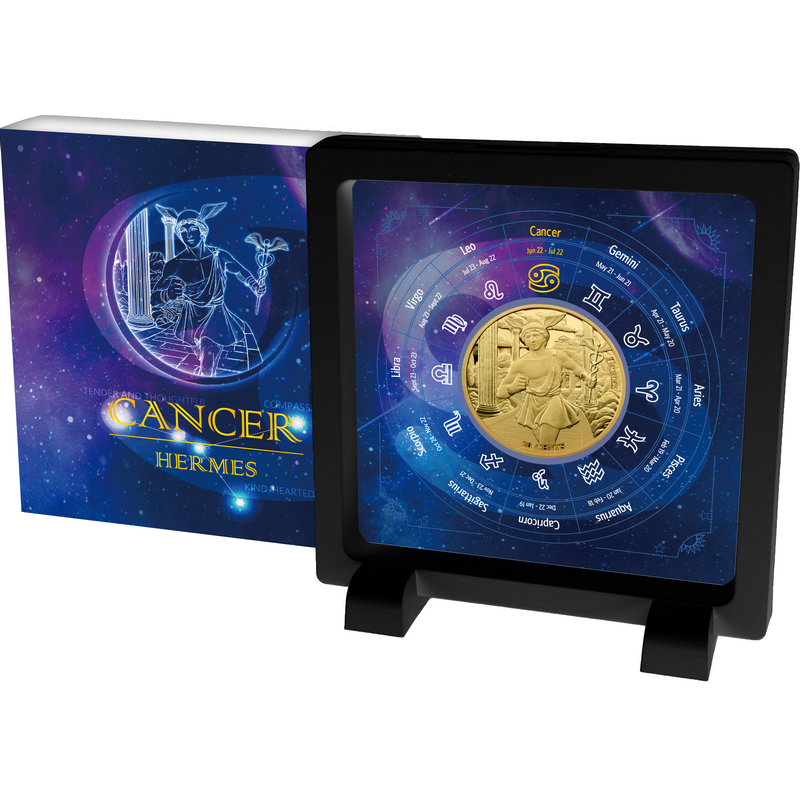
The Twelve Olympians in the Zodiac - Hermes & Cancer. Samoa 0.20 $ 2021 Gold plated Copper/Nickel coin
Price:
35,00 €
Face value: 0.2 $
Issuing country: Samoa
Weight: 25 g
Diameter: 40 mm
Mintage: 3000
Issuing country: Samoa
Weight: 25 g
Diameter: 40 mm
Mintage: 3000
Kollektsioon
The Twelve Olympians in the Zodiac - Ares & Scorpio Samoa 0.20 $ 2021 Gold plated Copper/Nickel coin
Face value: 0.2 $
Issuing country: Samoa
Weight: 25 g
Diameter: 40 mm
Scorpio is the second Mars sign, and the one that most relates to Ares: while the fiery aspects of Aries might relate to him to some extent, it’s the more emotional Scorpio that resonates closer to him and his primal nature. As the later Autumn sign, Scorpio is related to Winter’s start, and thus to sunset-like conditions: as the Sun dims, so does life. Scorpio is defined by it’s loyalty bordering on possessiveness, as well as a rather strong impulsive nature but consciously made subtle or even outright hidden. Ares displays a surprising amount of loyalty to his family, even when most of Olympus doesn’t like him very much, and while numerous, his affairs are occult, unlike Zeus’ or Apollo’s. This reflects water as darkness: driven by strong impulses, but with the element of mystery and hidden nature. Due to Scorpio’s vindictiveness and hidden nature, it is often considered the most malign of the signs, just as Ares is the most distrusted of the Olympians, but neither are “evil” and while unpleasant they are necessary for the inner workings of nature. Darkness is after all important to health in it’s Melatonin friendliness, especially when it’s connected to water.
Issuing country: Samoa
Weight: 25 g
Diameter: 40 mm
Scorpio is the second Mars sign, and the one that most relates to Ares: while the fiery aspects of Aries might relate to him to some extent, it’s the more emotional Scorpio that resonates closer to him and his primal nature. As the later Autumn sign, Scorpio is related to Winter’s start, and thus to sunset-like conditions: as the Sun dims, so does life. Scorpio is defined by it’s loyalty bordering on possessiveness, as well as a rather strong impulsive nature but consciously made subtle or even outright hidden. Ares displays a surprising amount of loyalty to his family, even when most of Olympus doesn’t like him very much, and while numerous, his affairs are occult, unlike Zeus’ or Apollo’s. This reflects water as darkness: driven by strong impulses, but with the element of mystery and hidden nature. Due to Scorpio’s vindictiveness and hidden nature, it is often considered the most malign of the signs, just as Ares is the most distrusted of the Olympians, but neither are “evil” and while unpleasant they are necessary for the inner workings of nature. Darkness is after all important to health in it’s Melatonin friendliness, especially when it’s connected to water.
35,00 €
Face value: 0.2 $
Issuing country: Samoa
Weight: 25 g
Diameter: 40 mm
Hephaestus‘ correspondence with Libra is derived from his role as the smith god. By crafting fire, he made the weapons that the gods use to impose justice, down to the scales of Dike, the goddess of justice, often thought to be the woman depicted in the sign. As just, Hephaestus is a god of innovation, taming the chaos of the flames to produce items to impose civilization.
Issuing country: Samoa
Weight: 25 g
Diameter: 40 mm
Hephaestus‘ correspondence with Libra is derived from his role as the smith god. By crafting fire, he made the weapons that the gods use to impose justice, down to the scales of Dike, the goddess of justice, often thought to be the woman depicted in the sign. As just, Hephaestus is a god of innovation, taming the chaos of the flames to produce items to impose civilization.
35,00 €
Similar products
Face valie 0,5 AUD
Metal: copper/nickel
Weight: 15,37 g
Diameter: 31,51 mm
Mintage: unlimited
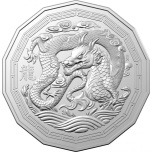
In 2024 we celebrate the Lunar of the Dragon. People who are born under this sign are said to be enthusiastic, confident and 'natural born leaders'. This 2024 50c Uncirculated Tetradecagon Coin, with it's traditional and auspicious design, will make an honored and traditional gift for Chinese New Year.
Metal: copper/nickel
Weight: 15,37 g
Diameter: 31,51 mm
Mintage: unlimited
In 2024 we celebrate the Lunar of the Dragon. People who are born under this sign are said to be enthusiastic, confident and 'natural born leaders'. This 2024 50c Uncirculated Tetradecagon Coin, with it's traditional and auspicious design, will make an honored and traditional gift for Chinese New Year.
29,00 €
Issuing Country: France
Face value: 5 €
Metal: Copper/Nickel
Diameter: 29 mm
Quality: B.U.
Mintage: 25 000
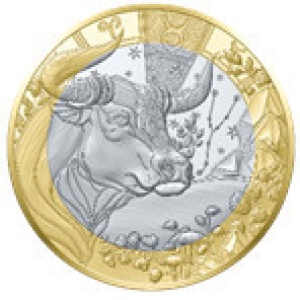
The wheel of the zodiac signs is engraved on the coin's gold-colored crown. One sign stands out from the background because it is larger than the others and has a sandblasted background, different from the smoother one of the others. It is the symbol of the Taurus. A pattern of leaves, mushrooms and crystals, reminiscent of the sign's element, earth, surrounds the imposing bust of a bull. The animal's horns and forehead are adorned with arabesques. The starry sky in the background features the Taurus constellation.
Face value: 5 €
Metal: Copper/Nickel
Diameter: 29 mm
Quality: B.U.
Mintage: 25 000
The wheel of the zodiac signs is engraved on the coin's gold-colored crown. One sign stands out from the background because it is larger than the others and has a sandblasted background, different from the smoother one of the others. It is the symbol of the Taurus. A pattern of leaves, mushrooms and crystals, reminiscent of the sign's element, earth, surrounds the imposing bust of a bull. The animal's horns and forehead are adorned with arabesques. The starry sky in the background features the Taurus constellation.
20,00 €
Issuing Country: France
Face value: 5 €
Metal: Copper/Nickel
Diameter: 29 mm
Quality: B.U.
Mintage: 25 000
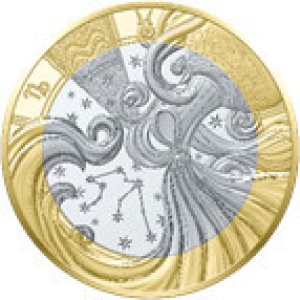
The wheel of the zodiac signs is engraved on the coin's gold-colored crown. One sign stands out from the background because it is larger than the others and has a sandblasted background, different from the smoother one of the others. It is the symbol of Aquarius. Part of the wheel is hidden by spirals of mist, in reference to air, the element of this sign. Another part of the wheel is submerged by water poured from the spout of an ornate vase. A starry sky with the constellation Aquarius can be seen in the background.
Face value: 5 €
Metal: Copper/Nickel
Diameter: 29 mm
Quality: B.U.
Mintage: 25 000
The wheel of the zodiac signs is engraved on the coin's gold-colored crown. One sign stands out from the background because it is larger than the others and has a sandblasted background, different from the smoother one of the others. It is the symbol of Aquarius. Part of the wheel is hidden by spirals of mist, in reference to air, the element of this sign. Another part of the wheel is submerged by water poured from the spout of an ornate vase. A starry sky with the constellation Aquarius can be seen in the background.
20,00 €
Face Value: 3 Euro
Quality: B.U,
Diameter: 34 mm
Metal: Copper/nickel
Weight: 16 g
Mintage: 65 000
Comes without packaging
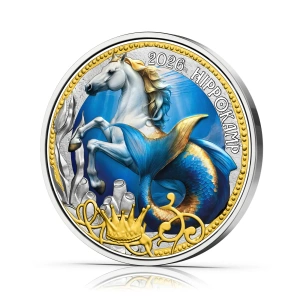
The Mythical Creatures series continues its journey into the world of legends with the 3-euro Hippocampus coin. The hippocampus is an ancient hybrid creature, part horse and part fish, which, according to mythology, pulled the chariot of Poseidon, god of the sea. Its name is derived from the Greek words for horse (hippos) and sea monster (kampos). On the colour-printed coin, a white horse with a shimmering fish tail rears up, surrounded by seaweed and coral. Under UV light, the motif appears to come to life. The obverse shows an ornately decorated key with the letter F for mythical creature and a stylised sun.
Quality: B.U,
Diameter: 34 mm
Metal: Copper/nickel
Weight: 16 g
Mintage: 65 000
Comes without packaging
The Mythical Creatures series continues its journey into the world of legends with the 3-euro Hippocampus coin. The hippocampus is an ancient hybrid creature, part horse and part fish, which, according to mythology, pulled the chariot of Poseidon, god of the sea. Its name is derived from the Greek words for horse (hippos) and sea monster (kampos). On the colour-printed coin, a white horse with a shimmering fish tail rears up, surrounded by seaweed and coral. Under UV light, the motif appears to come to life. The obverse shows an ornately decorated key with the letter F for mythical creature and a stylised sun.
29,00 €
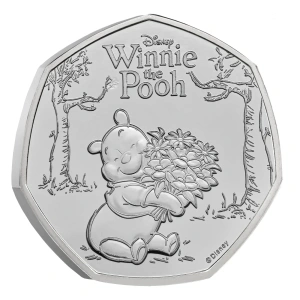
Denomination: 50 p
Maximum Coin Mintage: Unlimited
Alloy: Copper/Nickel
Weight: 8.00 g
Diameter: 27.30 mm
Quality B.U.
Year 2026
First written by A.A. Milne in 1926, Winnie-the-Pooh and its sequel, The House at Pooh Corner (1928), have become timeless classics loved by generations around the world. These beloved children’s books tell the adventures of Winnie the Pooh and his friends in the Hundred Acre Wood that sometimes include visits from Christopher Robin, a young boy based on Milne’s son of the same name. The legacy of the Winnie the Pooh stories found new life through the animations created by Disney, which saw Pooh gain his iconic red shirt.
Maximum Coin Mintage: Unlimited
Alloy: Copper/Nickel
Weight: 8.00 g
Diameter: 27.30 mm
Quality B.U.
Year 2026
First written by A.A. Milne in 1926, Winnie-the-Pooh and its sequel, The House at Pooh Corner (1928), have become timeless classics loved by generations around the world. These beloved children’s books tell the adventures of Winnie the Pooh and his friends in the Hundred Acre Wood that sometimes include visits from Christopher Robin, a young boy based on Milne’s son of the same name. The legacy of the Winnie the Pooh stories found new life through the animations created by Disney, which saw Pooh gain his iconic red shirt.
29,00 €