


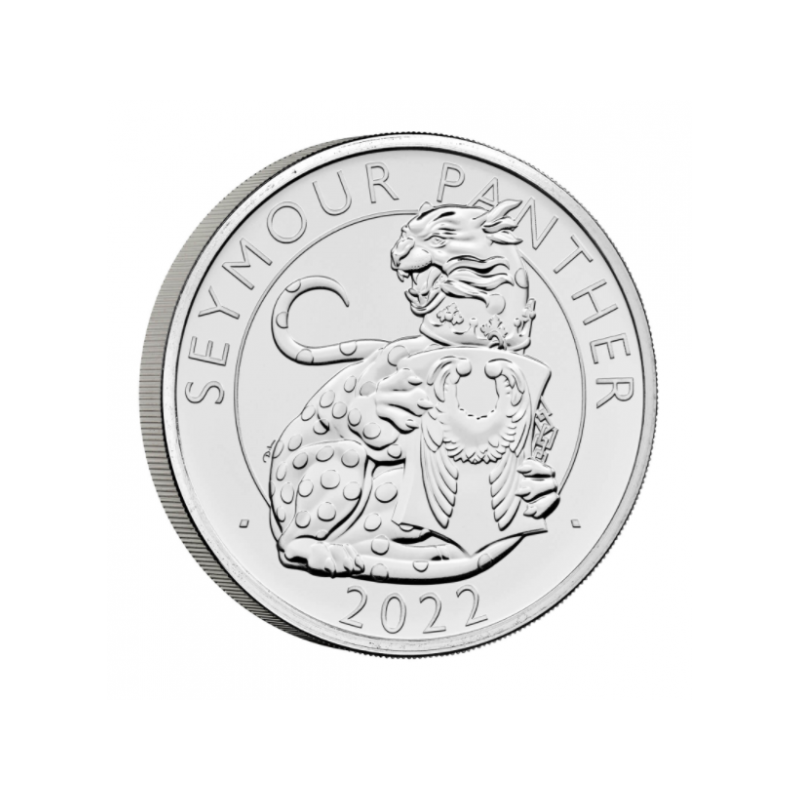
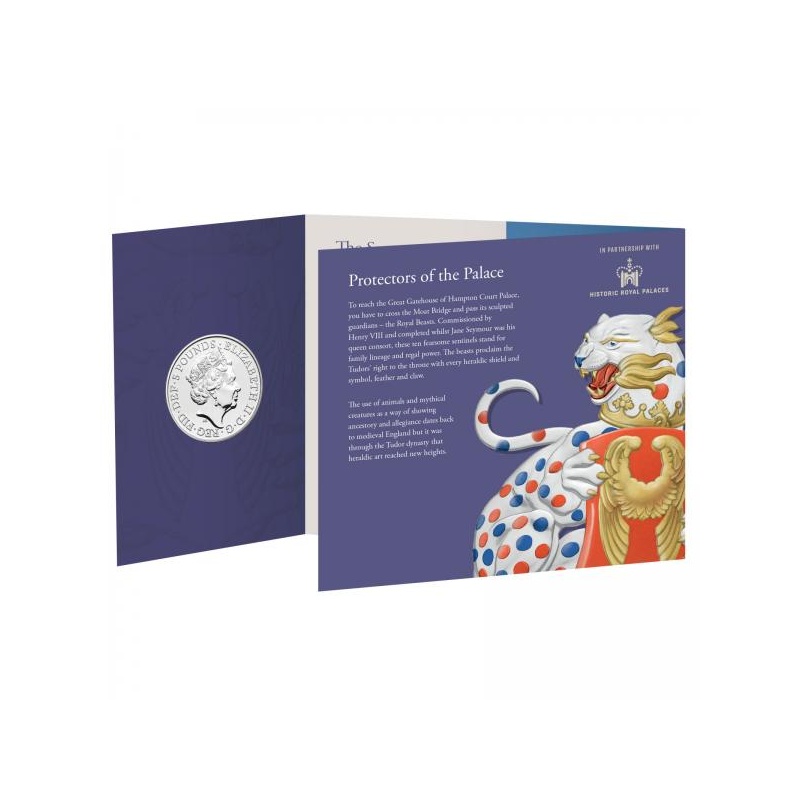
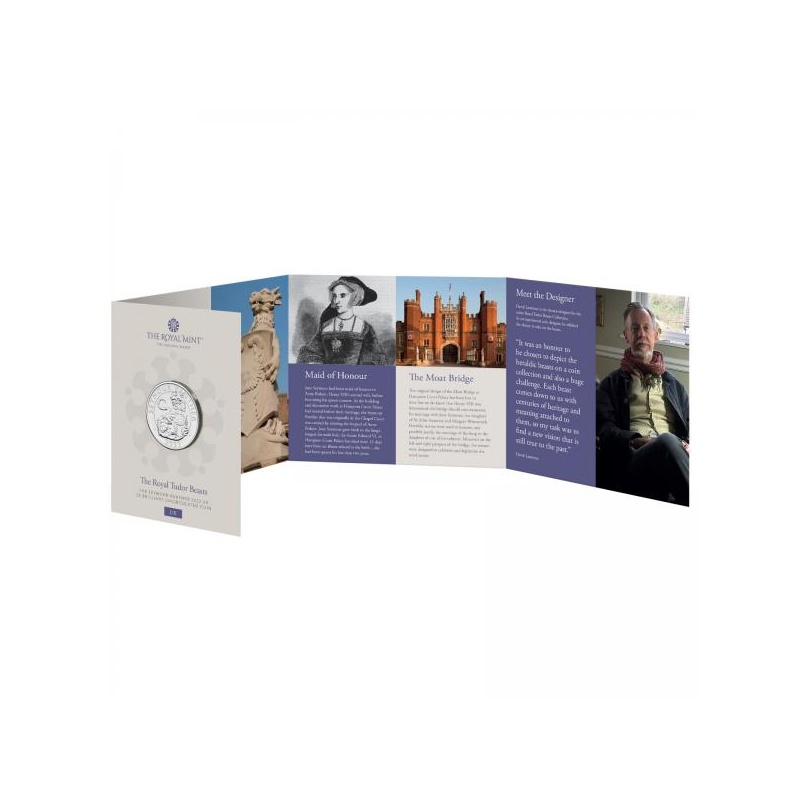
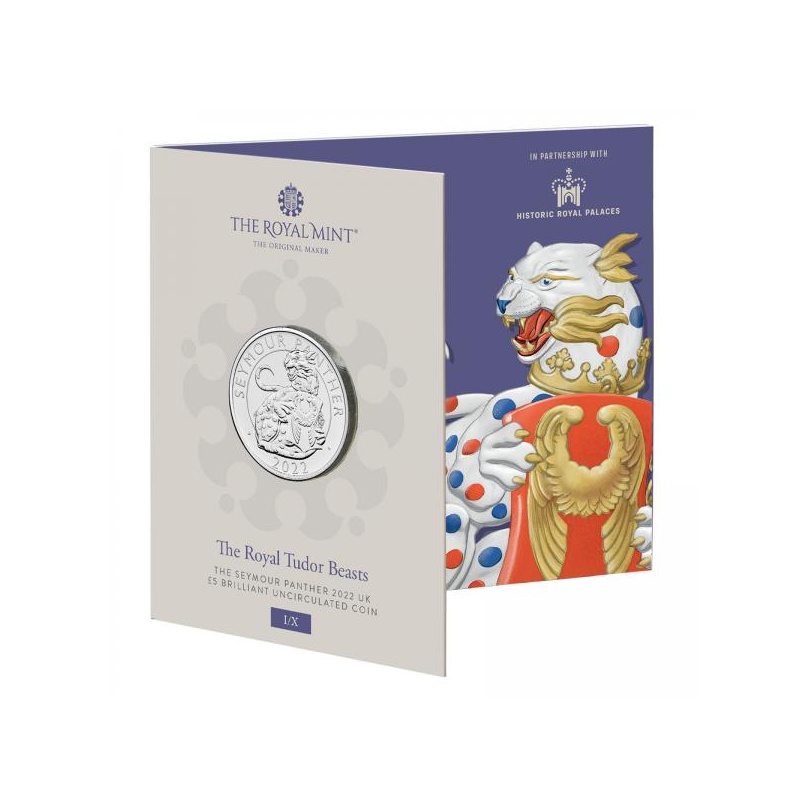
The Royal Tudor Beast - The Panther of Seymour UK 5£ 2022 Brilliant Uncirculated Coin
Price:
25,00 €
Denomination: 5 £
Alloy: Cupper/Nickel
Weight: 28.28 g
Diameter: 38.61 mm
Year: 2022
The first coin in a collection honouring ten heraldic Royal Beasts
Celebrate the matrimonial union of Henry VIII and Jane Seymour
Commemorate the heraldic beasts of the Tudor dynasty
The first coin in the Royal Tudor Beasts Collection features the Seymour Panther, which was given to Jane Seymour by the king from the royal treasury of beasts. Depicted with flames coming out of its mouth and ears and known for its intoxicating fragrant breath, the fiery beast represents the union between a committed consort and a mighty monarch.
Alloy: Cupper/Nickel
Weight: 28.28 g
Diameter: 38.61 mm
Year: 2022
The first coin in a collection honouring ten heraldic Royal Beasts
Celebrate the matrimonial union of Henry VIII and Jane Seymour
Commemorate the heraldic beasts of the Tudor dynasty
The first coin in the Royal Tudor Beasts Collection features the Seymour Panther, which was given to Jane Seymour by the king from the royal treasury of beasts. Depicted with flames coming out of its mouth and ears and known for its intoxicating fragrant breath, the fiery beast represents the union between a committed consort and a mighty monarch.
Similar products
„Colours of Wildlife. Jaguar" Barbados 5$ 2024 99,9% silver coin with translucent green enamel. 3 oz
Face Value: 5 Dollars
Weight: 3 oz
Silver: 99-9%
Diameter: 50 mm
Quality: Antique Finish
Issuing Country: Barbados
Year Date: 2024
Special Feature: Extra High Relief with translucent green enamel
Mintage: 999
Weight: 3 oz
Silver: 99-9%
Diameter: 50 mm
Quality: Antique Finish
Issuing Country: Barbados
Year Date: 2024
Special Feature: Extra High Relief with translucent green enamel
Mintage: 999
575,00 €
Face value: 0.2 $
Issuing country: Samoa
Weight: 25 g
Diameter: 40 mm
Hestia's main sign if Capricorn, which stresses her more subtle but relevant nature. Capricorn, like Sagittarius, also stresses order, stability and stoicness. More so, it takes theses traits further and is a sign associated with practicality, hard work, strong will and stubbornness. Hestia, as the perpetual tender of the flames, is definitely a very hard working and practical goddess, and while I by no means would refer to her as “stubborn”, she does have a strong will in what little myths she appears in. Capricorn is also relevant in it’s role in the Zodiac. It’s the sign that covers the Winter Solstice, when the Sun is at it’s lowest, being opposite to Cancer. Thus, not only does it coincide with the time of the year where Hestia’s influence is most important, as well as to her role as the center, it also coincides with a liminal time in the Zodiac, when the Sun is reborn.
Issuing country: Samoa
Weight: 25 g
Diameter: 40 mm
Hestia's main sign if Capricorn, which stresses her more subtle but relevant nature. Capricorn, like Sagittarius, also stresses order, stability and stoicness. More so, it takes theses traits further and is a sign associated with practicality, hard work, strong will and stubbornness. Hestia, as the perpetual tender of the flames, is definitely a very hard working and practical goddess, and while I by no means would refer to her as “stubborn”, she does have a strong will in what little myths she appears in. Capricorn is also relevant in it’s role in the Zodiac. It’s the sign that covers the Winter Solstice, when the Sun is at it’s lowest, being opposite to Cancer. Thus, not only does it coincide with the time of the year where Hestia’s influence is most important, as well as to her role as the center, it also coincides with a liminal time in the Zodiac, when the Sun is reborn.
35,00 €
Quality: Special Uncirculated
Face Value: 5 Euro
Diameter: 28,5 mm
Copper: 99,9%
Total Weight: 8,5 g
Comes without packaging
The New Year Coin 2024 is a special coin for a very special year. With 366 days instead of the usual 365, 2024 is a leap year and this limited-mintage coin is designed to remind you that the extra day should be enjoyed amid the hustle and bustle of everyday life.
The extra day in a leap year keeps the calendar year synchronised with the solar year and thus with the cosmic order. You should accept it as a heavenly gift and treat it as an extra portion of luck. The extra day is a day with great potential on which you can allow yourself a little more ‘me time’, dedicate more time than usual to someone else, or do something you have always wanted to do. Or if you have resolved to tackle something completely new by the end of the year, why not use the extra day for that? Everyday life tends to demand a great deal from us without making any concessions, but that is not the case in 2024 when we are given a whole extra day to enjoy.
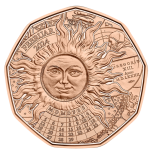
The reverse of the nine-sided coin is dedicated to the Gregorian calendar, which was introduced by Pope Gregory XIII in 1582 to bring the calendar back into line with the solar year. Pope Gregory XIII features on the right edge of the coin next to a large, flame-haired human manifestation of the Sun. Below the Sun is the calendar page for the month of February showing the 29th of February – the extra day. At the top is the zodiac sign Pisces, which corresponds to late February. The coin’s obverse shows the coats of arms of the nine provinces of Austria.
Face Value: 5 Euro
Diameter: 28,5 mm
Copper: 99,9%
Total Weight: 8,5 g
Comes without packaging
The New Year Coin 2024 is a special coin for a very special year. With 366 days instead of the usual 365, 2024 is a leap year and this limited-mintage coin is designed to remind you that the extra day should be enjoyed amid the hustle and bustle of everyday life.
The extra day in a leap year keeps the calendar year synchronised with the solar year and thus with the cosmic order. You should accept it as a heavenly gift and treat it as an extra portion of luck. The extra day is a day with great potential on which you can allow yourself a little more ‘me time’, dedicate more time than usual to someone else, or do something you have always wanted to do. Or if you have resolved to tackle something completely new by the end of the year, why not use the extra day for that? Everyday life tends to demand a great deal from us without making any concessions, but that is not the case in 2024 when we are given a whole extra day to enjoy.
The reverse of the nine-sided coin is dedicated to the Gregorian calendar, which was introduced by Pope Gregory XIII in 1582 to bring the calendar back into line with the solar year. Pope Gregory XIII features on the right edge of the coin next to a large, flame-haired human manifestation of the Sun. Below the Sun is the calendar page for the month of February showing the 29th of February – the extra day. At the top is the zodiac sign Pisces, which corresponds to late February. The coin’s obverse shows the coats of arms of the nine provinces of Austria.
15,00 €
Country: Cook Islands
Year: 2024
Face Value: 5 Dollars
Silver: 99.9%
Weight: 1 oz
Size: 38,61 mm
Quality: Proof
Mintage: 1 500
Technique: Smartminting®
Dive into myth and folklore with our latest issue of the «X-Ray» series. Mermaids, or sirens, evoke both peril and benevolence in various traditions. From the haunting beauty of Greek sirens to Hans Christian Andersen’s poignant tale of «The Little Mermaid», their appeal persists.
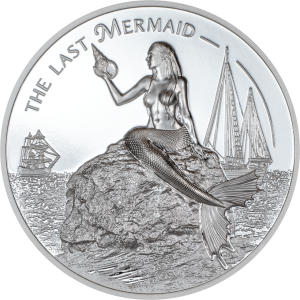
The front features a mermaid with detailed polished scales and imposing ships in the backdrop. Meanwhile, the back exhibits a sophisticated application of colour, presenting a near-realistic portrayal of an X-ray image of the «Last Mermaid».
Year: 2024
Face Value: 5 Dollars
Silver: 99.9%
Weight: 1 oz
Size: 38,61 mm
Quality: Proof
Mintage: 1 500
Technique: Smartminting®
Dive into myth and folklore with our latest issue of the «X-Ray» series. Mermaids, or sirens, evoke both peril and benevolence in various traditions. From the haunting beauty of Greek sirens to Hans Christian Andersen’s poignant tale of «The Little Mermaid», their appeal persists.
The front features a mermaid with detailed polished scales and imposing ships in the backdrop. Meanwhile, the back exhibits a sophisticated application of colour, presenting a near-realistic portrayal of an X-ray image of the «Last Mermaid».
199,00 €
Issuing Country: France
Face value: 5 €
Metal: Copper/Nickel
Diameter: 29 mm
Quality: B.U.
Mintage: 25 000
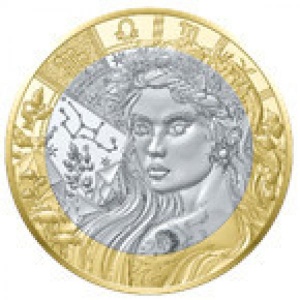
The wheel of the zodiac signs is engraved on the coin's gold-colored crown. One sign stands out from the background because it is larger than the others and has a sandblasted background, different from the smoother one of the others. It is the symbol of the Virgo. The main feature of the engraving is the bust of a woman whose long hair is topped with a crown of flowers. She is gazing over her shoulder with an air of mystery. Around her, a backdrop of leaves, mushrooms and crystals recalls the element of the sign, earth. In the background, a starry sky features the constellation of Virgo
Face value: 5 €
Metal: Copper/Nickel
Diameter: 29 mm
Quality: B.U.
Mintage: 25 000
The wheel of the zodiac signs is engraved on the coin's gold-colored crown. One sign stands out from the background because it is larger than the others and has a sandblasted background, different from the smoother one of the others. It is the symbol of the Virgo. The main feature of the engraving is the bust of a woman whose long hair is topped with a crown of flowers. She is gazing over her shoulder with an air of mystery. Around her, a backdrop of leaves, mushrooms and crystals recalls the element of the sign, earth. In the background, a starry sky features the constellation of Virgo
20,00 €