




Mythical Creatures - The Elf - 3 € 2026 base metal coin, 16 g
Price:
39,00 €
Face Value: 3 Euro
Quality: B.U,
Diameter: 34 mm
Metal: Copper/nickel
Weight: 16 g
Mintage: 65 000
Comes without packaging
A fleeting being flits through the air, an exquisitely delicate creature. But then it alights for a moment. And allows itself to be admired. – The coin allows you to become closely acquainted with a lovable elf.
The third coin in the ‘Magical and Mythical Creatures’ series depicts a colourful elf with butterfly wings. – Especially when ultraviolet light sweeps across her, she seems to come alive. – “Elves remind us that there’s more than we see with the naked eye alone. There’s the wood elf, the wind elf, the sun elf, the moon elf – and then there’s your elf.” (Thomas Brezina)
Elven Myths
Depending on which myth and which era we look at, a different image of elves prevails. The terms ‘elf’ and ‘fairy’ are often used interchangeably in everyday language today, but they have different mythological origins.
Elves come from Norse and Celtic mythology. They played an important role in medieval superstition. Elves were also frequently equated or confused with dwarves or demons.
In 19th-century children’s books, a friendlier image of elves began to take hold. It became common to imagine elves as small magical beings that live among flowers and flit about in nature.
In Iceland they are actually invisible. The so-called huldufólk – or the hidden people – are firmly rooted in local folklore. In legends and fairy tales, they populate wild and untouched nature. Nowadays, very few people in Iceland believe in elves in the literal sense. But for the vast majority, they certainly have significance as part of the cultural heritage. Today, a belief in elves primarily expresses appreciation for an ancient storytelling tradition and a close connection with nature. In Icelandic planning approval procedures, one aspect considered alongside others is whether a project would cause damage to cultural heritage. This includes features of the landscape such as large stones or rocks, which are regarded in Icelandic folklore as being inhabited by elves.
Coin motif
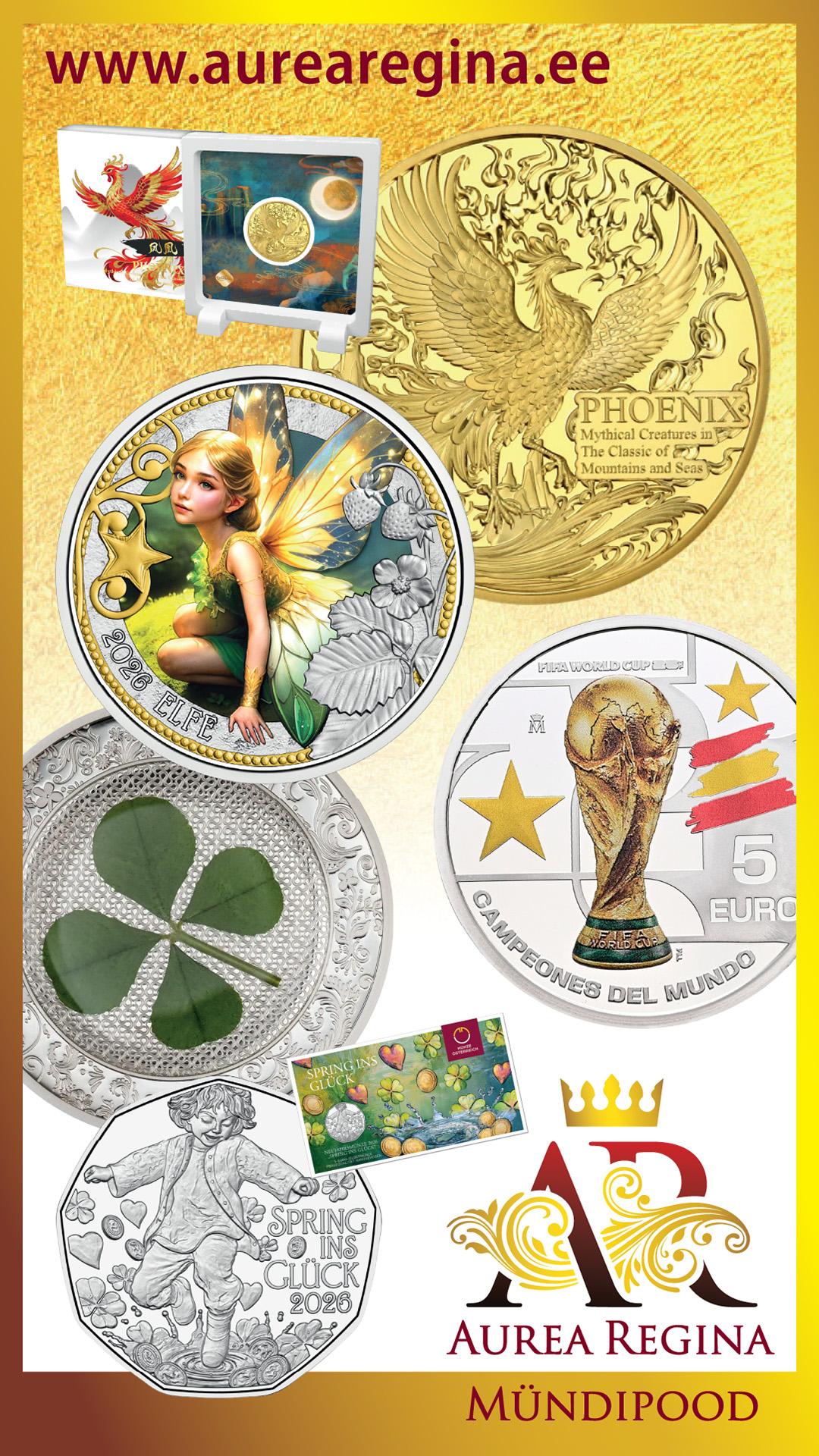
A winged elf in a little greenish dress has alighted on the coin. To her right, strawberries together with their blossoms and leaves can be seen in the foreground. To the left, an ornament printed in gold and a star are visible. A band around the edge, also printed in gold, is interrupted in places by the relief. – The colours of the mythical creature and the inscription ‘ELFE’ change in ultraviolet light, enhancing the magical effect of the motif.
The obverse features an intricately decorated key with the letter ‘F’ – ‘F’ as in fairy tale. In the background, a sun is depicted in the style of a silhouette, recessed into a circular relief with a subtle texture. The stars sparkling at the edge and all around, as well as the irregularly shaped letters, create a magical effect.
Kollektsioon
Face Value: 3 Euro
Quality: B.U,
Diameter: 34 mm
Metal: Copper/nickel
Weight: 16 g
Mintage: 65 000
Comes without packaging
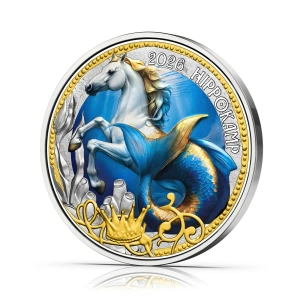
The Mythical Creatures series continues its journey into the world of legends with the 3-euro Hippocampus coin. The hippocampus is an ancient hybrid creature, part horse and part fish, which, according to mythology, pulled the chariot of Poseidon, god of the sea. Its name is derived from the Greek words for horse (hippos) and sea monster (kampos). On the colour-printed coin, a white horse with a shimmering fish tail rears up, surrounded by seaweed and coral. Under UV light, the motif appears to come to life. The obverse shows an ornately decorated key with the letter F for mythical creature and a stylised sun.
39,00 €
Similar products

Face value: Samoa 2$
Weight: 31,1 gr
Silver: 99,9%
Diameter: 40 mm
Mintage: 2024
In East Asian Buddhism, the Twelve Heavenly Generals or Twelve Divine Generals are the protective deities,
Weight: 31,1 gr
Silver: 99,9%
Diameter: 40 mm
Mintage: 2024
In East Asian Buddhism, the Twelve Heavenly Generals or Twelve Divine Generals are the protective deities,
149,00 €
Face value: 5 €
Diameter: 34 mm
Weight: 19.1 g
Metal: Brass
Mintage: 40,000
Obverse:
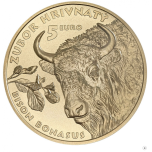
The obverse of the euro collector coin depicts a male European bison with trees in the background above and fallen branches in the foreground below. The Slovak coat of arms appears in the lower right of the design, just below the year of issuance ‘2024’. The name of the issuing country ‘SLOVENSKO’ is inscribed along part of the left edge. In the lower part of the design are the mint mark of the Kremnica Mint (Mincovňa Kremnica), consisting of the letters ‘MK’ placed between two dies, and the stylised letters ‘KL’, referring to the coin’s designer Karol Ličko.
Reverse:
On the reverse, a depiction of a European bison’s head dominates the centre and right of the design. Above the head are the coin’s denomination and currency, ‘5 EURO’. The Slovak name of the European bison, ‘ZUBOR HRIVNATÝ’, is inscribed along the upper-left edge, and the scientific name, ‘BISON BONASUS’, is at the lower-left edge. The two names are separated by a beech twig with leaves and nuts.
The bison is Europe’s largest land mammal, with its build resembling that of cattle. It has a relatively short, rounded head and is covered with brown hair from head to tail. The forequarters are bulkier than the hindquarters and are further accentuated by longer hair. Strong, hollow horns are a permanent feature of both sexes and grow with age. Bison are most active at dusk, and their vision has adapted accordingly. Their best-developed senses are hearing and smell. They can live to around 35 years of age. Bison are a social animal that typically live in herds of 8 to 13 animals, though older males tend to be solitary. They feed mainly on green and woody plant matter, including branches, bark and leaves. They prefer younger forest stands with dense undergrowth. In winter, their staple food sources are brambles, tree bark, shrubs and dry grass, which they dig out from under the snow. The bison’s historical range extended almost throughout Europe. In Slovakia today, approximately 70 individuals of the species live wild on a reservation in the Poloniny National Park.
14,90 €

Metal: NordicGold
Weight: 15,80 g
Diameter: 34 mm
Mintage: 10 000
In 2022, Smiley celebrates its fifth decade of smiles and optimism.
The emblematic yellow, round face of the brand was born on 1st, January 1972 in France, when journalist Franklin Loufrani used this infectious smile in the newspaper France-soir in order to highlight stories which brought positive news and cheered up French people’s spirit. This operation, called « Take the time to smile » was an immediate success.
In 1996, the logo is relaunched and developed in other forms : a new 3D version is created and new expressions are added in. Nowadays, from the smiley to the emoticon, smiling takes multiple forms, becoming a representative of cheerfulness !
Since the creation of the yellow smile in 1972, Smiley diversified the range of its expressions, conveying over a hundred émotions. From the smiley to the emoticon, smiling takes multiple forms.
Each mini-medal highlights a particular emotion : love, gratitude, gluttony, joy and laughing.
The medals are packaged in a coloured packaging, to treat to someone or to yourself.
30,00 € (23%)
39,00 €
39,00 €

Issuing Country: France
Face value: 5 €
Metal: Copper/Nickel
Diameter: 29 mm
Quality: B.U.
Mintage: 25 000
The wheel of the zodiac signs is engraved on the coin's gold-colored crown. One sign stands out from the background because it is larger than the others and has a sandblasted background, different from the smoother one of the others. It is the symbol of Scorpio. The lower part of the wheel is embedded in a wave, in reference to water, the element of this sign. A Scorpion, its shell and claws adorned with arabesques, hugs the circular shape of the coin as it arcs into it. In the background, a starry sky features the Scorpio constellation.
20,00 €
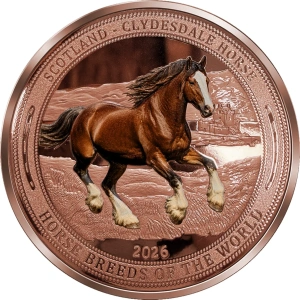
Face Value: 1$
Diameter:65 mm
Copper: 99,9%
Total Weight: 155,5 g
Auality: B.U.
Mintage: 999
Comes in box
The third release in the Horse Breeds of the World series celebrates Scotland's iconic Clydesdale Horse. Struck in 5 oz of copper with vibrant colour, it beautifully captures the power and grace of this legendary breed.
99,00 €