


Fauna and flora in Slovakia. European pond turtle. Slovakia 5€ 2026 commemorative coin
Unit: tk
Price:
19,00 €
Face value: 5 €
Diameter: 34 mm
Weight: 19.1 g
Metal: Brass
Mintage: 55,000
The European pond turtle (Emys orbicularis) is an aquatic turtle species. Native to Slovakia, the pond turtle was once widespread throughout the south of the country, but today its strongest populations are found in the Eastern Slovak Lowland and the Danubian Lowland. It is a protected reptile species that can live for more than 100 years. The pond turtle inhabits still or slowly flowing waters with muddy bottoms and rich vegetation, such as oxbow lakes, canals, ponds, lakes, and marshes. It is an excellent swimmer and diver and often basks in the sun on banks, tree trunks, or stones. Sandy areas are essential for egg laying. After overwintering, the hatchlings dig their way out and move to the water. Adults hibernate underwater, buried in mud. The pond turtle’s diet consists mainly of aquatic invertebrates, but it also feeds on frogs, tadpoles, fish, algae, and plants. Appropriate measures to support its conservation include the restoration of wetlands and nesting sites in their surroundings, as well as preventing the release of non-native invasive turtle species into the wild.
Obverse:
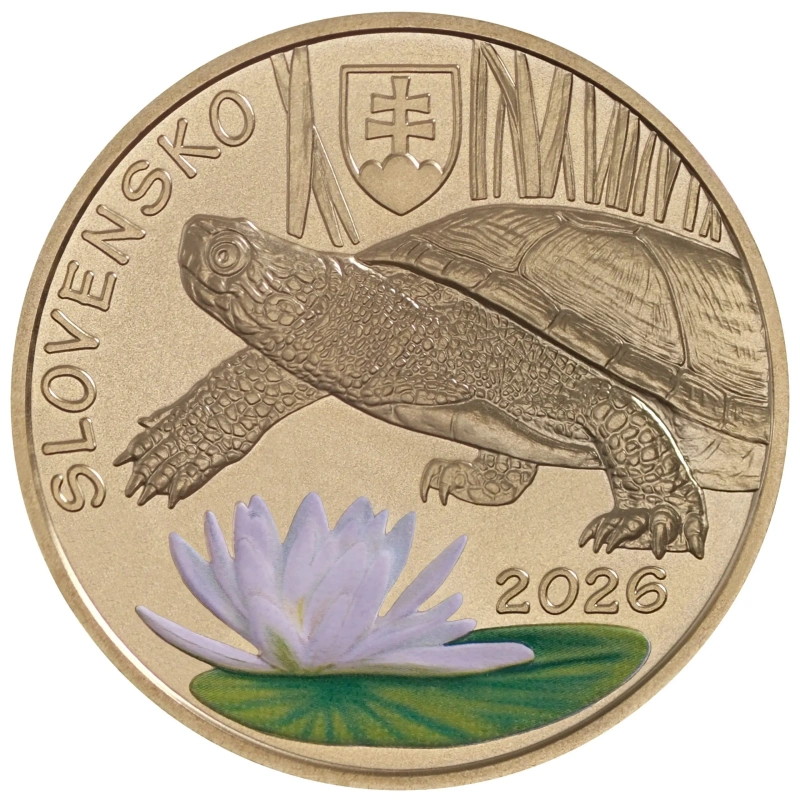
The obverse depicts a European pond turtle (Emys orbicularis) in its natural habitat. The bottom of the field features a white water lily rendered in colour. Above the turtle is the Slovak coat of arms, and below it, in the lower right, is the year of issuance ‘2026’. The name of the issuing country ‘SLOVENSKO’ is inscribed along the upper left edge.
Reverse:
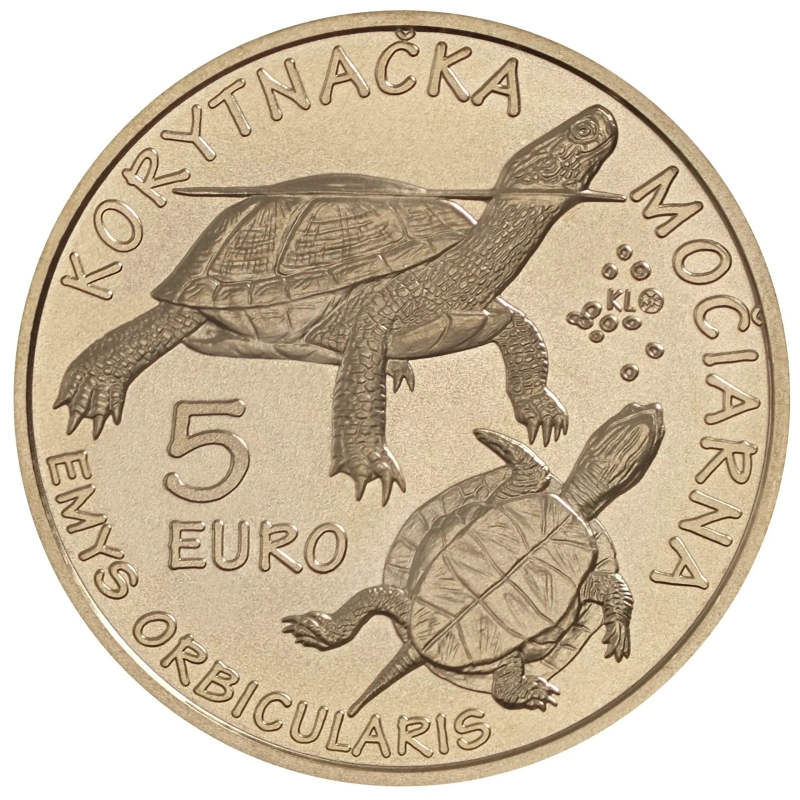
The reverse design consists of two European pond turtles swimming in water. To their left are the coin’s denomination ‘5’ and currency ‘EURO’, one above the other. The inscription ‘KORYTNAČKA MOČIARNA’, the Slovak name of the European pond turtle, runs along the edge of the field from the upper left to the lower right, while the scientific name ‘EMYS ORBICULARIS’ is inscribed along the lower left edge. On the right side, among the bubbles between the turtles’ heads, are the stylised initials ‘KL’ of the coin’s designer, Karol Ličko, and the mint mark of the Kremnica Mint (Mincovňa Kremnica), consisting of the letters ‘MK’ between two dies.
Diameter: 34 mm
Weight: 19.1 g
Metal: Brass
Mintage: 55,000
The European pond turtle (Emys orbicularis) is an aquatic turtle species. Native to Slovakia, the pond turtle was once widespread throughout the south of the country, but today its strongest populations are found in the Eastern Slovak Lowland and the Danubian Lowland. It is a protected reptile species that can live for more than 100 years. The pond turtle inhabits still or slowly flowing waters with muddy bottoms and rich vegetation, such as oxbow lakes, canals, ponds, lakes, and marshes. It is an excellent swimmer and diver and often basks in the sun on banks, tree trunks, or stones. Sandy areas are essential for egg laying. After overwintering, the hatchlings dig their way out and move to the water. Adults hibernate underwater, buried in mud. The pond turtle’s diet consists mainly of aquatic invertebrates, but it also feeds on frogs, tadpoles, fish, algae, and plants. Appropriate measures to support its conservation include the restoration of wetlands and nesting sites in their surroundings, as well as preventing the release of non-native invasive turtle species into the wild.
Obverse:
The obverse depicts a European pond turtle (Emys orbicularis) in its natural habitat. The bottom of the field features a white water lily rendered in colour. Above the turtle is the Slovak coat of arms, and below it, in the lower right, is the year of issuance ‘2026’. The name of the issuing country ‘SLOVENSKO’ is inscribed along the upper left edge.
Reverse:
The reverse design consists of two European pond turtles swimming in water. To their left are the coin’s denomination ‘5’ and currency ‘EURO’, one above the other. The inscription ‘KORYTNAČKA MOČIARNA’, the Slovak name of the European pond turtle, runs along the edge of the field from the upper left to the lower right, while the scientific name ‘EMYS ORBICULARIS’ is inscribed along the lower left edge. On the right side, among the bubbles between the turtles’ heads, are the stylised initials ‘KL’ of the coin’s designer, Karol Ličko, and the mint mark of the Kremnica Mint (Mincovňa Kremnica), consisting of the letters ‘MK’ between two dies.
Similar products
Face value: 5 €
Diameter: 34 mm
Weight: 19.1 g
Metal: Brass
Mintage: 45,000
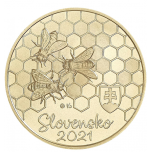
The first coin from the series “Fauna and Flora of Slovakia”.
Bees are a social insect characterized by division of labor, collective care for their offspring, and the ability to survive adverse periods through colony thermoregulation and stockpiling.
The obverse of the coin depicts three bees on a honeycomb, the lower right part of which is covered with the coat of arms of Slovakia. Also indicated is the name of the issuing state “SLOVENSKO”, the year of issue of the coin, the mark of the Kremnica mint, consisting of the letters “MK” and the letter “KL” (initials of the coin designer Karol Lichko)
The reverse depicts two flowers, the largest of which is a bee. The denomination of the coin is indicated at the top. Below – the theme of the coin – “včela medonosná” (“honey bee”).
Diameter: 34 mm
Weight: 19.1 g
Metal: Brass
Mintage: 45,000
The first coin from the series “Fauna and Flora of Slovakia”.
Bees are a social insect characterized by division of labor, collective care for their offspring, and the ability to survive adverse periods through colony thermoregulation and stockpiling.
The obverse of the coin depicts three bees on a honeycomb, the lower right part of which is covered with the coat of arms of Slovakia. Also indicated is the name of the issuing state “SLOVENSKO”, the year of issue of the coin, the mark of the Kremnica mint, consisting of the letters “MK” and the letter “KL” (initials of the coin designer Karol Lichko)
The reverse depicts two flowers, the largest of which is a bee. The denomination of the coin is indicated at the top. Below – the theme of the coin – “včela medonosná” (“honey bee”).
14,90 €
Face value: 5 €
Diameter: 34 mm
Weight: 19.1 g
Metal: Brass
Mintage: 45,000
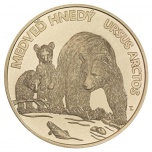
The obverse of this euro collector coin is dominated by the head of a brown bear in profile. Centrally positioned above the head is the Slovak coat of arms. The denomination and currency ‘5 EURO’ appear along the lower left edge. Inscribed along the upper edge are the name of the issuing country and the year of issuance: ‘SLOVENSKO 2023’. At the right edge is the mint mark of the Kremnica Mint (Mincovňa Kremnica), consisting of the letters ‘MK’ placed between two dies.
Reverse:
On the reverse is a depiction of a female bear and her two cubs hunting fish. Inscribed along the upper edge are the Slovak name for the brown bear ‘MEDVEĎ HNEDÝ’ and the animal’s scientific name ‘URSUS ARCTOS’. At the lower right edge are the stylised initials ‘TL’, referring to the coin’s designer Tomáš Lamač.
The brown bear is Slovakia’s largest predator. It has a stocky body, small eyes and ears, a short tail, pronounced claws, and thick fur that is 8 to 12 cm long and comes in a wide range of shades from light brown to almost black. The adult male can weigh up to 350 kg. Brown bears in Slovakia are concentrated in the central, northern and north-eastern mountain areas. The brown bear is an omnivore that prefers to live in mixed and coniferous forests. Its diet is 90% vegetable matter with the remaining 10% consisting of carrion, smaller animals, insects and, occasionally, sick or injured hooved game. Bears hibernate in dens from around early November to April. Female bears and their cubs are the first to enter the dens and the last to emerge from them. Male bears seek out females only during the mating season, usually from the end of April to the beginning of August. The cubs are born during January and February in the safety of the winter den. At birth they are blind, have short fur and weigh less than 500 g. Bears in the wild can live to be more than 30 years old.
Diameter: 34 mm
Weight: 19.1 g
Metal: Brass
Mintage: 45,000
The obverse of this euro collector coin is dominated by the head of a brown bear in profile. Centrally positioned above the head is the Slovak coat of arms. The denomination and currency ‘5 EURO’ appear along the lower left edge. Inscribed along the upper edge are the name of the issuing country and the year of issuance: ‘SLOVENSKO 2023’. At the right edge is the mint mark of the Kremnica Mint (Mincovňa Kremnica), consisting of the letters ‘MK’ placed between two dies.
Reverse:
On the reverse is a depiction of a female bear and her two cubs hunting fish. Inscribed along the upper edge are the Slovak name for the brown bear ‘MEDVEĎ HNEDÝ’ and the animal’s scientific name ‘URSUS ARCTOS’. At the lower right edge are the stylised initials ‘TL’, referring to the coin’s designer Tomáš Lamač.
The brown bear is Slovakia’s largest predator. It has a stocky body, small eyes and ears, a short tail, pronounced claws, and thick fur that is 8 to 12 cm long and comes in a wide range of shades from light brown to almost black. The adult male can weigh up to 350 kg. Brown bears in Slovakia are concentrated in the central, northern and north-eastern mountain areas. The brown bear is an omnivore that prefers to live in mixed and coniferous forests. Its diet is 90% vegetable matter with the remaining 10% consisting of carrion, smaller animals, insects and, occasionally, sick or injured hooved game. Bears hibernate in dens from around early November to April. Female bears and their cubs are the first to enter the dens and the last to emerge from them. Male bears seek out females only during the mating season, usually from the end of April to the beginning of August. The cubs are born during January and February in the safety of the winter den. At birth they are blind, have short fur and weigh less than 500 g. Bears in the wild can live to be more than 30 years old.
14,90 €
Face value: 5 €
Diameter: 34 mm
Weight: 19.1 g
Metal: Brass
Mintage: 40,000
The black stork is an unmistakable bird species. The adult has mainly black plumage with white underparts, long coral red legs and a long pointed beak. The beak and eye areas are the same colour as the legs, and the black plumage has an intense greenish-purple sheen. Adults weigh between around 2.4 kg and 3.2 kg. Black storks are distributed throughout most of Europe and Asia, and most forest areas of Slovakia are nesting sites for these birds. They typically nest in mature deciduous and mixed forests, preferring areas with wetlands and watercourses where they can forage for food. They select large trees with strong horizontal branches and show high fidelity to breeding sites and nesting trees. The base of the nest is formed by thick branches, while the interior is lined with twigs, clumps of grass, lichens and moss. The female lays two to four eggs. Both parents feed the fledglings by regurgitating food onto the nest floor. Black storks feed on smaller fish, amphibians, insects, gastropods, small mammals and small birds. They migrate to wintering grounds mainly in August and September. In Slovakia, the black stork is a protected species.
Obverse:
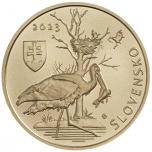
The obverse of the euro collector coin depicts a black stork hunting on a body of water. In the background is a tree with a stork’s nest. An adult stork is depicted flying towards a chick in the nest, carrying food in its beak. On the upper left side is the Slovak coat of arms and, above it, the year of issuance ‘2023’. On the right side is the mint mark of the Kremnica Mint (Mincovňa Kremnica), consisting of the letters ‘MK’ placed between two dies. Inscribed along part of the right edge is the name of the issuing country ‘SLOVENSKO’.
Reverse:
The reverse design depicts a black stork taking flight. To the right of this image are the denomination ‘5’ and currency ‘EURO’, one above the other. In the lower part of the design, next to the stork’s legs, are the stylised initials ‘MŠ’, referring to the coin’s designer Marie Šeborová. Inscribed along the lower edge and separated by a medial dot are the Slovak and scientific names for the black stork: ‘BOCIAN ČIERNY’ and ‘CICONIA NIGRA’.
Diameter: 34 mm
Weight: 19.1 g
Metal: Brass
Mintage: 40,000
The black stork is an unmistakable bird species. The adult has mainly black plumage with white underparts, long coral red legs and a long pointed beak. The beak and eye areas are the same colour as the legs, and the black plumage has an intense greenish-purple sheen. Adults weigh between around 2.4 kg and 3.2 kg. Black storks are distributed throughout most of Europe and Asia, and most forest areas of Slovakia are nesting sites for these birds. They typically nest in mature deciduous and mixed forests, preferring areas with wetlands and watercourses where they can forage for food. They select large trees with strong horizontal branches and show high fidelity to breeding sites and nesting trees. The base of the nest is formed by thick branches, while the interior is lined with twigs, clumps of grass, lichens and moss. The female lays two to four eggs. Both parents feed the fledglings by regurgitating food onto the nest floor. Black storks feed on smaller fish, amphibians, insects, gastropods, small mammals and small birds. They migrate to wintering grounds mainly in August and September. In Slovakia, the black stork is a protected species.
Obverse:
The obverse of the euro collector coin depicts a black stork hunting on a body of water. In the background is a tree with a stork’s nest. An adult stork is depicted flying towards a chick in the nest, carrying food in its beak. On the upper left side is the Slovak coat of arms and, above it, the year of issuance ‘2023’. On the right side is the mint mark of the Kremnica Mint (Mincovňa Kremnica), consisting of the letters ‘MK’ placed between two dies. Inscribed along part of the right edge is the name of the issuing country ‘SLOVENSKO’.
Reverse:
The reverse design depicts a black stork taking flight. To the right of this image are the denomination ‘5’ and currency ‘EURO’, one above the other. In the lower part of the design, next to the stork’s legs, are the stylised initials ‘MŠ’, referring to the coin’s designer Marie Šeborová. Inscribed along the lower edge and separated by a medial dot are the Slovak and scientific names for the black stork: ‘BOCIAN ČIERNY’ and ‘CICONIA NIGRA’.
14,90 €
Face value: 5 €
Diameter: 34 mm
Weight: 19.1 g
Metal: Brass
Mintage: 40,000
Obverse:
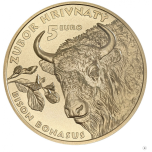
The obverse of the euro collector coin depicts a male European bison with trees in the background above and fallen branches in the foreground below. The Slovak coat of arms appears in the lower right of the design, just below the year of issuance ‘2024’. The name of the issuing country ‘SLOVENSKO’ is inscribed along part of the left edge. In the lower part of the design are the mint mark of the Kremnica Mint (Mincovňa Kremnica), consisting of the letters ‘MK’ placed between two dies, and the stylised letters ‘KL’, referring to the coin’s designer Karol Ličko.
Reverse:
On the reverse, a depiction of a European bison’s head dominates the centre and right of the design. Above the head are the coin’s denomination and currency, ‘5 EURO’. The Slovak name of the European bison, ‘ZUBOR HRIVNATÝ’, is inscribed along the upper-left edge, and the scientific name, ‘BISON BONASUS’, is at the lower-left edge. The two names are separated by a beech twig with leaves and nuts.
The bison is Europe’s largest land mammal, with its build resembling that of cattle. It has a relatively short, rounded head and is covered with brown hair from head to tail. The forequarters are bulkier than the hindquarters and are further accentuated by longer hair. Strong, hollow horns are a permanent feature of both sexes and grow with age. Bison are most active at dusk, and their vision has adapted accordingly. Their best-developed senses are hearing and smell. They can live to around 35 years of age. Bison are a social animal that typically live in herds of 8 to 13 animals, though older males tend to be solitary. They feed mainly on green and woody plant matter, including branches, bark and leaves. They prefer younger forest stands with dense undergrowth. In winter, their staple food sources are brambles, tree bark, shrubs and dry grass, which they dig out from under the snow. The bison’s historical range extended almost throughout Europe. In Slovakia today, approximately 70 individuals of the species live wild on a reservation in the Poloniny National Park.
Diameter: 34 mm
Weight: 19.1 g
Metal: Brass
Mintage: 40,000
Obverse:
The obverse of the euro collector coin depicts a male European bison with trees in the background above and fallen branches in the foreground below. The Slovak coat of arms appears in the lower right of the design, just below the year of issuance ‘2024’. The name of the issuing country ‘SLOVENSKO’ is inscribed along part of the left edge. In the lower part of the design are the mint mark of the Kremnica Mint (Mincovňa Kremnica), consisting of the letters ‘MK’ placed between two dies, and the stylised letters ‘KL’, referring to the coin’s designer Karol Ličko.
Reverse:
On the reverse, a depiction of a European bison’s head dominates the centre and right of the design. Above the head are the coin’s denomination and currency, ‘5 EURO’. The Slovak name of the European bison, ‘ZUBOR HRIVNATÝ’, is inscribed along the upper-left edge, and the scientific name, ‘BISON BONASUS’, is at the lower-left edge. The two names are separated by a beech twig with leaves and nuts.
The bison is Europe’s largest land mammal, with its build resembling that of cattle. It has a relatively short, rounded head and is covered with brown hair from head to tail. The forequarters are bulkier than the hindquarters and are further accentuated by longer hair. Strong, hollow horns are a permanent feature of both sexes and grow with age. Bison are most active at dusk, and their vision has adapted accordingly. Their best-developed senses are hearing and smell. They can live to around 35 years of age. Bison are a social animal that typically live in herds of 8 to 13 animals, though older males tend to be solitary. They feed mainly on green and woody plant matter, including branches, bark and leaves. They prefer younger forest stands with dense undergrowth. In winter, their staple food sources are brambles, tree bark, shrubs and dry grass, which they dig out from under the snow. The bison’s historical range extended almost throughout Europe. In Slovakia today, approximately 70 individuals of the species live wild on a reservation in the Poloniny National Park.
14,90 €
Face value: 5 €
Diameter: 34 mm
Weight: 19.1 g
Metal: Brass
Mintage: 45,000
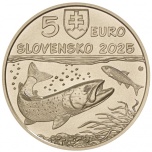
The Danube salmon or huchen (Hucho hucho) is endemic to the Danube basin and is the only native salmonid species in Slovakia. This predatory fish, the largest European salmonid, can grow up to around 150 cm in length, weigh more than 50 kg, and have a lifespan exceeding 15 years. Its body is torpedo-shaped, with a large head and a terminal mouth extending beyond the back edge of the eye. An adipose fin is located between the caudal and dorsal fins. Coloration ranges from grey-green to reddish-brown, with dark spots. Juveniles are lighter in colour with dark stripes along the sides of the body. The Danube salmon inhabits fast-flowing submontane rivers with cold, well-oxygenated water. When young, it feeds on invertebrates and smaller fish; as an adult, its diet consists mostly of fish. Spawning occurs between March and April, following upstream migration. The female uses her tail to make a shallow depression (redd) in the gravel riverbed, where the eggs are laid and fertilised. Juveniles remain in shallower currents or smaller tributaries, while older individuals occupy deeper river sections. In Slovakia, the Danube salmon occurs in the foothill reaches of the Hron, Váh, Turiec, and Orava rivers, as well as in the Danube River itself, and has been introduced into the Poprad and the Dunajec rivers.
The Danube salmon is an endangered species of European conservation importance. It is threatened primarily by river impoundment and resulting migration barriers, as well as by water pollution and other environmental changes. Fishing is permitted only under strict conditions and requires a special licence.
Obverse:
The obverse depicts a Danube salmon in its natural habitat, preying on a smaller fish just below the river surface. The scene is complemented by aquatic plants and a pebbled riverbed. Above the waterline is the name of the issuing country ‘SLOVAKIA’ and the year of issuance ‘2025’. At the top of the field is the Slovak coat of arms, positioned between the coin’s denomination ‘5’ and currency ‘EURO’. At the right edge is the mint mark of the Kremnica Mint (Mincovňa Kremnica), consisting of the letters ‘MK’ between two dies.
Reverse:
The reverse design is divided in half by the surface of a river, with a mountain landscape above and two Danube salmon below. On the right side of the water’s surface is the species’ scientific name ‘HUCHO HUCHO’, and below it, across the width of the field, is the Slovak name ‘HLAVÁTKA PODUNAJSKÁ’. The fish are shown swimming above a pebbled riverbed with aquatic plants on the left. At the right edge are the stylised initials ‘TL’ of the coin’s designer, Tomáš Lamač.
Diameter: 34 mm
Weight: 19.1 g
Metal: Brass
Mintage: 45,000
The Danube salmon or huchen (Hucho hucho) is endemic to the Danube basin and is the only native salmonid species in Slovakia. This predatory fish, the largest European salmonid, can grow up to around 150 cm in length, weigh more than 50 kg, and have a lifespan exceeding 15 years. Its body is torpedo-shaped, with a large head and a terminal mouth extending beyond the back edge of the eye. An adipose fin is located between the caudal and dorsal fins. Coloration ranges from grey-green to reddish-brown, with dark spots. Juveniles are lighter in colour with dark stripes along the sides of the body. The Danube salmon inhabits fast-flowing submontane rivers with cold, well-oxygenated water. When young, it feeds on invertebrates and smaller fish; as an adult, its diet consists mostly of fish. Spawning occurs between March and April, following upstream migration. The female uses her tail to make a shallow depression (redd) in the gravel riverbed, where the eggs are laid and fertilised. Juveniles remain in shallower currents or smaller tributaries, while older individuals occupy deeper river sections. In Slovakia, the Danube salmon occurs in the foothill reaches of the Hron, Váh, Turiec, and Orava rivers, as well as in the Danube River itself, and has been introduced into the Poprad and the Dunajec rivers.
The Danube salmon is an endangered species of European conservation importance. It is threatened primarily by river impoundment and resulting migration barriers, as well as by water pollution and other environmental changes. Fishing is permitted only under strict conditions and requires a special licence.
Obverse:
The obverse depicts a Danube salmon in its natural habitat, preying on a smaller fish just below the river surface. The scene is complemented by aquatic plants and a pebbled riverbed. Above the waterline is the name of the issuing country ‘SLOVAKIA’ and the year of issuance ‘2025’. At the top of the field is the Slovak coat of arms, positioned between the coin’s denomination ‘5’ and currency ‘EURO’. At the right edge is the mint mark of the Kremnica Mint (Mincovňa Kremnica), consisting of the letters ‘MK’ between two dies.
Reverse:
The reverse design is divided in half by the surface of a river, with a mountain landscape above and two Danube salmon below. On the right side of the water’s surface is the species’ scientific name ‘HUCHO HUCHO’, and below it, across the width of the field, is the Slovak name ‘HLAVÁTKA PODUNAJSKÁ’. The fish are shown swimming above a pebbled riverbed with aquatic plants on the left. At the right edge are the stylised initials ‘TL’ of the coin’s designer, Tomáš Lamač.
14,90 €