


Andorra cisrulation coins mixed years (3,88€)
Price:
35,00 €
Andorra signed a Monetary Agreement with the European Union on 30 June 2011. As a result, Andorra can use the euro as its official currency and issue its own euro coins. All the coins feature the 12 stars of the European flag.
The €2 coin shows the coat of arms of Andorra with the motto "virtus unita fortior" (virtue united is stronger). Edge-lettering of the €2 coin: 2 **, repeated six times.
The €1 coin features Casa de la Vall, the former seat of parliament and a building of cultural and historical interest.
The 10, 20 and 50 cent coins show the Romanesque church of Santa Coloma
The 1, 2 and 5 cent coins show a Pyrenean chamois and a golden eagle.
Similar products

Official Coin set Brilliant
Uncirculated with 8 coins: from 1 cent to 2 euro.
Mintage:10 000 sets.
The technical characteristics of the coins, having legal tender in the territory of the Republic of San Marino and in that of the Member States of the European Community that have adopted the Euro, are those established by the Council of the European Union for Euro coins. The artistic characteristics are determined as follows:
- 2 EURO Obverse: the portrait of Saint Marino, detail of a painting by Giovan Battista Urbinelli;
- 1 EURO Obverse: the Second Tower;
- 50 Eurocent Obverse: the portrait of Saint Marino, detail of a painting by Emilio Retrosi;
- 20 Eurocent Obverse: the Three Towers (from right Guaita, Cesta and Montale);
- 10 Eurocent Obverse: the façade of the Church and Convent of San Francesco;
- 5 Eurocent Obverse: the Church of the Capuchins;
- 2 Eurocent Obverse: the Porta del Paese, also known as Porta del Locho or Porta San Francesco;
- 1 Eurocent Obverse: the coat of arms of the Republic;
Numibox image dedicated to the Statue of Liberty, emblem of independence and sovereignty. This iconic monument, made of Carrara marble by the sculptor Stefano Galletti, depicts a young woman advancing triumphantly, with a turreted crown on her head, a symbol of strength, freedom and autonomy, which have characterized the Republic of San Marino for centuries.
69,00 €

Mint: Royal Dutch Mint
Quality: Brilliant Uncirculated
Issue limit: 11 ,500
Alloy: Base Metal
Denomination: Euro
Number of coins: 8
As culture carriers and a means of communication, coins function as a sort of time capsules. The Annual Sets The Netherlands from 2023 are therefore linked to (inter)national and personal milestones of this year. From 2022 to 2025, the Annual Sets from the National Collection® are devoted to the four elements: earth, water, air and fire. In nature, these elements are linked to the seasons that determine our annual rhythm. In 2022 we kicked off the series with the element Earth and in 2023 The Netherlands continue with the element ‘Water’.The Annual Set will be launched first in BU Quality. These are the coins that are minted with the new stamp. This makes them extra shiny. The Annual Set 2023 in BU Quality contains all eight shimmery euro coins of 2023. Discover more information about the element ‘Water’ on the packaging!
49,00 €
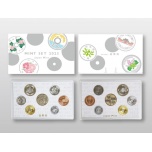
This is a standard coin set including six brilliant uncirculated coins of Japan as well as a special medal featuring this year's oriental zodiac, the Rabbit
39,00 €
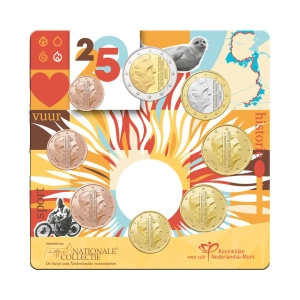
The Annual Sets The Netherlands 2025 contain all eight denominations in different qualities and packaging.
As culture carriers and a means of communication, coins function as a sort of time capsules. The Annual Sets The Netherlands from 2024 are therefore linked to (inter)national and personal milestones of this year. In addition, from 2022 to 2025, the Annual Sets from the National Collection® are devoted to the four elements: earth, water, fire and air. After all, the elements are linked to the seasons that determine our annual rhythm. The series continues this year with the element “Air”.
Mintage: 15 000 sets
19,00 €

The euro coin series comprises eight different denominations: 1, 2, 5, 10, 20 and 50 cent, €1 and €2. The euro coins have a common side and a national side. The national side indicates the issuing country. The common sides of the coins were designed by Mr Luc Luycx of the Royal Belgian Mint.
They show images of the European Union or of Europe and symbolise the unity of the EU. The 1, 2 and 5 cent coins show Europe in relation to Africa and Asia on a globe.
Croatia has chosen four designs for their national sides of the euro coins, all featuring the distinctive Croatian chequerboard pattern in the background. All the coins also depict the 12 stars of the European flag.
The €2 coin features a map of Croatia on a chequerboard background. The design, by Ivan Šivak, includes the year of issuance and the inscription “HRVATSKA”, the country’s name in Croatian.
Edge lettering of the €2 coin: “O LIJEPA O DRAGA O SLATKA SLOBODO” (“Oh beautiful, oh dear, oh sweet freedom”), a line from Ivan Gundulić’s famous play, Dubravka.
The €1 coin shows a marten on a chequerboard background and was designed by Jagor Šunde, David Čemeljić and Fran Zekan. The marten is a small mammal that lent its name to the country’s former currency, the kuna. The design includes the year of issuance and the inscription “HRVATSKA”, the country’s name in Croatian.
The 50 cent , 20 cent and. 10 cent coin features a portrait of inventor and engineer Nikola Tesla, who developed alternating current technology. The coin was designed by Ivan Domagoj Račić and includes the year of issuance and the inscription “HRVATSKA”, the country’s name in Croatian.
The 1, 2 and 5 -cent coin shows a motif of the letters “HR” in the angular Glagolitic script. The Glagolitic alphabet is the oldest known Slavic script and was used in Croatia until the 19th century. The coin was designed by Maja Škripelj and includes the year of issuance and the inscription “HRVATSKA”, the country’s name in Croatian.
45,00 €